
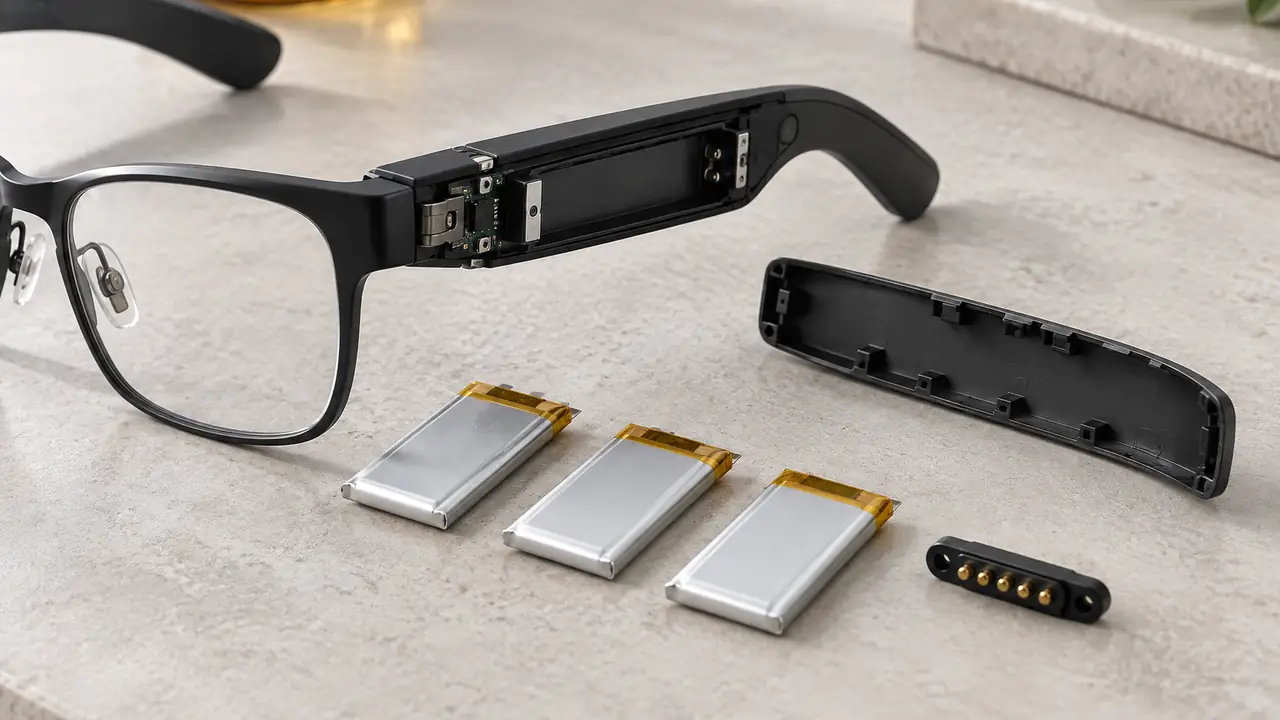
Cells in the temples
A smart glasses pair has no room for a single large battery. The usual layout places one slim lithium-ion cell in each temple, behind the hinge and often toward the ear end, with the board and speaker forward of it. Across the category, the two cells add up to about 85 to 235 mAh, which supports roughly 4 to 13 hours of music and 3 to 9 hours of calls depending on chipset, volume and features. Models with a camera, Wi-Fi or AI features draw more power, so the same capacity gives shorter runtime. Runtime figures are per spec sheet and are verified in the runtime test of the golden sample, using the same volume, codec and connection settings the spec sheet states. The reading of these claims is covered in smart glasses battery life explained.
Balance and weight distribution
Placement matters as much as capacity. Weight in the front sits on the nose pads; weight toward the ear end of the temple acts as a counterweight and makes the pair feel lighter on the nose, though it presses more behind the ear. Most designs aim for a balance point just behind the hinge, with equal mass left and right so the frame does not tilt. When a buyer asks for a larger cell, the temple has to grow in height or length, which changes the look and may need a new mould. The table summarises the trade-offs.
| Design choice | Benefit | Trade-off |
|---|---|---|
| Cell toward the ear end | Counterweight, less load on the nose | Longer wiring to the board; more pressure behind the ear |
| Cell near the hinge | Short wiring, compact temple tip | More weight on the nose pads |
| Larger total capacity | Longer runtime | Thicker or longer temples, heavier pair |
| One system per temple | No power flex through the hinge | Two charge contacts and two cells to match |
| Charging case with battery | Top-ups on the move with a small cell in the frame | Separate battery item for shipping, extra cost driver |
More detail is in temple battery design.
Magnetic pogo charging
Most audio glasses charge through magnetic pogo contacts on the inside of a temple rather than through a USB port, which would take space and let sweat in. Spring-loaded pins on the cable align on flat contacts on the frame, held by a magnet; a full charge takes about 1 to 2 hours across the category. The weak points are corrosion of the contacts from sweat, magnets too weak to hold alignment, and pins wearing after many connections. Contact plating, the seal around the contacts and the magnet strength are engineering choices, and the test plan covers artificial sweat soak on the contacts, salt spray and charging contact insertion life. Cycle counts and limits are a stated working default, confirmed per order. See magnetic pogo pin charging.
Charging cases
A charging case doubles as protection and a power bank: it holds its own battery and charges the glasses through the same contacts. Case capacity is stated in watt-hours, and the case changes the shipping picture because it is a battery in its own right. Depending on how it is packed and its Wh rating, it is classified as a battery packed with or contained in equipment, UN3481, or as a standalone battery, UN3480. That decision is made per Wh and per packing configuration with your forwarder. Cases sold as accessories typically start at 500-1,000 pieces, confirmed in writing.
Safety and transport rules
Battery safety for portable lithium cells is assessed under IEC 62133-2, which many buyers and marketplaces request alongside the product's other test reports. For transport, every cell and battery design needs a UN 38.3 test summary. By air, glasses with cells inside are shipped as UN3481, lithium-ion batteries contained in equipment, under Packing Instruction 967 Section II: each cell must be 20 Wh or less and each battery 100 Wh or less, no more than 5 kg net of lithium batteries per package on passenger aircraft, with the lithium battery mark and a statement on the air waybill. IATA recommends a state of charge of 30 percent or less; under PI 967 this is a recommendation rather than a requirement. In the EU, the Battery Regulation 2023/1542 adds labelling and documentation duties.
Shipping detail is on logistics and shipping and in shipping wearables with batteries. To specify capacity, case and contact design for your program, send a brief through the quote form.