
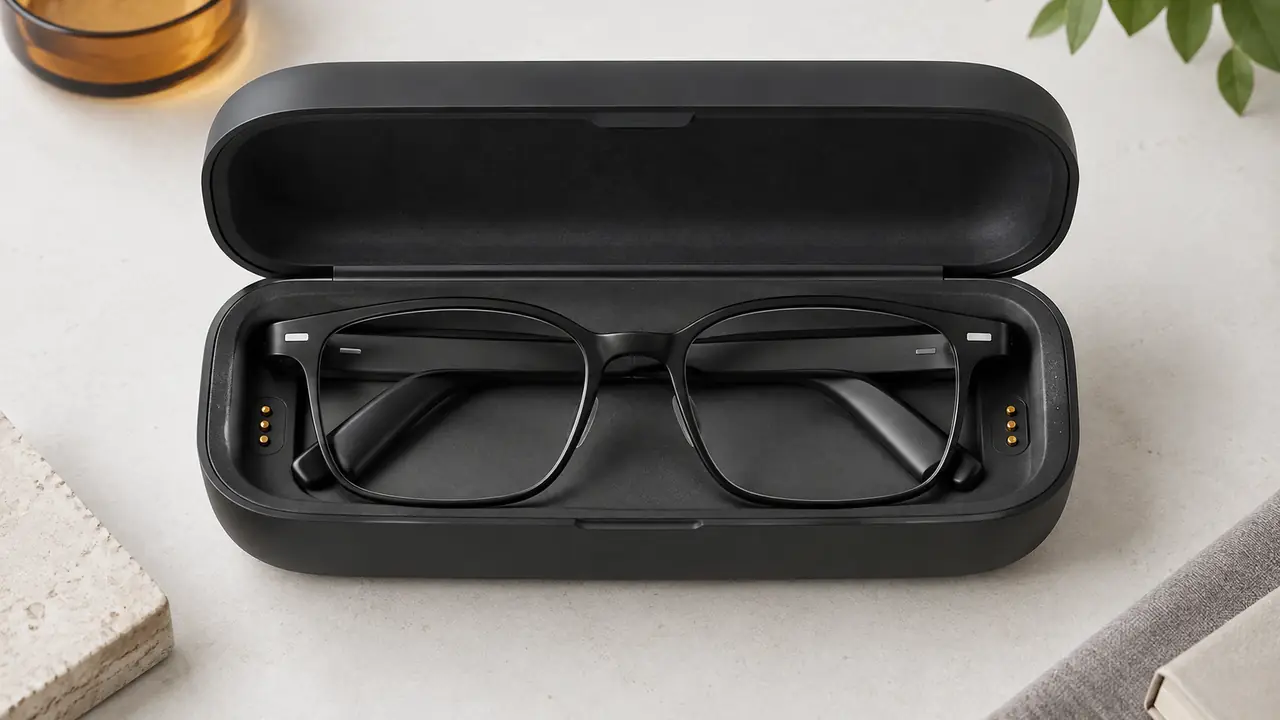
Why the temple carries the battery
In most smart glasses the front holds the lenses and, on some models, a camera; the temples hold almost everything else. The temple is the only part of a frame with enough length to fit a cell, a board, a speaker and microphones in a line, and it sits close to the ear where audio is needed. That is why the electronic temple is engineered in the Shenzhen electronics base and then matched to frames from eyewear clusters such as Shenzhen Henggang and Wenzhou Ouhai - the temple and the front come from different supply chains and have to meet at the hinge.
Across the category, the cells in both temples together hold about 85 to 235 mAh, and finished pairs weigh about 27 to 50 grams. Inside those ranges, the battery is usually the densest component. How big it is and where it sits drives temple thickness, the feel on the ear, the hinge design and even which certification files are needed.
Cell formats used in temples
Temple cells are small lithium-ion cells, usually in a pouch (lithium polymer) format because a flat, thin pouch fits a temple profile better than a rigid can. Some designs use small cylindrical or button-type cells where the temple is thick enough near the ear. The choice affects shape, protection circuit layout and how the cell is held in place.
| Format | Strengths | Watch points |
|---|---|---|
| Thin pouch cell | Flat profile follows the temple; flexible sizing per cell supplier | Needs support against bending and pressure; swelling margin in the housing |
| Small cylindrical cell | Rigid can, robust handling in assembly | Round section thickens the temple; fits mostly near the ear end |
| Button-type cell | Compact, easy to seal in a pocket | Lower capacity per cell; often used in pairs or on light models |
Whatever the format, the cell and its protection circuit are specified together. The protection circuit limits overcharge, over-discharge and short circuit, and it is part of what the battery safety tests in IEC 62133-2 look at. Cells also need UN 38.3 test summaries before they can ship. The notes on IEC 62133-2 battery safety and UN 38.3 for smart glasses cover the paperwork.
Placement: single, split and behind the ear
There are three common layouts. In a single-cell layout, one temple holds the battery and the other holds the board, with power carried through the hinge flex and across the front. In a split layout, each temple has its own cell, which balances weight left to right and shortens the power path to each speaker. In a rear-weighted layout, the cell sits in the temple tip behind the ear, where it acts as a counterweight to the front.
- Single cell: simpler charging and one protection circuit, but the pair can feel heavier on one side and the cable through the front carries more current.
- Split cells: better left-right balance and symmetric temples, but two cells to source, test and match, and charging has to keep both in step.
- Behind-the-ear cell: moves mass off the nose, which many wearers notice first, but the temple tip becomes thicker and the bend at the ear has to be shaped around the cell.
Most audio glasses use split cells. Models with a camera or AI processor in the front often push mass backwards on purpose, because the front is already heavy.
Placement also shapes the hinge. Every layout that puts the cell on the opposite side of the hinge from the board or the charging contacts routes power through the flex circuit in the hinge, which is then folded every time the glasses are put away. That is one reason hinge cycling is a standard test item, and why the note on hinges and flex cables belongs next to any battery layout decision.
Balance, comfort and fit
Total weight matters, but where the weight sits matters as much. A pair that is light overall but heavy at the front presses on the nose pads and slides down; a pair with mass near the ear can feel lighter than its scale weight. The battery is the part designers move to tune this. The comfort side of the question is covered in smart glasses weight and comfort.
Temple thickness is the other comfort limit. A larger cell means a thicker or longer temple, which can press on the side of the head and clash with headwear or helmets. Temple length across common frame sizes is about 140 to 150 mm, which bounds how far back a cell can go. For prescription and kids lines, where fit range matters more, a smaller cell and lower runtime is often the better trade.
Heat, swelling and service life
Lithium cells age faster when hot and can swell slightly over their life. A temple design leaves margin around the cell, keeps it away from the warmest parts of the board and avoids glue or clamping that stresses the pouch. Sweat and skin contact add moisture near the charging contacts, which is why cell location and contact location are designed together. Aging behaviour is covered in battery aging in wearables.
A related decision is serviceability. Most temple cells are sealed in for size and water resistance reasons. EU Battery Regulation 2023/1542 introduces obligations on portable batteries over the coming years, including rules on removability and replaceability with defined exemptions; whether and how they apply to a given pair is a question for your test lab and counsel, ideally before the temple is tooled.
What to fix on the spec sheet
- Cell model and supplier, with nominal capacity, voltage and Wh from the cell spec sheet.
- Layout: single, split or behind the ear, and which temple carries the board.
- Weight targets: total pair weight and, if agreed, weight per temple, checked on the golden sample.
- Protection and test files: protection circuit spec, IEC 62133-2 report and UN 38.3 summary, verified per project.
- Change control: no cell substitution without written approval, because a new cell needs new tests.
Custom cell sizes are possible on full custom programs, which typically start from 3,000 pairs per model; catalog models use the cell already in the design. Reference ranges are confirmed in writing for each program on MOQ and lead time, and a brief can be sent through the quote form.