
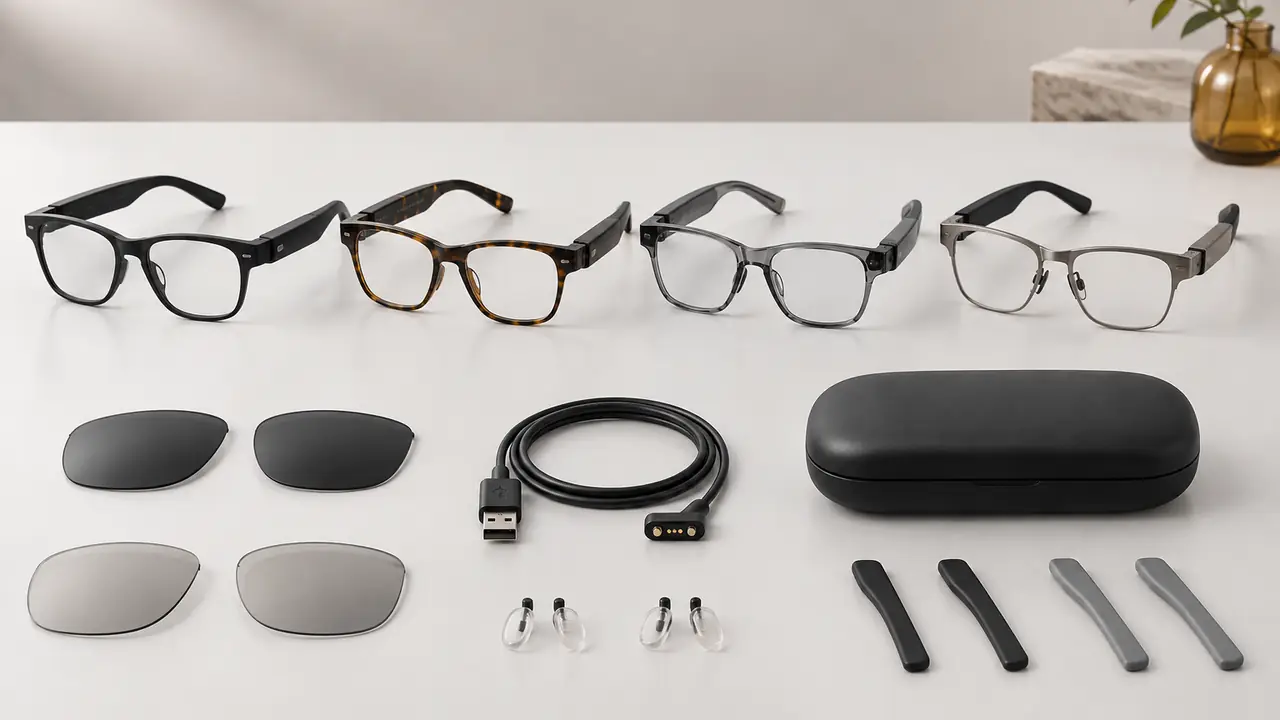
Why accessories belong in the range plan
Smart glasses wear out in predictable places. Lenses scratch, nose pads harden, charging cables get lost and the occasional temple is sat on. A range that offers spares for those parts keeps customers using the product and turns a return into a small repeat order. For marketplace sellers and wholesalers, accessories are also a way to sell into an installed base, and for distributors they are the backbone of after-sales service. The condition is that the accessories are designed with the glasses, not added later: lens shapes, contact pitch and front fit must match the models they serve.
The desk therefore plans accessories with the main program. Replacement lenses come from the same Danyang or Xiamen lens partner that supplies the original, cut to the same shape file. Cables and cases are built around the same magnetic pogo contacts as the temples. Fit parts follow the frame plant's moulds. Lines that share contacts and fronts across the range need far fewer accessory SKUs, which is the simplest way to keep stock under control.
What the accessory set usually includes
The table lists the common items, what to specify for each and the rule that follows.
| Item | What to specify | Rule or document |
|---|---|---|
| Replacement lenses | Shape file, base curve, type: polarized, photochromic, blue-light filter, clear or Rx blank | Lens category and UV marking per ISO 12312-1 or ANSI Z80.3; blue-light filter with no health claim |
| Spare fronts | Front size and hinge interface for swappable-front models | Same material and coating spec as the original front |
| Nose pads and temple sleeves | Silicone hardness, colour, fit to pad arm or temple profile | RoHS and REACH material declarations |
| Magnetic pogo pin cable | Contact pitch, magnet strength, cable length, USB-A or USB-C end | Insertion and pull cycles per order; RoHS |
| Charging case | Cell rating in Wh, input, number of top-ups, closure | UN 38.3, IEC 62133-2; UN3480 or UN3481 in transport |
| Storage case and cloth | Hard or soft case, logo, insert for cable | Material declarations; packaging rules per market |
Lens types are explained under lens options; spare parts planning is covered in warranty and spare parts planning.
Charging cases and battery rules
A charging case with a built-in cell is a battery product in its own right. The cell needs a UN 38.3 test summary, and most buyers also ask for IEC 62133-2. In the EU, the case falls under the EU Battery Regulation 2023/1542 as well as the radio or EMC rules that apply to its electronics, and in the US the electronics follow FCC Part 15 Subpart B. The capacity of the cell is stated in watt-hours, and that figure drives the transport classification.
In transport, a case shipped on its own is generally treated as a lithium-ion battery under UN3480, while a case packed with the glasses or a pair shipped inside its case falls under UN3481, packed with or contained in equipment. Which entry applies, and which packing instruction, depends on the Wh rating, the packing and the mode, so the classification is confirmed with your forwarder for each SKU. The glasses themselves ship under UN3481 under PI 967 Section II by air, where cells are at most 20 Wh. Details are on charging cases for smart glasses and logistics and shipping.
Cables, contacts and fit parts
Magnetic pogo pin cables are the most frequently replaced item, so they deserve a proper spec. The contact pitch and polarity must match the temples exactly, the magnet must hold the cable in place without pulling the glasses off a table, and the contacts need a plating that resists sweat. Glasses typically recharge in 1 to 2 hours on the magnetic cable, per model. Fit parts are simpler but just as visible: nose pads in two or three sizes and temple sleeves in a soft silicone help a single front cover more faces, and they are cheap to stock. Contact durability is discussed in magnetic pogo pin charging.
Quantities and timing
Accessories usually start at 500-1,000 pieces per item, a typical reference range. Logo or private label packaging adds the minimum for printed pouches or boxes, and charging cases need their battery documents in place before the first shipment. Samples follow the usual 5-10 working days for catalog items and 10-15 working days with a logo, and batch production runs 20-35 days. Figures are confirmed in writing for each program on MOQ and lead time. To add accessories to a program, use the quote form.