
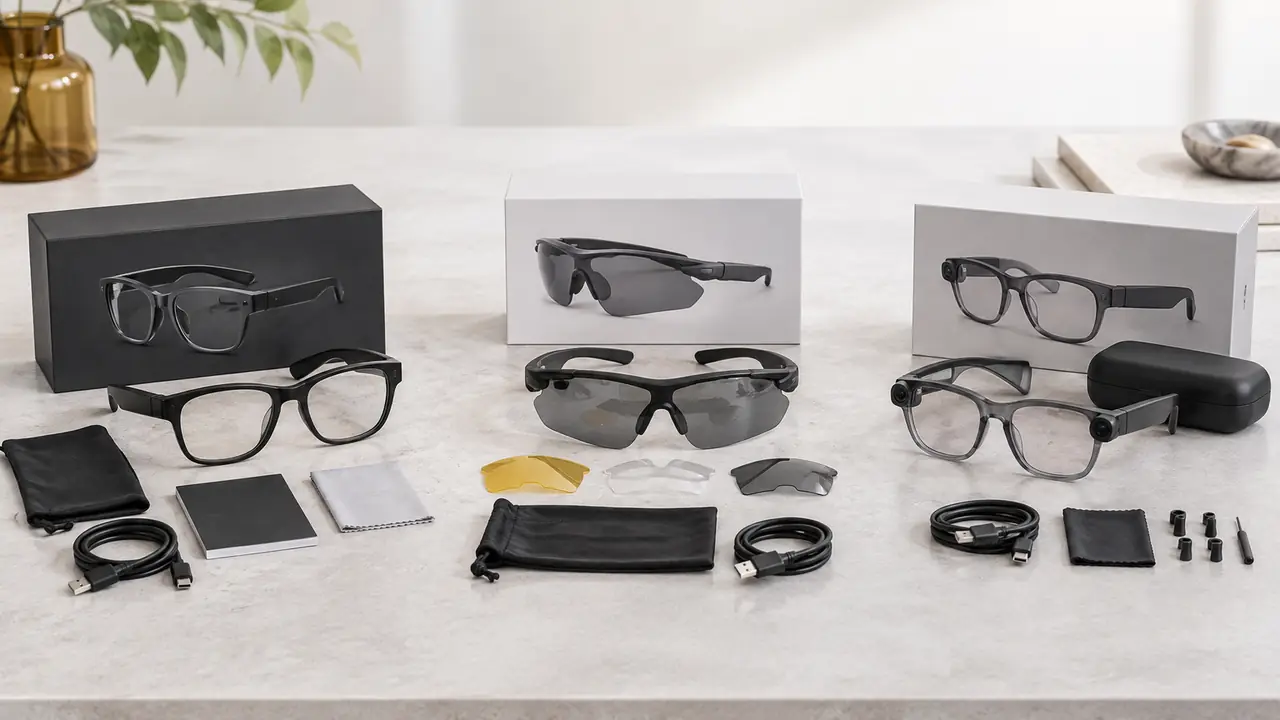
How to read these cases
The four programs below are illustrative composites built from the kinds of brief smart glasses buyers commonly bring. Names, quantities and results are deliberately generic: there are no client names, sales figures or return rates, because those belong to the buyers. What each case shows is the decision path - the constraint that mattered most, the route chosen, what was checked before shipment and what changed for the next order. The structure of each case is the same: background, constraints, approach, inspection and outcome.
| Case | Buyer type | Line | Route | Main constraint |
|---|---|---|---|---|
| 1 | DTC brand | Open-ear audio glasses | Logo program | Returns on fit and pairing |
| 2 | Optical retailer | Rx-ready smart frames | Logo program on a catalog front | Lens edging by the retailer's lab |
| 3 | Enterprise buyer | AI translation glasses | Catalog fleet | App accounts and data handling |
| 4 | Marketplace seller | Sports smart glasses | Logo program | Listing compliance and battery shipping |
Case 1: a DTC brand's first audio glasses order
Background. A direct-to-consumer brand selling accessories online wanted its first audio glasses model, with two colours and a sunglass version. Constraints. A limited first budget, a launch date and a strong concern about returns, since online buyers cannot try the frame on. Approach. The desk proposed the logo route on an open-ear catalog model rather than new tooling, shortlisted three partner plants, and compared samples on weight, fit range and sound leakage. The brand chose a mid-size front and added a sizing note to the product page. Inspection. Pre-shipment checks focused on pairing on both temples, hinge flex routing and charging contacts. Outcome. The brand launched on schedule and logged return reasons by category, which pointed the second order toward a wider front and a firmware update to pairing prompts.
Case 2: a retailer's Rx-ready range
Background. A regional optical retailer wanted prescription-ready smart frames that its own lab could glaze. Constraints. Lens edging had to fit the retailer's workflow, the frames needed try-on samples for every store, and staff needed a short training sheet. Approach. The desk matched a catalog Rx-ready front with a lens groove the retailer's lab could work with, ran an edging trial on sample fronts, and specified a counter-display box plus non-powered try-on frames for stores that preferred them. Inspection. Frame dimensions and lens groove were checked against the golden sample alongside the electronic tests. Outcome. The range entered stores with a fitting guide for staff, and the retailer kept the spec sheet for a second colourway.
Case 3: an enterprise translation glasses fleet
Background. A company running trade-fair and visitor programs wanted a fleet of AI translation glasses for its staff. Constraints. Languages and latency depend on the app and translation engine, typically 0.5-3 seconds in the cloud; the buyer needed clarity on accounts, data handling and how devices are reset between users. Approach. The desk chose a catalog model, documented the supported languages per app and engine, tested latency in conditions close to a fair hall, and agreed a reset and charging routine for shared devices. Inspection. Each unit was paired, updated to the agreed firmware version and checked for microphone function. Outcome. The fleet was deployed with a written operating sheet, and the buyer used the pilot findings to set expectations with staff.
Case 4: a marketplace seller's sports model
Background. An online seller wanted a sports smart glasses model with polarized lenses and its own logo. Constraints. Listing compliance - an FCC ID, battery documents and a water-resistance claim stated as IPX4 or IP54 tested per IEC 60529 - and warehouse rules for lithium batteries. Approach. The desk took a catalog wraparound model on the logo route, collected the FCC, UN 38.3 and lens reports, and wrote listing facts from the spec sheet rather than from marketing copy. Inspection. Lens category marking, labels and carton marks were checked alongside the electrical tests. Outcome. The model was listed with its documents ready, and the seller added spare nose pads and temple sleeves on the reorder.
What the cases have in common
Each program started from a written brief, chose the lightest route that met the constraint, fixed a signed spec sheet and golden sample, and released goods only after pre-shipment inspection. To discuss a similar program, see MOQ and lead time and send your brief through the quote form.