
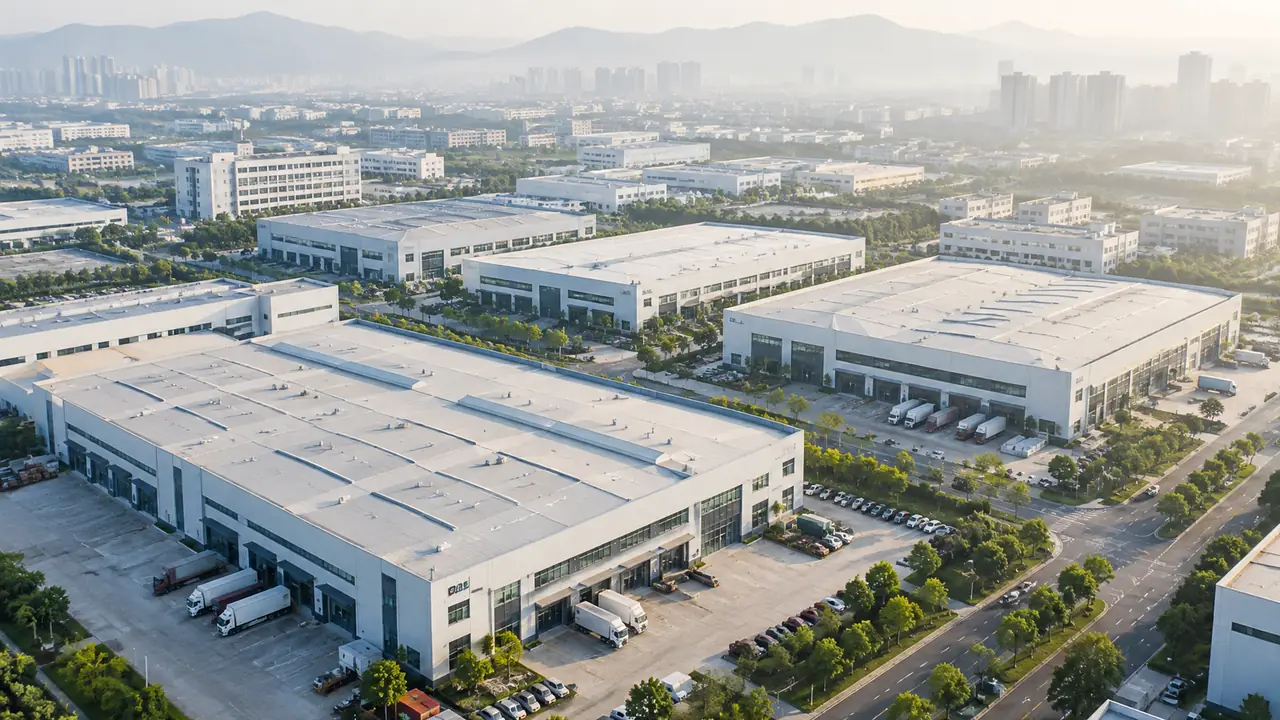
Why smart glasses are sourced from several cities at once
An ordinary pair of glasses is a frame and two lenses. A pair of smart glasses adds a third product hidden in the temples: a battery, a Bluetooth board, speakers, microphones and sometimes a camera module. In China these three parts are made by three different industries, and those industries grew up in different places. Temple electronics come from the consumer electronics base around Shenzhen and Dongguan. Frames come from long-established eyewear clusters in Shenzhen's Longgang district and in Ouhai, Wenzhou. Lenses come mostly from Danyang in Jiangsu and, for sunglass lenses, from Xiamen in Fujian.
That geography explains most of the problems buyers meet when they source smart glasses as if they were a single product. A temple board tuned in one city has to fit a frame moulded in another, behind a lens cut in a third. The sourcing desk exists to align those three chains in one program: fit, lens specification, assembly sequence and inspection. The rest of this page describes each cluster, what it contributes and the public figures that describe its scale. Every number below is attributed to the outlet that published it, with the year; none is a figure about a specific partner plant.
Shenzhen Longgang: the Henggang and Yuanshan eyewear cluster
Henggang and the neighbouring Yuanshan area in Longgang district are one of the country's main centres for mid to high-end frames and finished glasses. According to Shenzhen Special Zone Daily (May 2025), Henggang hosts about 1,200 eyewear companies; the same reporting gives a second figure of more than 1,500 companies when Yuanshan and Henggang are counted together. The cluster produces about 125 million pairs of mid to high-end glasses a year, and Longgang's eyewear industry output reached RMB 4.3 billion in 2024 by the same account. Local reporting also notes that more than a hundred kinds of components can be sourced and moved between workshops within 24 hours, which is the practical advantage for smart glasses: hinges, nose pads, temple tips and coatings are close at hand when a frame has to be adjusted around an electronic temple.
For smart glasses programs, Henggang is where fronts and structural frame parts are most often developed, especially TR90, acetate and metal fronts that must accept a wider temple and a hinge carrying a flex cable. Material choices are covered on frame materials.
Shenzhen Bao'an and Nanshan, and Dongguan: the electronic temple
The electronics inside the temple come from a different part of the same city. Bao'an is home to acoustic, display, PCBA and precision component suppliers; Nanshan hosts AI and chipset solution companies; neighbouring Dongguan contributes finished-product assembly and injection moulding. This description is qualitative, drawn from Science and Technology Daily (October 2026) and 21st Century Business Herald (June 2025). Reporting from 2025-2026 also notes that a Shenzhen AI glasses industry alliance has been working with the CAICT Telecommunication Terminal Test Lab on a series of AI glasses standards. For buyers, this is the cluster that decides runtime, call quality, pairing behaviour and firmware, so it is where most engineering samples are reviewed. The temple modules are explained in acoustic design and battery and charging.
Wenzhou Ouhai, Danyang and Xiamen
Wenzhou Ouhai is a long-standing base for metal and plastic frames, hinges and export private label work. Figures published by China.org.cn's Wenzhou channel put the district at 595 eyewear companies and more than 60,000 workers in 2020, with industry output above RMB 14.5 billion in 2019 and products exported to more than 100 countries. Wenzhou's culture, tourism and broadcasting bureau (2023) lists Ouhai with Yingtan, Shenzhen, Xiamen and Danyang as the five main eyewear production bases in China.
Danyang in Jiangsu is the lens city. Its output is reported at more than 400 million pairs of lenses a year. Sources differ on the share: People's Daily overseas edition, CCTV and Securities Times (all 2023) describe it as about three quarters of national output and roughly 40 to 50 percent of global output, depending on how lenses are counted, so the share should be read as a range rather than a single figure. 21st Century Business Herald (September 2025) reports more than 2,000 related companies and over 80,000 workers. Prescription, photochromic and polarized lenses for smart frames are typically sourced here; see lens options.
Xiamen in Fujian specialises in mid to high-end sunglasses, polarized lenses and sunglass frames. Xiamen's investment promotion office (2025) and the Fujian commerce department (2024) report more than 300 eyewear companies, over 20 of them with annual output above RMB 100 million, and describe Xiamen-made mid to high-end sunglasses as holding more than 80 percent of the domestic market.
Supply chain stage by cluster
The table shows which cluster usually supplies each stage of a smart glasses program. It is a planning view, not a fixed rule: a given program may source a stage elsewhere when the specification calls for it.
| Supply chain stage | Shenzhen Longgang (Henggang, Yuanshan) | Shenzhen Bao'an, Nanshan and Dongguan | Wenzhou Ouhai | Danyang | Xiamen |
|---|---|---|---|---|---|
| Front and frame development | Main source | - | Main source, metal and export frames | - | Sunglass frames |
| Hinges and frame hardware | Main source | - | Main source | - | Occasional |
| Acoustics, PCBA, cells and chipset solutions | - | Main source | - | - | - |
| Rx, photochromic and filter lenses | Occasional | - | Occasional | Main source | - |
| Polarized sunglass lenses | Occasional | - | - | Main source | Main source |
| Temple assembly and final assembly | Frame-led programs | Main source | - | - | - |
| Packaging and charging accessories | Available | Main source | Available | - | - |
How the desk works across the clusters
Templora is a sourcing desk, not a factory. The desk's office is in Yongjia, Wenzhou, also home to the Ouhai eyewear cluster; it is an operations office and no production takes place there. For each program the desk shortlists partner plants in the clusters that fit the brief, verifies them on site against the factory audit checklist, and then aligns the three chains: the temple board and cells, the front and hinge, and the lenses. The usual coordination points are the flex cable route through the hinge, the lens base curve and edge thickness against the front groove, and the order in which temples, fronts and lenses meet at final assembly, described on production process.
Quantities follow the typical reference ranges on MOQ and lead time, confirmed in writing for each program. To start a shortlist, send the brief through the quote form with the target market and the lines you are considering.