
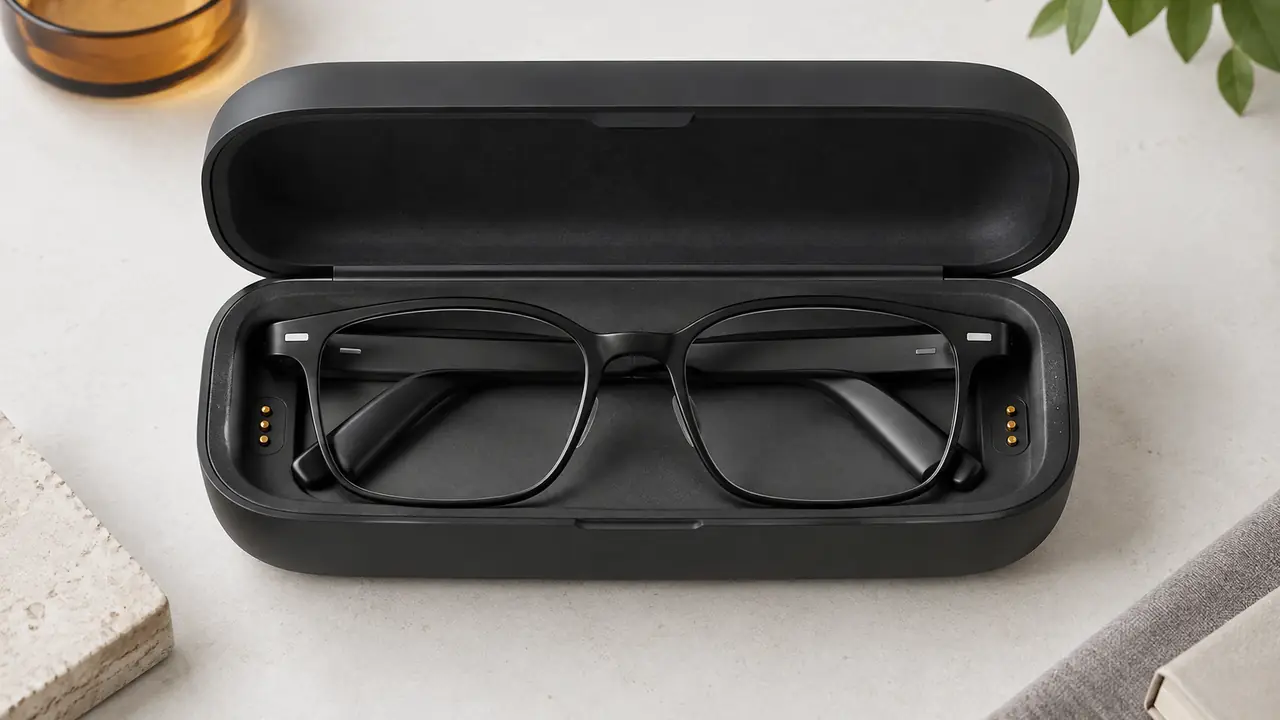
Why glasses use pogo pins
A standard USB socket is too deep for most temples and would leave an open port next to the skin. Magnetic pogo contacts solve both problems. The temple carries two or more flat contact pads, often slightly recessed, and the charging cable carries spring-loaded pins - the pogo pins - surrounded by a magnet that pulls the cable into position. When the cable snaps on, the springs press the pins against the pads and current flows; when it is pulled away, nothing is left open in the temple.
Across the category, a full charge through these contacts typically takes about 1 to 2 hours. The contacts carry modest current, but they have to make a clean connection every time, in a part of the frame that touches skin, hair and sweat all day.
How the contact system is built
A pogo contact system has three halves that must be specified together: the pads on the temple, the pins on the cable, and the magnets that align them. If any one changes, the others may no longer fit or hold.
| Part | Typical design choices | What it affects |
|---|---|---|
| Temple pads | Plated brass or stainless pads, flush or recessed, sealed into the housing | Corrosion resistance, sealing, appearance |
| Cable pins | Spring-loaded pins with plated tips, two to four pins | Contact pressure, wear, data or charge only |
| Magnets | Small magnets in the cable head and a steel or magnet target in the temple | Snap force, alignment, risk of reverse connection |
| Cable and plug | Cable length, strain relief, USB plug at the other end | Durability, user handling, input to the charge circuit |
Keying matters. If the magnet pattern allows the cable to attach the wrong way round, the charge circuit must tolerate it. Many designs use asymmetric magnets or a shaped head so the cable can only seat one way.
Sweat, plating and corrosion
The most common failure is not mechanical but chemical. Sweat contains salt and acids; on a charged contact it can start corrosion that leaves a green or dark film, raises resistance and eventually stops charging. Plating thickness and plating type on both pads and pins decide how long the contacts last. Sealing around the pads matters as much, because liquid that creeps behind a pad reaches the board.
Test plans for smart glasses commonly include salt spray and artificial sweat immersion on the contacts, plus a charge check afterwards. Water resistance is stated as a test result - for example IPX4 to IP54 across the category, tested per IEC 60529 - not as a promise for the life of the pair. The problem side is covered in sweat corrosion on smart glasses, and the rating side in IP ratings for smart glasses.
Wear, plug cycles and magnet strength
Each connection slides the pins slightly across the pads. Over many cycles the plating wears, springs lose force and debris collects in recesses. A plug cycle test, also called a charging interface insertion test, connects and disconnects the cable a stated number of times and checks charging at intervals. It is one of the inspection items commonly agreed for smart glasses programs, alongside hinge cycling and temple bending.
- Magnet too weak: the cable falls off when the glasses are moved, and users report charging that stops overnight.
- Magnet too strong: the cable snaps on hard, which can chip coatings, and it can pick up metal debris from pockets and bags.
- Spring force too low: intermittent contact, slow charging and warm contacts.
- Pads proud of the surface: faster wear and skin contact with exposed metal.
Charging complaints often have a simple fix: cleaning the pads, reseating the cable or replacing a worn cable. The troubleshooting note smart glasses not charging sets out the order to check.
Cables, chargers and spares
The pogo cable is a proprietary part. If a customer loses it, the glasses cannot charge, so spare cables need to be planned in the after-sales stock and the packaging. Some programs ship a charging case or a stand instead of, or as well as, a cable; the case route is covered in charging cases for smart glasses. Spare cables and cases sit in the accessories line, where typical quantities are 500 to 1,000 pieces per item, confirmed in writing per program.
The cable also has its own compliance points. Its USB end connects to chargers of unknown quality, so the charge circuit inside the temple should limit input current and handle over-voltage. If the cable has electronics in its head, it may need its own testing; confirm the scope with your test lab.
Checking contacts at inspection
Contacts are easy to check before shipment and expensive to fix after. A pre-shipment inspection on a sample of each lot usually looks at the pads under magnification for plating defects, scratches, glue residue and uneven height; seats the cable on every sampled pair and confirms that the charge indicator responds; and checks that the magnet pulls the cable into place from a short distance without help. A small number of pairs per lot can be charged from low to full to confirm that charge time sits within the tolerance agreed on the golden sample.
Incoming checks on cables matter as much as checks on the glasses. Cables are often made by a separate accessory supplier, and a change of magnet grade or pin spring at that supplier will not show up in the glasses themselves. Keeping a reference cable from the golden sample and comparing snap force and fit against it on each cable lot catches most drift. The general approach is on quality control.
What to put in the specification
- Contact layout: number of pins, keying, pad material and plating, pad position on the temple.
- Magnet target: snap and pull-off behaviour agreed on the golden sample.
- Durability tests: plug cycles, artificial sweat and salt spray on contacts, with a charge check after each.
- Cable: length, strain relief, plug type and a branded or plain head.
- Spares: spare cable quantity per order and packaging.
A contact design change after tooling usually means new housing parts, so it is worth fixing early. Lead time ranges are on MOQ and lead time, and the specification can be sent through the quote form.