
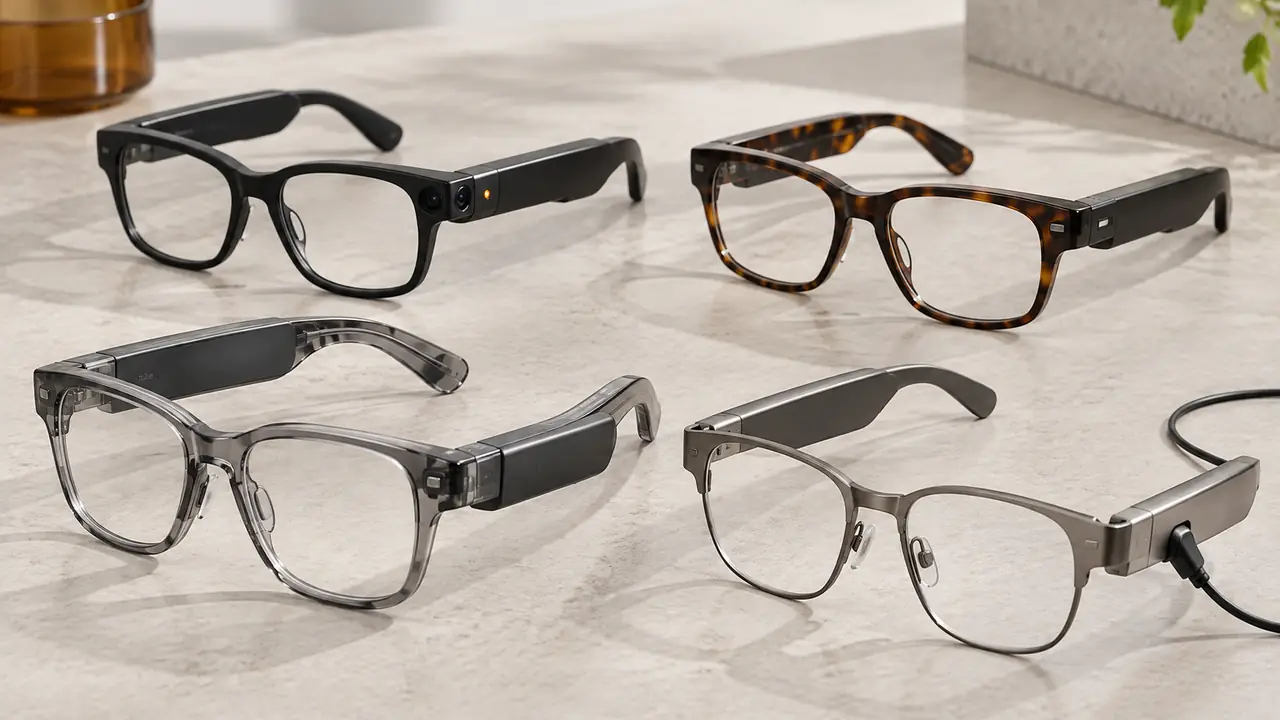
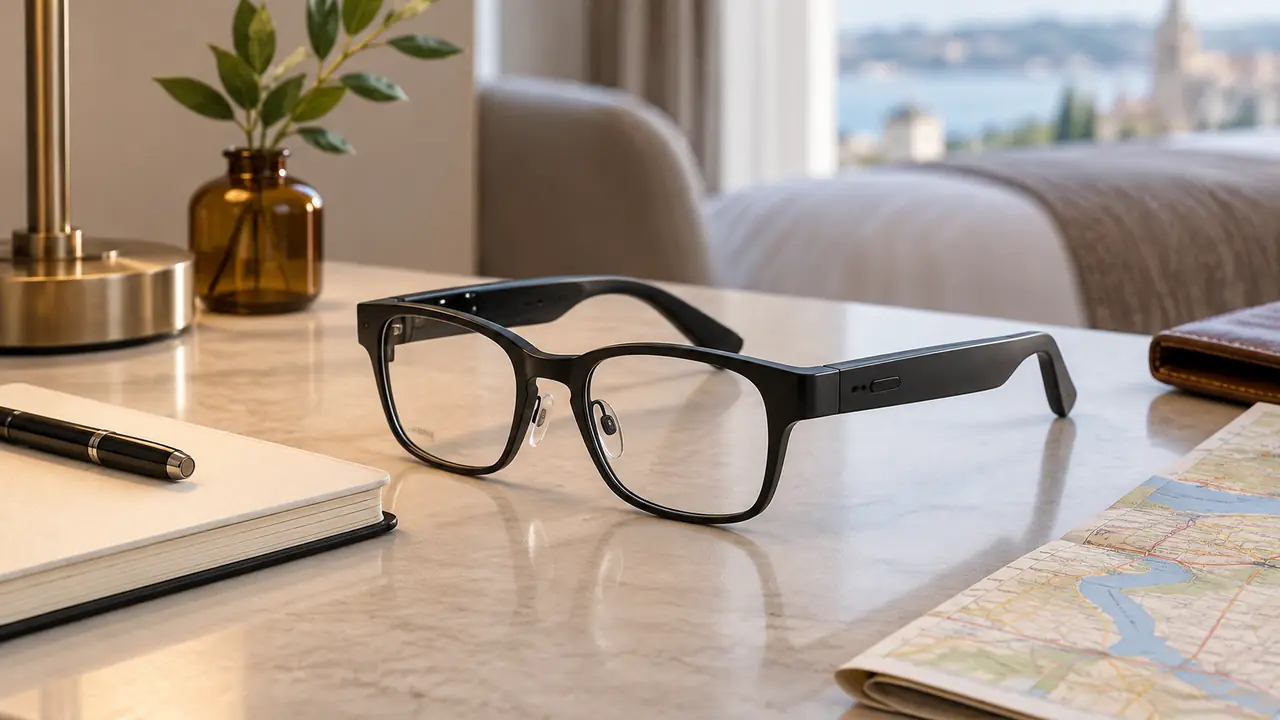
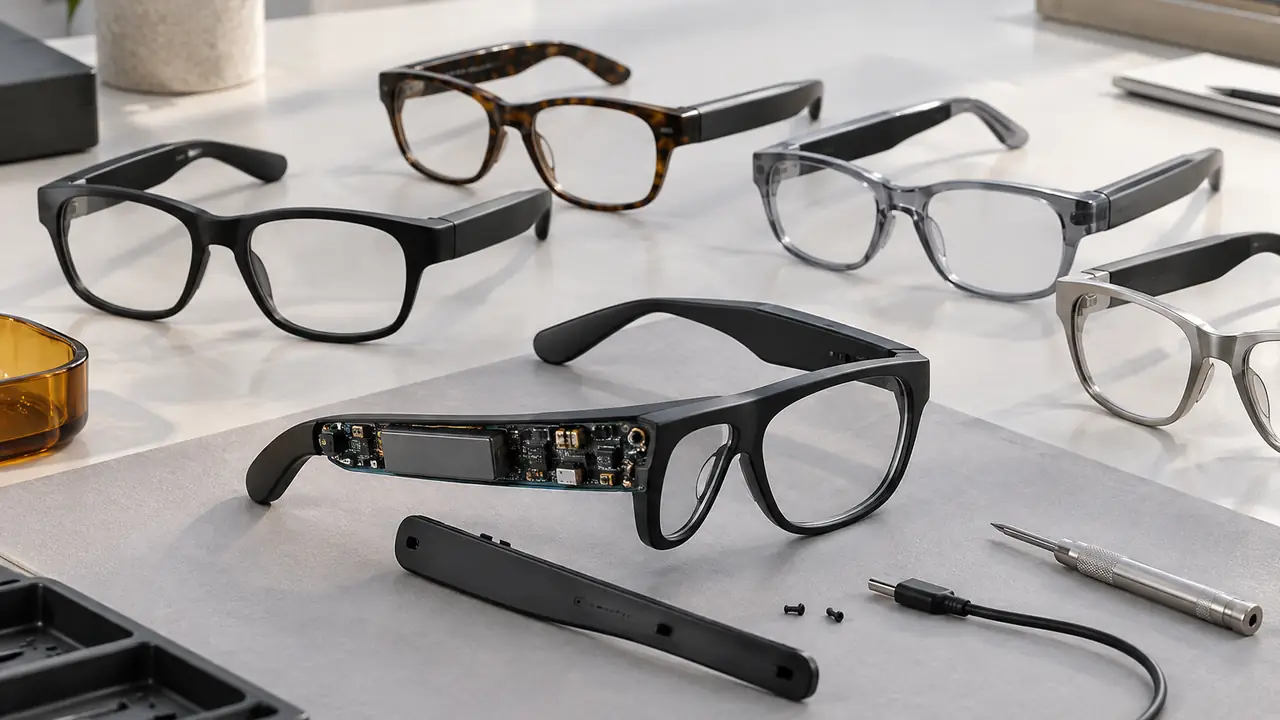
What sets the AI family apart
Every smart glasses program starts from the same skeleton: a front with lenses, a hinge that carries a flexible circuit, and two temples holding a board, small lithium-ion cells, speakers and microphones. Audio glasses stop there. The AI family adds one more capability on top of that skeleton - a stronger microphone array and an app link for translation, a camera module for capture, a display or switchable lens for the field of view, or open interfaces for developers. Each addition changes power draw, weight balance, the certification scope and, for cameras and microphones, the privacy questions a buyer must answer.
Market trackers describe fast growth. Omdia counted about 8.7 million AI glasses shipped worldwide in 2025, up 322% year on year, and reported that models with a display rose from 3.3% to 8.4% of that volume, roughly 730,000 units. Counterpoint reported that AI smart glasses made up 88% of smart glasses shipments in the second half of 2025. These are third-party estimates; for a brand, the more useful question is which of the four lines below fits its channel and its compliance appetite. A wider comparison sits in AI glasses vs audio glasses.
The four lines compared
The table summarises typical reference ranges across the category, taken from public spec sheets and listings. They describe the category, not a measured product, and every figure is confirmed per spec sheet for each program.
| Line | What it adds | Typical reference range | Main buyer question |
|---|---|---|---|
| AI translation glasses | Temple microphone array, app link to a translation engine | 6-60+ languages per app; typical cloud latency 0.5-3 s | Which app, which engine, which language pairs offline |
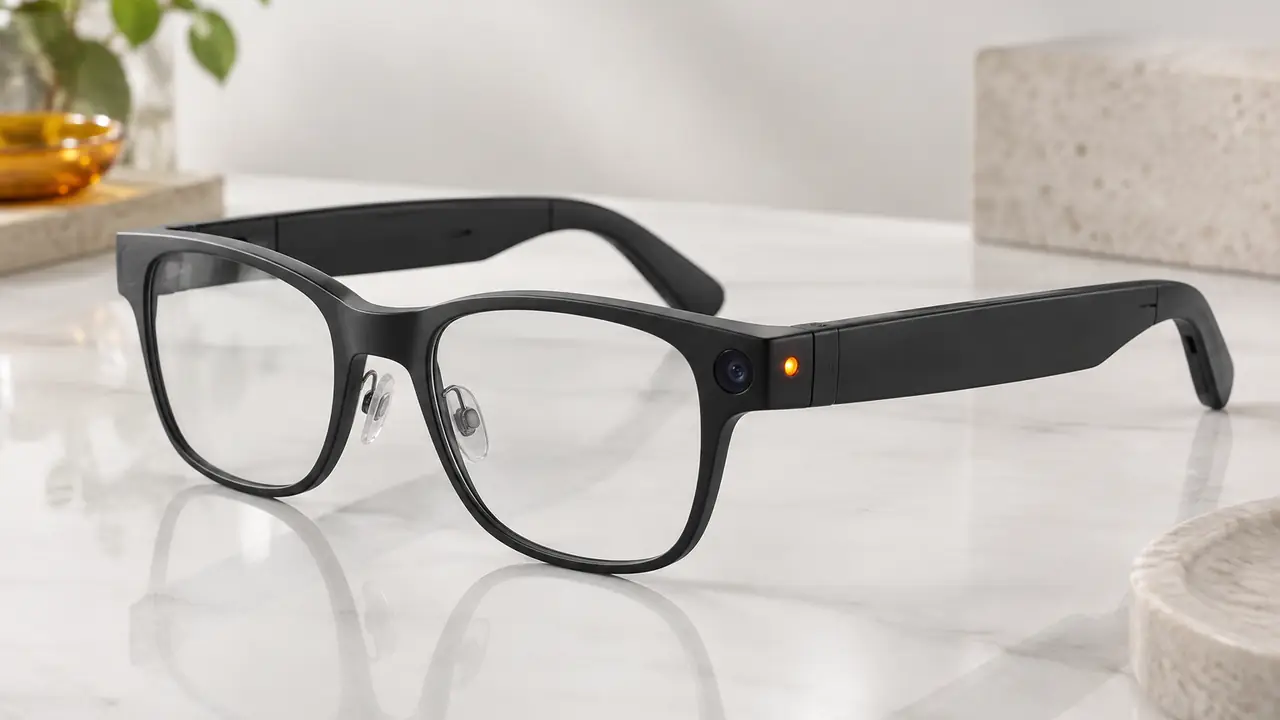
| Camera glasses | Camera module, storage, Wi-Fi transfer | 5-12 MP actual sensor; 1080p video, 4K at the high end; 16-128 GB | Recording indicator design and data handling |
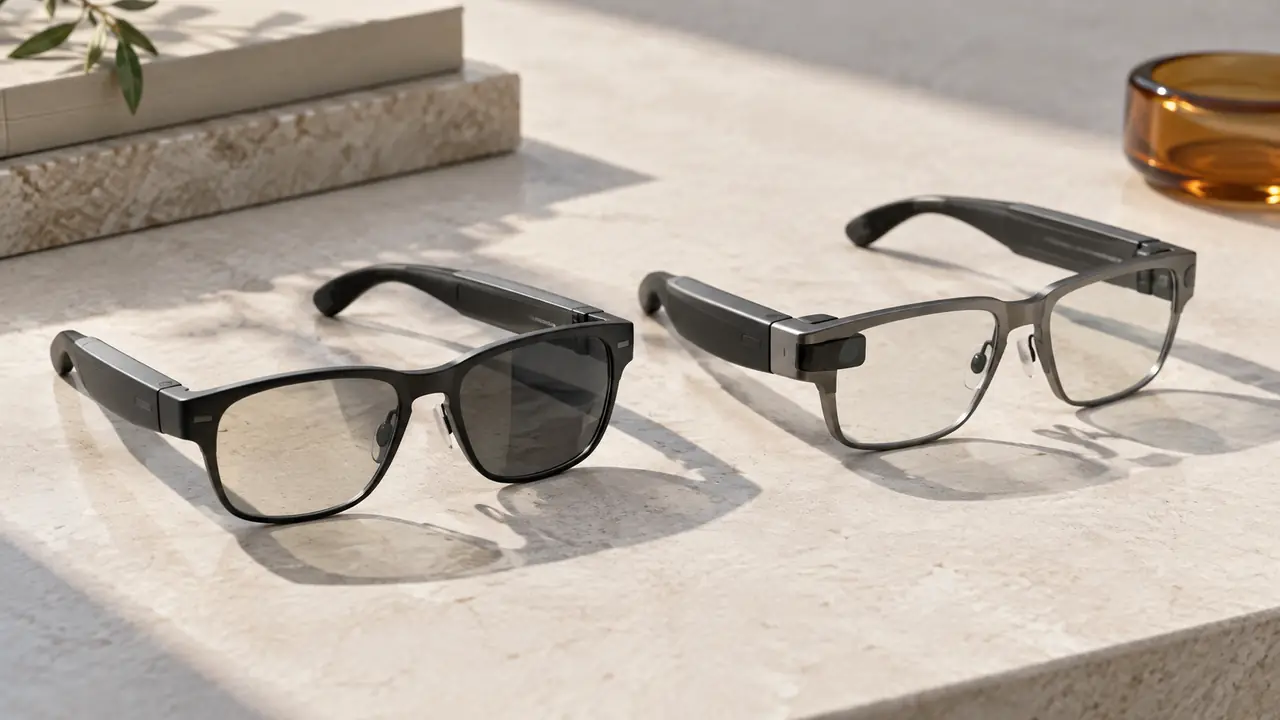
| Photochromic and AR glasses | Light-adaptive lenses or a HUD display | Cat. 0-3 dynamic per lens spec; monocular or binocular HUD per program | Optical standard, display brightness, weight |
| Developer smart glasses | Open SDK, BLE GATT, serial debug, optional sensors | Wi-Fi, camera and IMU optional; OTA per firmware | Interface documentation and long-term firmware access |
All four lines share the same frame and lens supply chains as the audio family: fronts from the Shenzhen Henggang and Wenzhou Ouhai eyewear clusters, lenses from Danyang and Xiamen, and temple electronics from Shenzhen. The desk aligns those three chains in one program, so a brand can run an audio model and an AI model on related fronts.
Writing privacy and data into the spec
Microphones that stream speech to the cloud and cameras that capture people nearby raise questions that are much cheaper to settle at the spec stage than after launch. The desk adds a privacy and data block to every AI program spec sheet. The questions below are the ones partner plants and app teams most often leave open.
- Recording indicator. For camera models: LED position, colour, brightness in daylight, and distinct light patterns for video and photo. In October 2026 the European Data Protection Board adopted a statement on smart glasses - guidance, not new law - that places the duty to inform bystanders on manufacturers, asks that indicators stay visible in varied lighting and use different signals for recording and photos, says the device should not record when the indicator is covered, and notes that a white LED can be mistaken for a reflection.
- Where audio and images go. On-device only, phone app, or cloud; which region hosts the servers; how long data is kept; whether it is used to train models.
- App permissions. Which phone permissions the app requests and why, and whether the white-label app can be configured to request fewer. See the data and app permissions checklist.
- Cybersecurity. Since 1 August 2025, glasses sold in the EU as wearable radio equipment fall under RED Article 3(3)(d)(e)(f), with EN 18031 as the harmonised standard family; from 11 December 2027 the Cyber Resilience Act takes over that role.
- Firmware ownership. Who signs OTA updates, how long security fixes are supplied, and what happens if the app provider changes.
Certification and testing for AI models
Radio, battery and optical rules apply exactly as they do for audio models: FCC Part 15.247 and Subpart B in the US, CE under RED 2014/53/EU with EN 300 328, EN 301 489, EN 62368-1 and EN 18031 in the EU, Bluetooth SIG qualification, UN 38.3 and IEC 62133-2 for cells, and ISO 12312-1 or ANSI Z80.3 for lenses. Wi-Fi on camera and developer models widens the radio test scope, and RF exposure is assessed per EN 50566 or EN 62479 and the FCC rules. Order-level testing adds firmware stability, OTA, indicator behaviour and transfer reliability to the usual hinge, drop and runtime checks. The certification guide covers each standard in more detail.
How a program runs
Most AI programs start from a catalog model and a white-label app. Catalog models usually run at 50-500 pairs per model, logo programs at 500-1,000 pairs, and full custom OEM or ODM programs with new tooling, tuning and app work from 3,000 pairs per model. ODM engineering samples take 30-60 days including 25-45 days of tooling, and full custom batches 45-75 days excluding certification queues. These are typical reference ranges, confirmed in writing for each program on MOQ and lead time. To brief a program, use the quote form.