
From mAh to hours
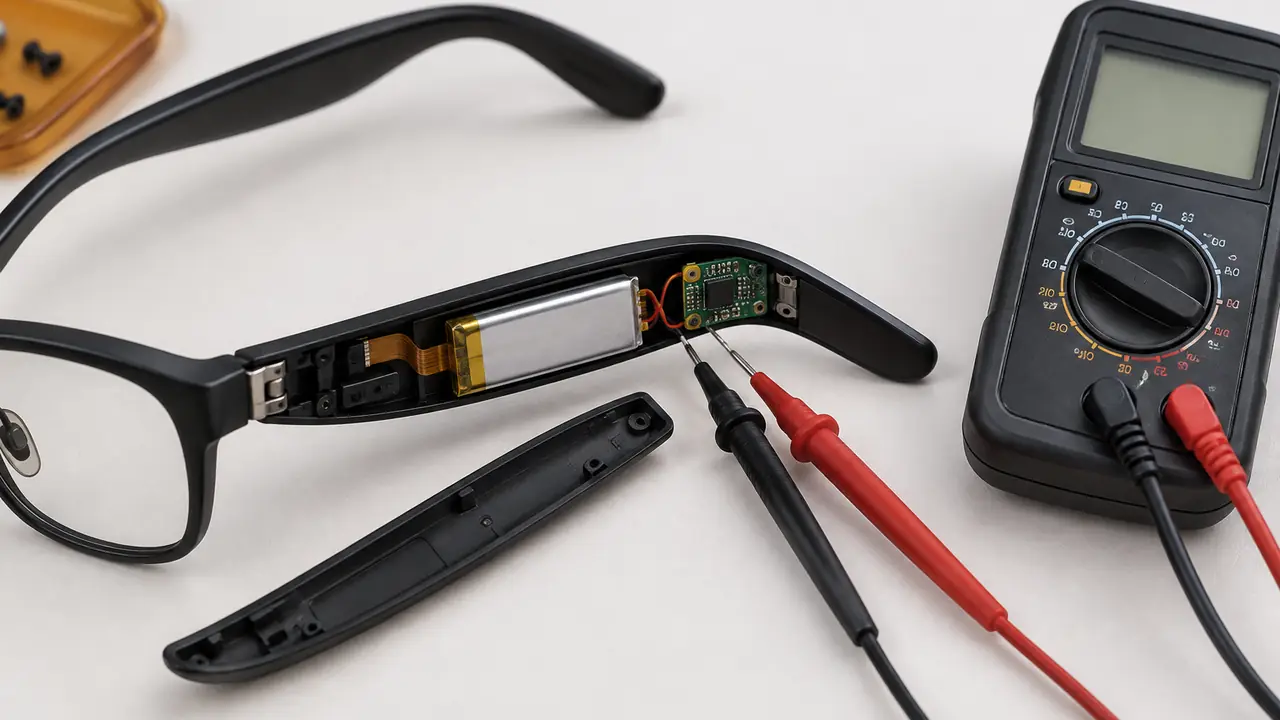
Smart glasses carry small lithium-ion cells in the temples, typically 85 to 235 mAh in total across both sides. Runtime is that capacity divided by the average current the pair draws, so two pairs with the same cells can differ by hours. Across the category, music playback runs about 4 to 13 hours and calls about 3 to 9 hours, per spec sheet. Calls draw more than music because the microphones, noise reduction and two-way radio link all run at once.
| Factor | Effect on runtime | What to specify |
|---|---|---|
| Cell capacity | More mAh means more hours, but more weight in the temple | Capacity per temple and where the cell sits |
| Chipset and Bluetooth version | Newer audio SoCs at BT 5.2-5.4 can draw less per hour per firmware | Chipset generation and codec |
| Volume and acoustic design | Higher volume and less efficient speakers drain faster | Test volume used for the runtime claim |
| Microphones and ENC | Multi-mic noise reduction adds load during calls | Call-time test conditions |
| AI, camera or display | The largest extra draw on any model | Runtime per feature, not one headline number |
Ask every supplier for the test conditions behind its figures - volume, codec, distance from the phone, ambient temperature - and repeat the runtime test on the golden sample. Standby time is a different measure and should never be compared with playback. More detail: smart glasses battery life explained.
Why AI features shorten runtime
AI translation, assistant and camera features add work that pure audio glasses do not do: more microphones listening at once, audio streamed to a phone app and on to a cloud engine, a stronger processor waking more often and, on camera models, an image sensor plus Wi-Fi transfer. Each of these draws current on top of the audio path. That is why AI and camera models usually quote runtime per mode, and why a buyer should ask for separate figures for music, calls, translation sessions and recording. Translation is also affected by the network: typical cloud latency is 0.5-3 s per app and translation engine, and a weak connection keeps the radios busy longer. See AI features and power draw.
Charging and battery life over time
Most smart glasses charge through magnetic pogo pin contacts on the temple, typically in 1 to 2 hours. Some ranges add a charging case with its own battery. The contacts are the part to watch: sweat and skin oils corrode them, so the test plan should include an artificial sweat soak and a plug-in cycle test on the connector. Lithium-ion cells also lose capacity with charge cycles, heat and long storage at full charge, which matters for stock that sits in a warehouse for months; storage state of charge and rotation should be part of the after-sales plan.
Battery safety: IEC 62133-2 and UN 38.3
Two documents come up on almost every program. IEC 62133-2 is the safety standard for portable lithium cells and batteries, and many retail and marketplace buyers request the report. UN 38.3 is the transport test series - altitude, thermal, vibration, shock, short circuit and others - and its test summary is needed to ship lithium batteries. In the EU, the Battery Regulation 2023/1542 adds labelling and other obligations for batteries placed on the market. The reports are issued by test labs to the cell maker, the partner plant or your brand; the desk verifies scope and validity per project. Read IEC 62133-2 for wearable batteries.
Shipping: UN3481 and PI 967 Section II
Smart glasses ship by air as UN3481, lithium-ion batteries contained in equipment, under IATA Packing Instruction 967. Section II applies when each cell is no more than 20 Wh and each battery no more than 100 Wh, which smart glasses cells fall far below: as illustrative arithmetic, 235 mAh at a nominal 3.7 V is under 1 Wh. On passenger aircraft each package may contain no more than 5 kg net of lithium batteries; packages need the lithium battery mark and the airway bill a declaration. IATA recommends a state of charge of no more than 30 percent for batteries in equipment under PI 967, but this is a recommendation, not a requirement. Charging cases with their own battery are assessed separately as UN3480 or UN3481 per Wh. Routes and timing are on logistics and shipping.
Runtime in the brief
State the runtime target per mode, the cell placement, the charging method and the documents the channel requires. Catalog and logo batches typically take 20-35 days after the golden sample, as typical reference ranges confirmed in writing for each program on MOQ and lead time. Send the brief through the quote form.