
What counts as smart glasses
For a buyer, the useful definition is practical: a pair of glasses that a person can wear all day in public, that looks close to ordinary eyewear, and that adds at least one electronic function. In almost every product on sale that function is audio - small directional speakers in the temples and microphones for calls. Many models add a voice assistant, translation through a companion app, a camera or a small display. The frame still has to do everything a frame does: fit a range of faces, hold lenses to an optical standard and survive being folded and unfolded thousands of times.
That double identity drives most engineering trade-offs and most returns. An audio product that pinches behind the ear is returned as an eyewear failure. A frame with a weak hinge fails as an electronics product, because the hinge carries the flexible circuit between the two temples. Programs that work treat both halves seriously from the first brief, and put the frame, the lens and the electronics on one specification instead of three. A longer reader's version is the note what are smart glasses.
Five types and twelve lines
Retail and wholesale ranges usually sort into five types. The boundaries blur as chipsets become more capable, but the split still decides price tier, certification scope and the questions end customers ask. Templora organises its twelve product lines under three families.
| Type | What it adds to a frame | Lines on this site |
|---|---|---|
| Audio glasses | Open-ear or bone conduction speakers, microphones, touch controls | Bluetooth audio, open-ear, bone conduction, business call |
| AI and translation glasses | Microphone arrays, an assistant or translation per app and engine | AI translation, developer |
| Camera glasses | A small camera module, storage and a recording indicator LED | Camera glasses |
| Display and AR glasses | A HUD, birdbath or waveguide optic, or photochromic lenses | Photochromic and AR |
| Specialty frames | Rx-ready fronts, sports wraps, kids sizes, spare parts | Prescription-ready, sports, kids, accessories |
The families have their own overviews: audio glasses, AI and camera glasses and specialty smart glasses. Translation figures are always stated per app and translation engine, with typical cloud latency of 0.5-3 s depending on network and language pair.
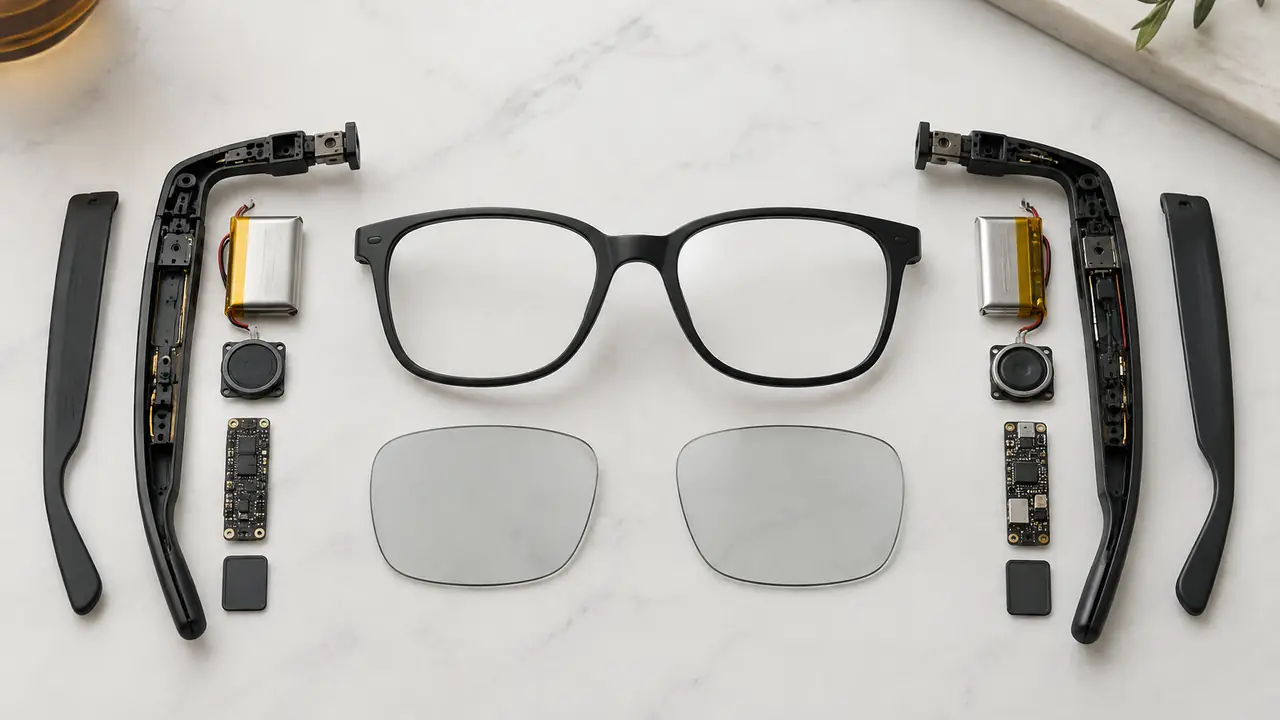
What sits inside the temple
Open a temple and you find a compact stack that every program has to specify. The order below is the order partner plants assemble it and the order used on every Templora spec sheet.
- Front and lenses. The frame front in TR90, acetate or metal, and lenses that follow ISO 12312-1 in Europe or ANSI Z80.3 in North America.
- Hinge and flex. A metal hinge with a thin flexible circuit running through it, linking the two temples.
- Board and chipset. A Bluetooth audio system-on-chip, usually version 5.2 to 5.4, plus an AI or imaging processor on richer models.
- Battery and charging. Small lithium-ion cells, typically 85 to 235 mAh in total across both temples, charged through magnetic pogo contacts in about 1-2 hours.
- Audio or imaging module. A directional speaker or bone conduction transducer near the ear, or a camera module at the hinge.
- Mics, controls and app. One to four microphones per side, a touch strip, and the companion app that carries settings and firmware updates.
Across the category, audio pairs weigh about 27 to 50 grams and play music for about 4 to 13 hours, per spec sheet. These are typical ranges, not measured values of any one product. The engineering detail behind each layer is on engineering.
Market signals, with attribution
Research firms describe a category that is growing quickly and is still mostly audio-first. Omdia counted about 8.7 million AI glasses shipped worldwide in 2025, up 322 percent year on year; models with a display rose from 3.3 to 8.4 percent of that total, roughly 730,000 units, and China accounted for about 10.9 percent, close to one million pairs and the second-largest market after the United States. Counterpoint reported that global smart glasses shipments grew 139 percent year on year in the second half of 2025, with AI smart glasses at 88 percent of shipments and North America at 37 percent. IDC expected China's smart glasses shipments to reach about 2.9 million units in 2025, with audio and audio-camera glasses around 2.2 million of them.
For range planning the practical reading is simple: audio models carry the volume, AI features are becoming the default on new models, and display models remain a smaller, heavier and more expensive tier. More context is in smart glasses market signals.
Three supply chains in one pair
A pair of smart glasses joins three supply chains that grew up separately. The electronic temple - acoustics, PCBA, cells and charging - comes from Shenzhen, where Bao'an hosts acoustic, display and PCBA suppliers, Nanshan hosts AI and chipset solution companies and nearby Dongguan handles assembly and injection moulding. Frames come from the eyewear clusters: local reporting puts around 1,200 eyewear companies in Henggang in Shenzhen's Longgang district, and Wenzhou's Ouhai district is one of China's five main eyewear bases, with metal and acetate frames, hinges and export private label. Lenses come from Danyang in Jiangsu, which local and national reporting credits with more than 400 million pairs of lenses a year, and from Xiamen, a centre for polarized lenses and mid to high-end sunglasses.
| Supply chain | Main clusters | What the desk aligns |
|---|---|---|
| Temple electronics | Shenzhen Bao'an and Nanshan, Dongguan | Chipset, cells, speakers, mics, firmware and app |
| Frames and fronts | Shenzhen Henggang, Wenzhou Ouhai | Temple cavity size, hinge and flex routing, finish |
| Lenses | Danyang, Xiamen | Lens category, polarized or photochromic, Rx-ready edging |
Templora is a sourcing desk, not a single plant. The desk's office is in Wenzhou, also home to the Ouhai eyewear cluster, and it coordinates partner plants across the three chains: shortlisting, samples, the certification route, pre-shipment inspection and shipping. The cluster detail is on industry clusters.
How buyers start a program
Most programs start from a catalog model and change the front, the lens, the branding and sometimes the app skin. Catalog models typically start at 50-500 pairs per model, logo programs at 500-1,000 pairs and full custom OEM at around 3,000 pairs, all typical reference ranges confirmed in writing for each program. The routes are compared on the OEM and private label guide, the current table is on MOQ and lead time, and a brief can be sent through the quote form.