
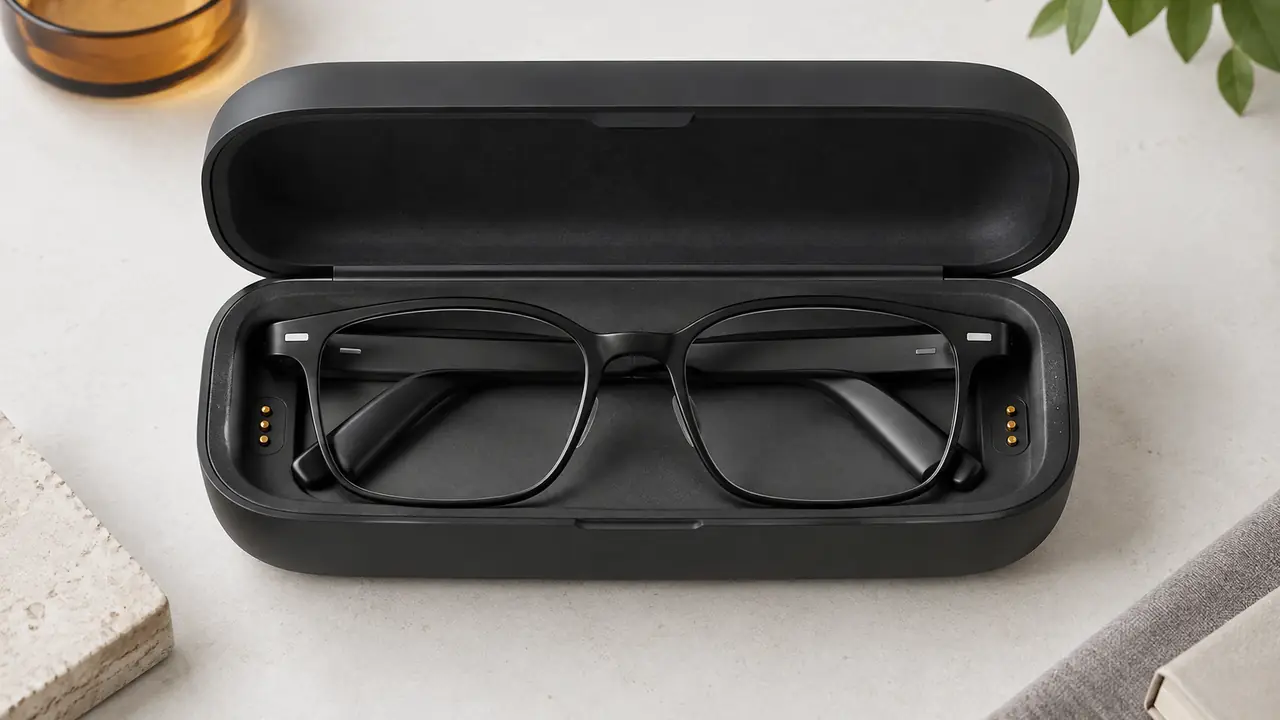
Why a pair of glasses is a battery shipment
Lithium cells can overheat if they are damaged, short-circuited or badly packed, so transport rules treat them as dangerous goods even when they are sealed inside a product. A pair of smart glasses contains small lithium-ion cells - typically about 85 to 235 mAh in total across both temples - and many programs add a charging case with its own cell. The cells are small, and the rules for small batteries are lighter than for large ones, but they still apply: classification, packing, marks, documents and, by air, limits per package.
The good news for wearables is that the energy per cell is low. The bad news is that shipments are frequent, mixed and often go through several hands - plant, consolidator, forwarder, airline, fulfilment centre - and each one can stop a box that is not marked or documented correctly. A clean file prepared once saves repeated delays.
Classifying the shipment
The first question is how the battery travels. Lithium-ion batteries contained in equipment, such as glasses with cells in the temples, are classed as UN3481. Batteries packed with equipment - for example a spare battery in the same box - are also UN3481 but follow a different packing instruction. Batteries shipped on their own are UN3480. A charging case sits at the boundary: inside a retail box with the glasses it is usually treated with the equipment; sold on its own as a spare it may be treated as a battery in its own right.
| Item as shipped | Usual classification | Note |
|---|---|---|
| Glasses with cells in the temples | UN3481, contained in equipment | By air, small batteries typically under PI 967 Section II |
| Glasses plus charging case in one retail box | UN3481, contained in or packed with equipment | Depends on how the case is classed; confirm with your forwarder |
| Charging case sold as a spare | UN3480 or UN3481, decided per Wh and packaging | Treated as a battery or as equipment depending on design |
| Spare battery packs | UN3480, batteries alone | Tighter rules by air; uncommon for glasses |
PI 967 Section II by air
For lithium-ion batteries contained in equipment, the air rules use Packing Instruction 967. Section II covers smaller cells and batteries and is the route most smart glasses shipments use. Its main conditions are:
- Energy limits: each cell no more than 20 Wh and each battery no more than 100 Wh.
- Package limit: on passenger aircraft, no more than 5 kg net of lithium batteries per package.
- Test evidence: each cell and battery type has passed UN 38.3, with a test summary available.
- Marks and documents: a lithium battery mark on the package where required and a statement on the air waybill.
- Packaging: strong outer packaging, with equipment protected against accidental activation and damage.
- State of charge: IATA recommends shipping at no more than 30 percent state of charge; for PI 967 this is a recommendation, not a requirement.
Watt-hours are calculated as nominal voltage multiplied by capacity in amp-hours, using values from the cell spec sheet. Temple cells across the category are far below the 20 Wh cell limit, and 5 kg of lithium batteries is a great many pairs, so the limits rarely bind for glasses. The conditions on marks, documents and packaging still do. The test side is in UN 38.3 for smart glasses.
Sea, road and express
Sea and road transport have their own dangerous goods codes, with provisions for small lithium batteries in equipment that are in some respects lighter than the air rules. Express couriers often apply their own account conditions on top of the regulations, and some routes or services do not accept lithium batteries at all. For planning, express and air shipments typically take about 5 to 10 days; sea freight, full or shared container, typically takes about 15 to 25 days to the US West Coast and 30 to 45 days to Europe. These are reference ranges, and battery acceptance should be checked per route with the forwarder.
Customs classification is a separate question from dangerous goods classification. Audio glasses are often classified under 8518.30 or 8517.62, camera glasses under 8525.89, plain sunglasses under 9004.10; confirm codes with your customs broker. The details are in HS codes for smart glasses.
The shipping file to prepare
Most delays come from missing or mismatched documents rather than from the rules themselves. A single shipping file per model, kept current, answers almost every request.
- Cell spec sheets: nominal voltage, capacity and Wh for each cell, including the charging case.
- UN 38.3 test summaries: for every cell and pack type fitted, matching the cell markings.
- Safety evidence: IEC 62133-2 reports where requested; see IEC 62133-2 for wearable batteries.
- Classification note: UN number and packing instruction proposed per item, confirmed with the forwarder.
- Packaging spec: retail box, inner and master carton, pairs per carton, battery mark artwork and placement.
- State of charge at packing: the value used on the line, recorded per lot.
Fulfilment centres and marketplaces often have their own battery review, asking for the UN 38.3 summary and a safety data sheet or equivalent before stock is accepted. Packing the marks and documents into the packaging design is easier than adding them at the warehouse; see packaging and retail boxes.
Common problems and how to avoid them
A few issues account for most battery shipping holds. Cells changed during production without new UN 38.3 summaries. Charging cases packed separately but documented as if inside the glasses box. Master cartons with the wrong mark, or a mark placed where it is covered by the shipping label. Glasses switching on in the carton because the power button can be pressed through the box. Stock packed fully charged and stored warm. Each is cheap to prevent at the plant and expensive to fix at an airport.
The desk checks cell markings, the battery file, carton marks and state of charge at pre-shipment inspection, and prepares the file with the forwarder before booking. Final classification and acceptance rest with the shipper and the forwarder; confirm with your forwarder for every new item or route. Typical batch lead times are on MOQ and lead time, and shipping questions can be sent with the brief through the quote form.