
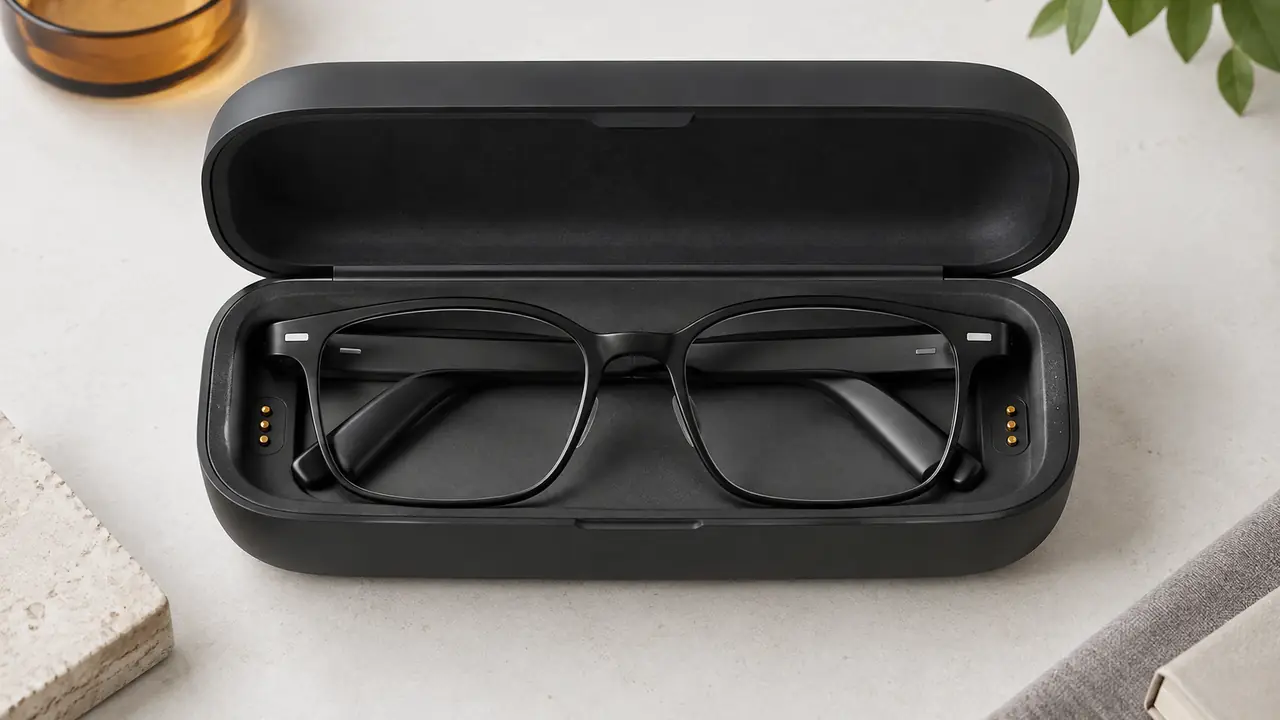
Why battery life is hard on a pair of glasses
A pair of earbuds sits in a charging case for most of the day and only has to run for a few hours at a time. A pair of smart glasses is expected to be worn like ordinary eyewear, from the morning commute to the evening, and it has very little space to store energy. Everything that holds charge has to fit inside two slim temples that also carry the speakers, the microphones, the board and the flexible circuit through the hinge. Add weight limits - finished pairs across the category weigh about 27 to 50 grams - and the battery becomes the main trade-off of the whole design.
That is why runtime is so often the first line on a spec sheet and the first reason in a return note. A buyer who understands where the hours come from can write a specification that partner plants can meet and that customers will recognise in daily use, instead of a headline figure measured under conditions nobody repeats.
From mAh to hours: the basic arithmetic
Capacity is stated in milliamp-hours (mAh). Across the category, the combined capacity of the cells in both temples is typically about 85 to 235 mAh. The hours a pair delivers depend on how much current the electronics draw on average while doing a given job. Streaming music at a moderate volume draws less than a call, because a call keeps the microphones, noise reduction and the uplink busy at the same time. Features such as a camera, an AI assistant or live translation draw more again.
Published specifications reflect this. Typical figures across the category are 4 to 13 hours of music playback and 3 to 9 hours of talk time, with a full recharge through the magnetic contacts taking about 1 to 2 hours. The spread is wide because cell size, chipset, speaker efficiency and test conditions all vary. Two pairs with similar capacity can differ by hours if one runs a more efficient audio chip or plays at a lower test volume.
What changes the hours in real use
The number on the box is measured in a lab under one set of conditions. Real use changes almost every variable. The table below shows the factors that move runtime most and what a buyer can ask for.
| Factor | Effect on runtime | What to specify |
|---|---|---|
| Volume level | Higher volume draws more current from the speaker amplifier | Test volume stated on the spec sheet, for example a stated percentage of maximum |
| Use mode | Calls and AI features draw more than music | Separate playback, talk and feature runtimes per test report |
| Codec and connection | Richer codecs and weak links raise radio activity | Codec used during the test; distance and environment |
| Temperature | Cold reduces usable capacity; heat speeds aging | Test temperature; operating range per cell spec sheet |
| Cell age | Capacity falls with charge cycles and time | Capacity retention target after a stated cycle count, confirmed per program |
| Firmware | Sleep timers and wake behaviour change idle drain | Firmware version used for the test; auto-off settings |
Two habits help. Ask for runtime per mode rather than one headline figure, and ask for the test conditions in writing. The note on standby vs playback time explains why a standby claim measured in days says little about a working day of calls, and AI features and power draw covers why camera and assistant models usually sit at the lower end of the range.
Specifying battery life for a program
A runtime specification that survives production and after-sales usually has four parts. First, the cell itself: chemistry, nominal capacity and supplier, with the cell spec sheet attached. Second, the runtime per mode, with test volume, codec, firmware version and temperature written next to each figure. Third, the charging spec: charge time to full, the charger or cable it was measured with and the behaviour of the charge indicator. Fourth, an aging target: the share of original capacity the pair should still hold after a stated number of cycles, verified on samples per the test plan.
- Fix the cell. Agree the cell model and capacity on the engineering sample, because a later cell swap changes runtime and the battery test reports.
- Measure per mode. Record music, call and feature runtime on the golden sample under the stated conditions.
- Set a tolerance. Agree how far a production pair may fall short of the golden sample figure before a lot is held.
- Check at inspection. Include runtime and standby checks on a sample of each lot before shipment, as set in the inspection plan.
The battery itself also drives paperwork. Cells need UN 38.3 test summaries and usually IEC 62133-2 reports, and the finished pair ships as lithium batteries contained in equipment. The battery and charging engineering page covers cell and contact design, and UN 38.3 for smart glasses covers the transport tests.
Writing runtime claims customers trust
Many negative reviews of smart glasses are not about short runtime as such but about a gap between the claim and the experience. A listing that says up to 13 hours, measured at low volume with every feature off, sets up disappointment for a buyer who spends the day on calls. A listing that states typical music and call runtime separately, notes the test volume and explains that AI features shorten runtime is easier to defend and generates fewer complaints.
A practical approach is to publish three numbers per model: typical music playback, typical talk time and charge time, each with a short footnote on conditions. Keep any standby figure separate and clearly labelled. Use words such as typical and up to consistently, and make sure every number in the listing matches the test report the partner plant provides. For a range with several tiers, it helps to show runtime side by side so customers can pick the pair that fits their day rather than the one with the biggest headline.
Runtime also shapes the range plan. A commuter line may live comfortably at the lower end of the category range; a sports or travel line usually needs more capacity, which means a thicker temple or a heavier pair. Those trade-offs are worth settling at brief stage, because cell size feeds directly into frame tooling, weight and certification scope.
Where to go next
Battery decisions touch the cell, the temple shape, the contacts and the shipping file at the same time. The note on temple battery design covers cell size and balance. Typical starting quantities run from 50 to 500 pairs for a catalog model up to 3,000 pairs or more for a full custom build, reference ranges confirmed in writing for each program on MOQ and lead time. When the runtime target is clear, the quote form lets you send it with the rest of the brief.