
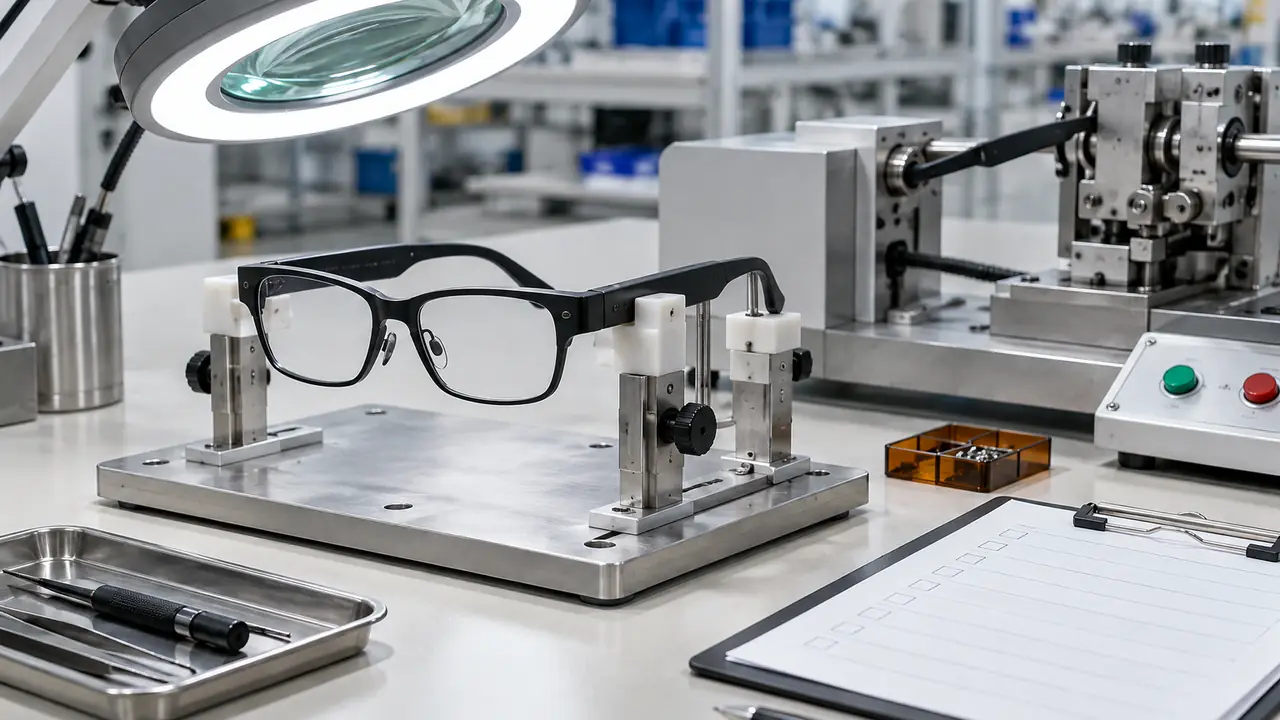
One reference, three gates
Every quality decision on a smart glasses program is taken against the same reference: a golden sample signed by the buyer, together with the spec sheet that describes it in words and numbers. The golden sample fixes what cannot easily be written down, such as the feel of the hinge, the colour and gloss of the front, the sound of the speaker at a given volume and the fit of the lens in its groove. The spec sheet fixes what can, such as approved parts, firmware version, weight window, lens category and the pass windows for each test. When the two disagree, the spec sheet is corrected before batch production, not during it.
Around that reference, quality is managed at three gates. Incoming quality control (IQC) stops wrong or defective parts before they enter the line. In-process quality control (IPQC) catches assembly errors at the station where they occur. Outgoing quality control (OQC) and the desk's pre-shipment inspection decide whether a finished batch ships. The partner plant runs IQC and IPQC; the desk reviews their records and runs or witnesses the final inspection.
What each gate checks
| Gate | Typical checks | Record kept |
|---|---|---|
| IQC - incoming | Parts against the approved list; cell batch documents and voltage; speaker and mic sensitivity sample; lens UV and transmission category; frame colour and finish against the golden sample | Incoming report per lot, with supplier and batch |
| IPQC - in-process | First article at each station; board functional test; hinge torque and flex continuity; seal and fit after temple assembly; firmware version | Station logs and first-article records per shift |
| OQC - outgoing | Full function, acoustic and RF checks; charging; visual and cosmetic; labels and markings; packing and accessories | OQC report per batch |
| Pre-shipment inspection | Random sample drawn by the desk at the AQL level agreed per order; witness tests; carton and marking check | Inspection report with photos and pass or hold decision |
AQL sampling and defect classes
Final inspection uses acceptance sampling. The sample size and the acceptance numbers come from the AQL level agreed per order, usually set separately for critical, major and minor defects. The desk does not apply one fixed level to every program, because a marketplace seller shipping a catalog model and a brand launching a custom frame carry different risks; the level is written into the order before production starts.
Defect classes are defined in the spec sheet so that inspectors on both sides read them the same way:
- Critical: anything that affects safety or compliance - a swollen or damaged cell, exposed conductors, a missing or wrong FCC ID or CE marking, a lens category on the label that does not match the lens, a recording indicator LED that does not light on a camera model.
- Major: anything that makes the product fail its function or likely to be returned - one temple silent, pairing failure, charging failure, touch control not responding, hinge too loose to hold the temple, a cracked front.
- Minor: cosmetic issues within tolerance limits stated in the spec sheet - small scratches outside the visible zone, slight colour variation, packaging scuffs.
A batch on hold is reworked or re-sorted and re-inspected; the desk reports the root cause and the corrective action. Common causes are discussed in reducing returns on smart glasses.
The golden sample in practice
The golden sample is built after engineering or catalog samples are approved and is signed by the buyer and the partner plant. At least two units are kept: one with the plant at the line and one with the desk or the buyer. Any change after signature - a different cell supplier, a new firmware build, a lens from another source - goes through a written change request and, where it affects function, a new sample. The sample process from catalog model to golden sample is set out in the smart glasses sample process.
How quality links to the rest of the program
Quality control depends on the work done before it. The factory audit confirms that the stations and records exist; the production process fixes where each check sits; the test plan on testing and inspection sets the pass windows. Quantities and lead times follow MOQ and lead time, confirmed in writing per program. To discuss inspection for an order, use the quote form.