
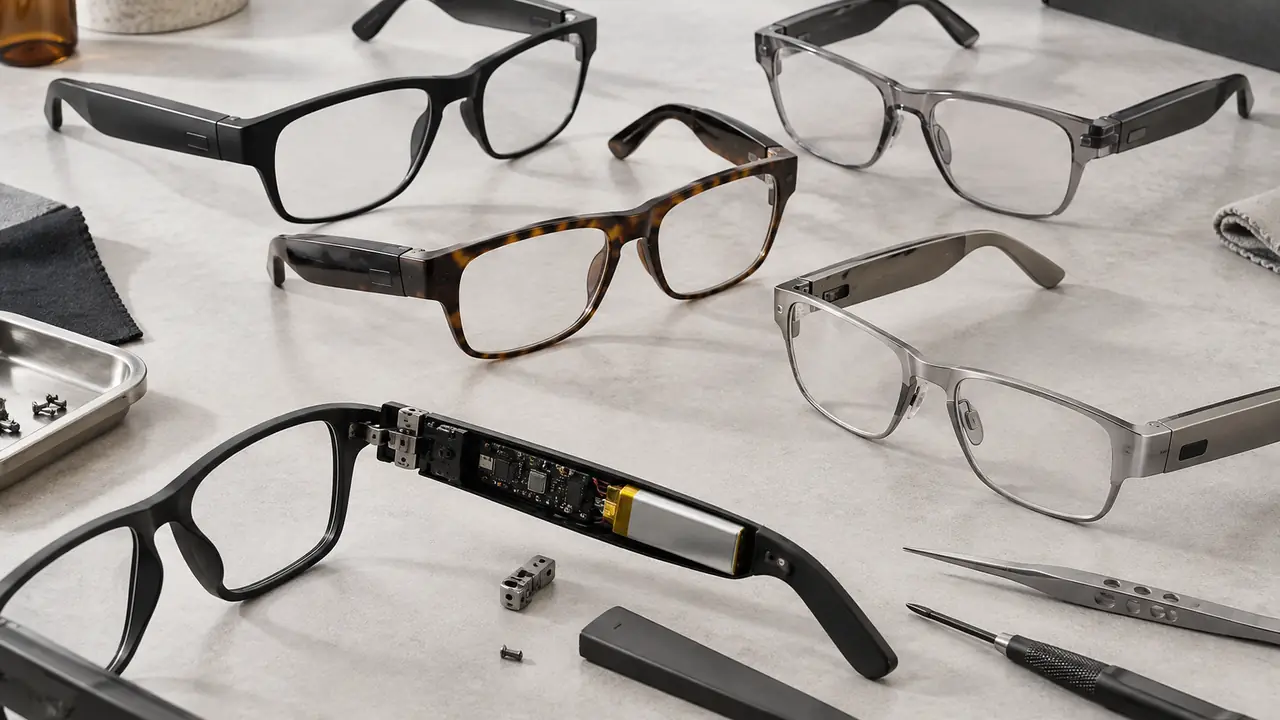
Symptoms and what they point to
'Not charging' covers several different failures. The indicator light may not come on at all when the cable is attached; it may come on but the glasses stay flat; charging may work only when the cable is held at an angle; or the pair charges normally but the runtime has dropped to a fraction of the original. The first three are usually problems in the charging path - cable, magnet, contacts or charge circuit. The fourth is usually the cell, its age or its storage history.
Across the category, smart glasses carry small lithium-ion cells, commonly about 85 to 235 mAh in total across both temples, charged through a magnetic pogo pin connector in one to two hours. That connector is small, exposed and touched by skin every day, which is why it dominates the list of root causes.
The charging path, part by part
| Part | Typical root cause | Layer |
|---|---|---|
| Cable and adapter | Broken conductor near the magnet head, weak USB adapter, charging from a port that sleeps | Materials, use |
| Magnet and alignment | Magnet too weak to seat the head, polarity allows a wrong orientation, head sits proud of the temple | Design |
| Pogo contacts | Sweat residue, oxidation, plating too thin, pin spring fatigue, debris in the recess | Materials, use |
| Charge circuit | Over-temperature or under-voltage protection tripping, damaged charge IC after a surge | Design, firmware |
| Cell | Deep discharge after long storage, ageing, cell capacity below specification | Materials, logistics |
| Flex across the hinge | Second temple not charging because the link through the hinge is cracked | Assembly, design |
The last row matters on glasses with a cell in each temple. If only one side charges, the charging port is often fine and the fault sits in the flex circuit that runs through the hinge. That is a durability problem, covered in hinge breakage in smart glasses, not a charging problem as such.
Logistics belongs on the list as well. Glasses that leave the plant with a low state of charge, sit in a hot container for several weeks and then wait in a warehouse for months can reach the customer with a cell that has slipped below the voltage at which the charge circuit will start normally. That case looks like a dead product, yet the hardware may be sound. The opposite mistake - shipping fully charged stock - raises its own transport and ageing questions, covered in battery aging in wearables. The practical answer is an agreed storage charge, a packing date on the carton and stock rotation, so that the oldest units are sold first.
Field triage routine
- Swap the cable and adapter. Try a second cable from the same model and a wall adapter rather than a laptop port. A large share of 'not charging' reports ends here.
- Inspect and clean the contacts. Look at the pogo pads on the temple under good light. Wipe with a dry cloth or a cotton swab lightly dampened with isopropyl alcohol per the manual; let them dry fully.
- Check the seating. Attach the magnetic head and see whether it snaps flat. If it rocks or can be attached the wrong way, note it.
- Leave it longer. A cell that has sat discharged for months may need time on the charger before the indicator responds. Follow the manual's guidance on wake-up time.
- Test each temple. On two-cell designs, check whether both sides power up and whether audio works on both after charging.
- Note temperature. If the glasses were charged in a hot car or in direct sun, protection circuits may block charging until they cool.
Units that still fail after these steps go back to the desk with serial number, firmware version, a photo of the contacts and the cable used. Photos of the contacts are often enough to tell corrosion from a plating or spring defect.
Spec lines that prevent it
Charging complaints drop when the purchase spec treats the connector as a wear part with its own acceptance criteria.
- Contact plating and base metal. State the plating type and thickness agreed with the plant, and require a sweat soak and salt spray check on the golden sample. The sweat side is covered in sweat corrosion on smart glasses.
- Connector mating life. Specify a charging connector insertion-cycle test, with the cycle count as a stated working default confirmed per order.
- Magnet and keying. Ask for keying or polarity that prevents reversed attachment, and a pull-off force agreed on the sample.
- Cable spec. Define cable length, strain relief at the magnet head and the adapter rating printed in the manual.
- Cell and safety documents. Cell capacity per spec sheet, IEC 62133-2 test report and UN 38.3 test summary for the cell or pack, verified per project; see IEC 62133-2 for wearable batteries.
- Storage charge. Agree the state of charge at packing. IATA guidance recommends a state of charge of 30 percent or less for lithium-ion cells shipped in equipment, and the plant should avoid fully empty cells sitting in a warehouse.
Inspection items
Lot inspection for charging should go beyond 'indicator lights up'. Typical items, confirmed per order:
- Charge from a set low state on a sample of units, timing against the one-to-two-hour category range and the figure on the golden sample.
- Visual check of pogo pads for plating colour, scratches, flux residue and recess depth.
- Magnetic head seating and reverse-attachment check.
- Both-temple power check after charging on two-cell designs.
- Cable continuity and strain-relief flex test on sampled cables.
- Battery voltage at packing, against the agreed storage charge.
- Document check: cell model and capacity on the label match the IEC 62133-2 and UN 38.3 files in the program folder.
Endurance items such as connector insertion life, salt spray and artificial sweat soak are run on samples at the golden sample stage and repeated when the plant changes a material or supplier.
Where support and sourcing meet
Charging complaints are a useful early warning. If the photos show green or dark residue on the pads, the coating or the user guidance needs attention; if they show clean pads with no contact, look at the spring pins or magnet; if one temple is dead, look at the hinge. Feeding that pattern back within the first weeks of a launch is cheaper than a reorder with the same defect. MOQ and lead time for a re-specified connector or cable depend on the route, with typical ranges on MOQ and lead time; the quote form is where a corrective order starts.