
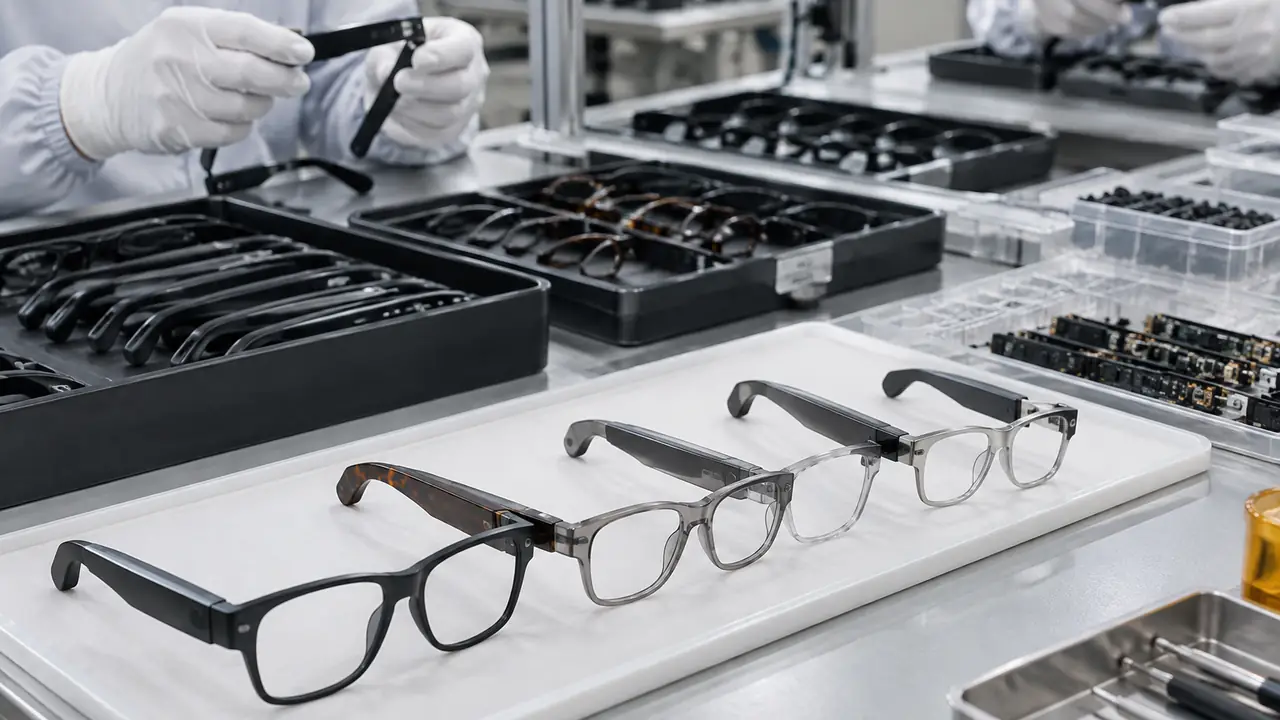
How a pair comes together
Smart glasses are built in two streams that meet late. The electronics stream turns bare boards, chips, cells, speakers and microphones into finished temples. The eyewear stream prepares fronts, hinges and lenses. The two streams meet at the hinge, where a flexible circuit links the left and right temples, and at the front, where lenses are fitted and the pair is aligned. Because the streams usually come from different clusters, the order of operations and the checks between them are agreed in the program plan before batch production starts, against a signed golden sample.
The description below is the typical sequence at a partner plant doing final assembly. Individual programs add or remove steps; a camera model adds module alignment and image checks, and an Rx-ready front may ship without lenses for fitting by an optician. What stays constant is the principle that each stage ends with a recorded check, so that a defect found at packing can be traced back to the station, the shift and the parts batch that produced it.
The eight stages
| Stage | What happens | Check that closes the stage |
|---|---|---|
| 1. Incoming materials | Boards, SoCs, cells, speakers, mics, flex cables, frames, hinges and lenses are received and quarantined | IQC to the approved parts list; cell documents and lens spec checked |
| 2. SMT and PCBA | Paste printing, placement and reflow of the temple boards; firmware flashing | Paste inspection, AOI, functional board test |
| 3. Temple assembly | Board, cell, speaker, mics and touch strip fitted into each temple shell; adhesive or ultrasonic sealing | Seal and fit check, power-on, button and touch test |
| 4. Hinge and FPC | Flex cable routed through the hinge; hinge screws torqued and secured | Open-close check, continuity across the hinge |
| 5. Front and lenses | Lenses edged and fitted to the front; temples joined to the front; alignment and fit adjustment | Visual, alignment, lens marking and category label |
| 6. Acoustic, RF and runtime tests | Speaker response, leakage, mic pickup, pairing and range, charge current | Pass window per program spec sheet |
| 7. Aging | Charge-discharge cycling or extended play on aging racks | Post-aging functional retest |
| 8. Packing | Cleaning, retail box, charging cable, inserts, labels, cartons with lithium battery marks | OQC and pre-shipment inspection |
Electronics stream: incoming parts, SMT and temples
The process starts with incoming inspection, because the most expensive defects in smart glasses enter with the parts: a cell batch that differs from the approved one, a speaker with a different sensitivity, a lens with the wrong transmission category. Approved parts are listed in the spec sheet with their source, and substitutions need written approval. Temple boards are then built on the SMT line, inspected and functionally tested, and firmware is flashed to the version agreed for the program. Firmware versions are recorded per batch, which matters later for OTA updates and for certification, since the tested radio configuration should match the shipped one. Temple assembly follows: the board, cell, speaker, microphones and touch strip go into each shell, which is sealed with adhesive or ultrasonic welding. Sealing quality decides how the unit performs against its stated water-resistance rating per IEC 60529.
Eyewear stream: hinge, flex, front and lenses
The hinge is the mechanical heart of the product. The flexible circuit that links the temples has to bend thousands of times without cracking, so its route, the bend radius and any protective sleeve are fixed at the engineering sample stage and checked on every unit for continuity. Hinge screws are torqued to a recorded value and secured. Lenses are edged to the front, often sourced from Danyang or Xiamen, and the finished pair is aligned so the temples sit evenly. Details of materials and lens choices are on frame materials and lens options; hinge durability is discussed in hinges and flex cables in smart glasses.
Tests, aging and packing
Once a pair is complete, it passes through end-of-line stations: acoustic boxes for speaker response and leakage, microphone pickup, RF pairing and range, and charge current through the magnetic contacts. Units then go to aging racks for charge-discharge cycling or extended playback and are retested afterwards. The number of cycles, duration and pass windows are stated working defaults, confirmed per order, as listed on testing and inspection.
Packing closes the line: cleaning, retail box, cable and inserts, then export cartons with lithium battery marks for shipment under UN3481. Packaging options are on packaging and retail boxes.
To plan a run, send the brief through the quote form.