
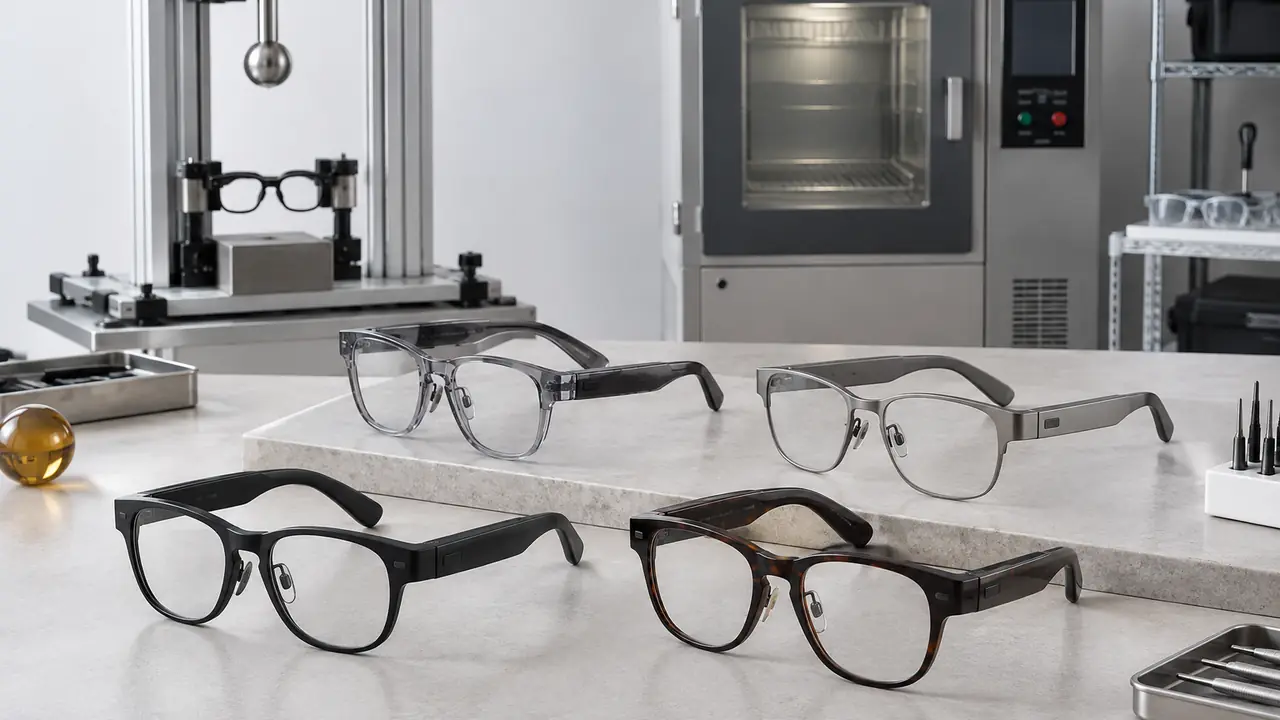
Three kinds of test on one order
A smart glasses order is tested in three ways. Lab tests are run by accredited test labs on samples and feed certification: radio, EMC, RF exposure, battery safety and lens optics. Reliability tests are run on samples from the engineering stage and, at an agreed frequency, from the batch: hinge cycling, bending, corrosion, water spray, drop and connector life. Production tests run on the line or at final inspection: acoustics, pairing, charging, runtime and firmware version. The three overlap, and the order's test plan lists which tests apply, how many units are tested, how often and what counts as a pass.
For every item, the number of cycles, durations and pass criteria are a stated working default, confirmed per order. Defaults give buyers a starting point; the final values depend on the product, the target market and the buyer's own standards, and they are written into the spec sheet before batch production.
The test item list
| Test item | Purpose | Where it is done | Cycles and criteria |
|---|---|---|---|
| Bluetooth RF and EMC | Spectrum and emissions for FCC Part 15 and EN 300 328 / EN 301 489 | Accredited lab | Per standard |
| SAR / RF exposure assessment | RF exposure near the head under FCC rules and EN 50566 / EN 62479 | Accredited lab | Per standard |
| Battery UN 38.3 and IEC 62133-2 | Transport and safety of the lithium-ion cells | Accredited lab | Per standard |
| Lens UV400 and transmission category | UV cut-off and Cat. 0-4 under ISO 12312-1 or ANSI Z80.3 | Lab, plus incoming checks | Per standard and lens spec |
| Drop ball impact | Lens impact resistance under 21 CFR 801.410 for the US | Lab or partner plant | Per regulation |
| Hinge open-close life | Durability of hinge and flex cable | Partner plant fixture | Stated working default, confirmed per order |
| Temple bending | Temple and board resistance to flexing | Partner plant fixture | Stated working default, confirmed per order |
| Salt spray | Corrosion of metal parts and contacts | Partner plant or lab | Stated working default, confirmed per order |
| Artificial sweat soak | Corrosion of charging contacts and finishes | Partner plant or lab | Stated working default, confirmed per order |
| IPX water spray | Water resistance to the stated IPX4-IP55 rating per IEC 60529 | Lab or partner plant | Per stated rating |
| Drop | Survival of a fall onto a hard surface | Partner plant | Stated working default, confirmed per order |
| Charging connector insertion life | Wear of magnetic pogo contacts and cable | Partner plant fixture | Stated working default, confirmed per order |
| Speaker frequency response and leakage | Sound against the golden sample, sound escaping to bystanders | Acoustic test box | Pass window per spec sheet |
| Microphone call noise reduction | Call pickup in noise, per firmware | Acoustic test box | Pass window per spec sheet |
| Runtime and standby | Playback, call and standby time against the spec sheet | Partner plant, sample basis | Stated working default, confirmed per order |
| Firmware stability and OTA | Long-run stability and a full update cycle | Partner plant and desk | Stated working default, confirmed per order |
Lab tests: radio, battery and optics
Lab tests are the ones that end up on certificates and test reports. Radio and EMC testing supports the FCC grant in the US and the CE declaration under the Radio Equipment Directive in the EU. RF exposure is assessed because the transmitter sits next to the head. Cells need a UN 38.3 test summary for transport and usually IEC 62133-2 for safety. Lenses are tested for UV cut-off and transmission category, and for the US the FDA drop ball impact test applies to glasses and sunglasses. Reports are issued by the lab to the partner plant or the brand; the desk checks that their scope matches the model. The route by market is on compliance and certifications.
Reliability and environmental tests
Reliability tests target the failure modes that drive returns. Hinge cycling and temple bending check the flex cable and the board; salt spray and artificial sweat soak target the charging contacts, which are the most common corrosion point; IPX spray checks the seals against the stated rating per IEC 60529, and the products are described as water-resistant, never as suitable for immersion. Drop and connector life tests complete the set. Typical failure causes are discussed in hinge breakage in smart glasses and sweat corrosion on smart glasses.
Production and performance tests
On the line, acoustic boxes compare each unit's speaker response and leakage with the golden sample and check microphone pickup. RF pairing, charging current and touch controls are checked per unit. Runtime and standby are measured on samples, because a full discharge test on every unit would take days; the figure is compared against the spec sheet, which states runtime as a typical range rather than a single promise. Firmware stability and a full OTA cycle are tested before release and again when firmware changes. Acoustic methods are covered in acoustic testing for smart glasses.
To agree a test plan for your order, send the brief through the quote form.