
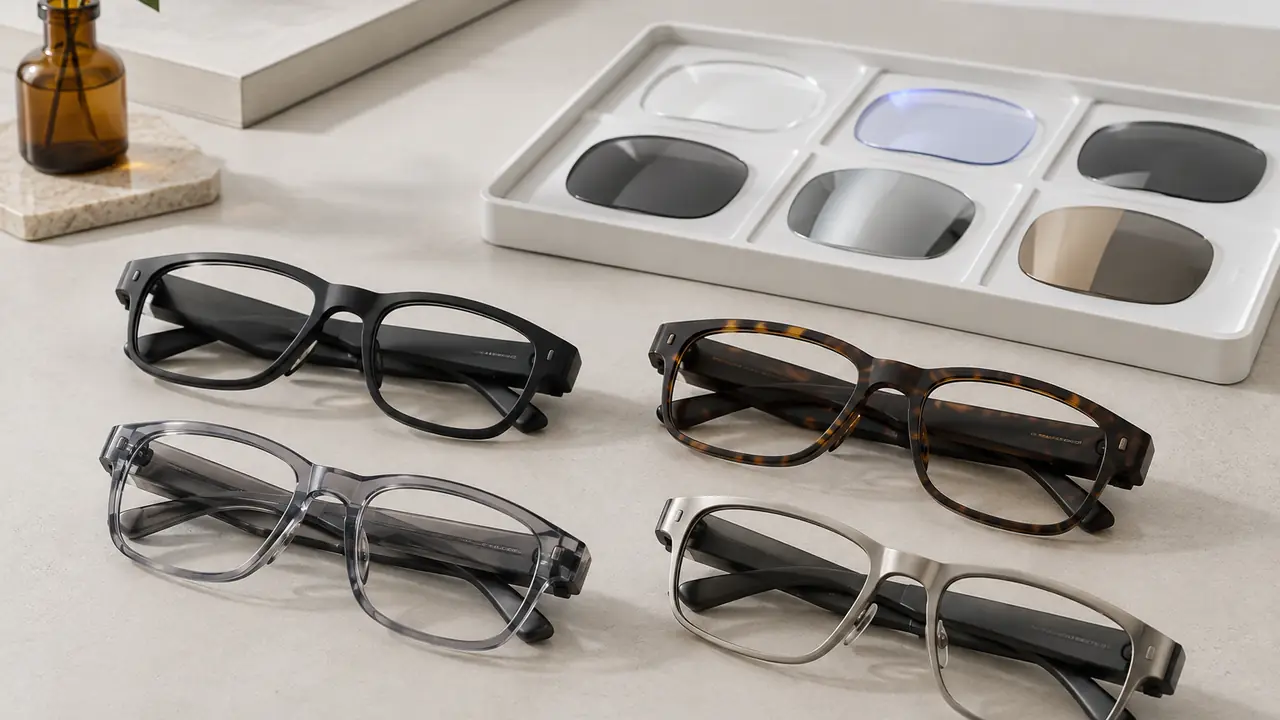
Why lenses need their own engineering
In a smart glasses program the electronics get most of the attention, but the lens is where the product meets optical regulation. A sunglass lens has to block ultraviolet light, transmit a defined amount of visible light, survive an impact test and be labelled with its category. A clear or filter lens still needs the impact test in the US. And because smart frames are thicker at the temples and often have a fixed front geometry, the lens shape, base curve and edge thickness must be agreed with the frame drawing before tooling. The desk treats the lens as a separate supply chain - most lenses come from Danyang in Jiangsu or Xiamen in Fujian - aligned with the frame and temple electronics in one spec sheet.
Lens types and what can be said about them
| Lens type | What it is | How to describe it honestly |
|---|---|---|
| Clear | Uncoloured lens, often with anti-reflective coating | Category 0 per ISO 12312-1 where applicable; impact tested |
| Blue-light filtering | Lens or coating that attenuates part of the blue band | Transmission curve per lens spec; no health claim |
| Polarized | Polarizing film in TAC, PC or nylon lens | Reduces glare from reflective surfaces; category per test report |
| Photochromic | Darkens under UV, clears indoors | Dynamic Cat. 0-3 per lens spec; slower in cold or behind glass |
| Rx-ready | Front designed for prescription lenses fitted by a lab | Lens power range and edging per lab |
Blue-light filtering lenses are a common request for office and kids lines. They are described by their measured transmission curve and nothing more; this site makes no health claim for them, and buyers should avoid claims in listings too. See blue light filtering lenses: what can honestly be claimed.
Materials: TAC, PC and nylon
Sun lenses in this category are usually one of three materials. TAC (cellulose triacetate) is the common choice for polarized lenses at the volume end: light, optically good and easy to laminate with a polarizing film, but less impact resistant than the others. Polycarbonate (PC) is tough and light, the usual answer when impact performance matters, though it scratches more easily without a hard coat. Nylon lenses sit between them with good clarity and flexibility and are often used in sports fronts. Coatings stack on top: hard coat, anti-reflective layers, mirror finishes and hydrophobic top coats. Each coating adds a step and a cosmetic inspection point, and mirror coatings on smart fronts should be checked for colour match between lenses from different lots. More in polarized lenses for smart glasses.
Photochromic and prescription lenses
Photochromic lenses darken in response to UV and clear indoors, moving dynamically through Cat. 0 to Cat. 3 per lens spec. Because the reaction depends on UV and temperature, they darken less behind a car windscreen and more slowly in heat, which should be stated plainly in product copy. For electrochromic lenses that switch electronically, ISO 12312-1:2022 includes a note on photosensitive epilepsy that the instructions should address.
Prescription lenses are not made by the frame plant. An Rx-ready front is designed so that an optician or lens lab can fit prescription lenses; the lens power range and edging depend on the lab and the front geometry. Some programs add magnetic or clip-in Rx inserts. The workflow is in prescription lenses for smart frames and on the prescription-ready line.
Standards and tests
In Europe, sunglass lenses follow EN ISO 12312-1, which sets UV requirements, defines transmittance categories 0 to 4 and requires Cat. 4 lenses to be labelled as not suitable for driving. In North America, ANSI Z80.3 covers non-prescription sunglasses and fashion eyewear, and in the US the FDA impact rule in 21 CFR 801.410 requires eyeglasses and sunglasses to pass a drop-ball test. UV400 is stated per lens spec and confirmed in the test report. The order-level test plan usually adds coating adhesion, abrasion, cosmetic inspection and a check that the lens stays in the front after the frame bend and hinge tests. Sampling sizes and limits are a stated working default, confirmed per order; the rules themselves are explained in lens categories 0-4 under ISO 12312-1.
Where lenses come from
Danyang in Jiangsu is the largest lens base in China: reporting puts annual output at more than 400 million pairs of lenses, about three quarters of national output and roughly 40 to 50 percent of global output depending on the source (People's Daily, CCTV and Securities Times, 2023), with more than 2,000 related companies (21st Century Business Herald, 2025). Xiamen in Fujian has more than 300 eyewear companies and is reported to supply over 80 percent of China's domestic mid to high-end sunglasses market (Xiamen investment promotion, 2025), with strength in polarized sun lenses. The desk chooses the lens source by type and aligns the lens drawing with the front. Replacement lens programs typically start at 500-1,000 pieces, confirmed in writing; the full table is on MOQ and lead time, and briefs go through the quote form.