
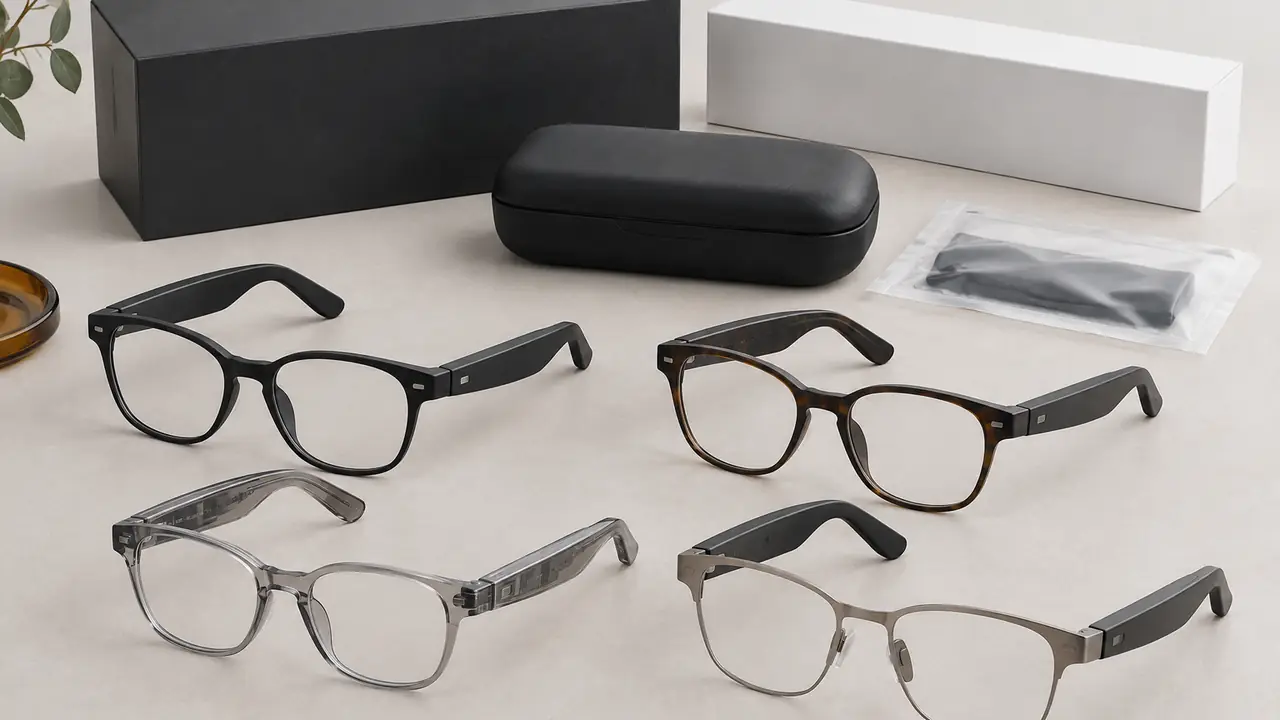
The packaging layers in a smart glasses program
A finished smart glasses unit usually ships in four or five layers, and each one is a separate specification on the program file. Getting the layers agreed early matters because packaging is often the last item to be approved and the first to delay a batch.
| Layer | Typical options | What to specify |
|---|---|---|
| Charging case or pouch | Hard case with charging contacts, soft pouch, folding case | Colour, logo method, whether it holds a battery (changes shipping, see below) |
| Insert tray | Moulded pulp, flocked plastic, card insert | Fit with temples folded, cable and cloth compartments |
| Retail or gift box | Rigid two-piece gift box, folding carton with window, sleeve over a plain box | Board grade, print method, finish, hang tab for peg display |
| Printed matter | Quick start card, multilingual manual, warranty card, safety leaflet | Languages, page count, content owner, regulatory text |
| Shipper carton | Inner carton of 10-50 units, master carton | Units per carton, drop test, carton marks and labels |
The brief should also say where the product will be sold. A box designed for an optical counter, a peg display in a store and a direct-to-consumer mailer are three different structures; the retail side is discussed in smart glasses in retail and the unboxing side in smart glasses packaging and unboxing.
Gift boxes, retail boxes and charging cases
Gift boxes suit brand owners and corporate gifting programs: a rigid two-piece box with a magnetic or lift-off lid, an insert that holds the glasses folded and a compartment for the charging cable. Retail boxes suit marketplace sellers, wholesalers and store chains: a folding carton is lighter, cheaper to ship and easier to print in several language versions. A sleeve over a plain inner box is a common middle option when one structure must serve several markets.
The charging case deserves its own decision. A protective case with no electronics is a packaging item. A case with a built-in battery that recharges the glasses is an electronic accessory: it needs its own battery documentation, its own marking and its own shipping classification. The desk flags this early because it changes the document set, as covered on the accessories line.
Barcodes, labels and manuals
Barcodes are issued to the brand by its numbering organisation; the partner plant prints the codes supplied, and the desk checks them on the packaging sample and again at pre-shipment inspection. Carton labels follow the packing specification: model, colour, quantity, gross and net weight, carton number and any retailer-specific marks you provide.
Manuals are where many programs slip. The quick start card and the full manual should cover pairing, charging, the meaning of the indicator lights, care around sweat and rain within the stated IPX4 or IP54 rating tested per IEC 60529, battery safety and disposal, and the regulatory statements for each market. Languages are set per market; the brand owns the content and the desk checks that the printed text matches the approved file. For lens models, the manual also carries the lens category and, for Category 4 lenses, the not-for-driving warning that ISO 12312-1 requires.
Battery marks, WEEE and regulatory text
Smart glasses are radio equipment with lithium-ion cells, so the packaging or the product usually carries several marks:
- United States: the FCC ID and the Part 15 statement on the product, in the manual, or electronically where permitted.
- European Union: CE marking under the Radio Equipment Directive 2014/53/EU; the crossed-out wheeled bin symbol for WEEE; battery information under EU Battery Regulation 2023/1542 as its requirements phase in; GPSR operator details on the product or packaging.
- United Kingdom and other markets: UKCA, MIC or KC marks where the program covers those markets, confirmed per project.
- Kids models: tracking information and the CPC route under CPSIA for the US.
Shipping marks for lithium batteries belong on the outer shipping package rather than the retail box, and are covered on logistics and shipping. Market-by-market routes are on compliance and certifications.
Quantities and timing for custom packaging
Custom printed packaging normally follows the logo route, with a typical minimum of 500-1,000 pairs per model, and the packaging sample is made with the logo sample in about 10-15 working days. Rigid gift boxes and special finishes add time to both sampling and production, so the desk asks for final artwork before the golden sample is signed. Figures are typical reference ranges, confirmed in writing for each program on MOQ and lead time. Send dielines, languages and target markets through the quote form.