
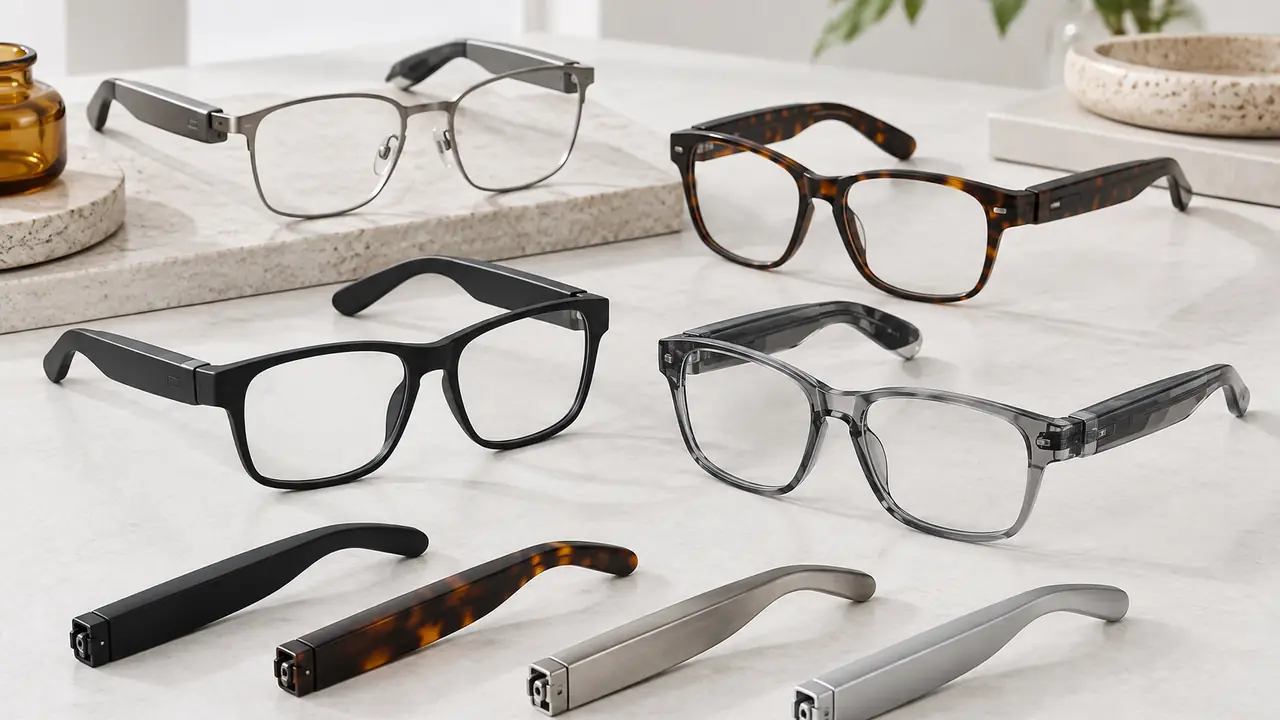
The frame is the enclosure
In ordinary eyewear, a frame only has to hold lenses and fit a face. In smart glasses the temples are enclosures: they carry a cell, a board, a speaker and microphones, and the front often carries antenna clearance, a camera or a light sensor. The frame material therefore decides more than look and feel. It sets the minimum wall thickness, how the two halves of a temple are joined and sealed against sweat, whether the Bluetooth antenna can radiate through the shell, and how much the temple can flex before stressing the parts inside. Finished pairs across the category weigh about 27 to 50 grams, and the frame is the part with the most room to save or add weight.
Material options compared
| Material | How it is made | Strengths in smart glasses | Watch points |
|---|---|---|---|
| TR90 (thermoplastic nylon) | Injection moulding | Light, flexible, radio-transparent; easy to mould hollow temple shells | New shape needs a new mould; paint or coating adhesion must be tested |
| Acetate | Cut from sheet, milled and polished; temples often moulded or inserted | Premium look, colour depth, adjustable by heating | Heavier; electronic temples are often a different material joined at the hinge |
| Titanium | Stamped, machined or wire-formed, then welded and finished | Thin, strong, comfortable front and bridge; good with nose pads | Blocks radio; antennas stay in plastic sections; longer process chain |
| Aluminium | CNC machining or extrusion, anodised | Rigid thin-wall temple shells, precise fit for modules, heat spreading | Blocks radio; needs plastic antenna windows; anodised edges show wear |
Many programs mix materials: a titanium or acetate front for look and adjustability, with TR90 or plastic-windowed aluminium temples for the electronics. The buyer's view of this choice is in TR90 vs acetate vs metal frames and TR90 vs titanium smart frames.
Injection moulding versus CNC
Injection moulding is the default for volume. A steel mould produces TR90 or other plastic temple shells with ribs, clips and screw bosses formed in one shot, at low unit cost once the mould is cut. The trade-off is up-front time: a new front or temple mould falls within the 25-45 days of tooling inside a typical 30-60 day ODM engineering sample stage. CNC machining starts faster and suits metal shells, small batches and engineering samples, but cycle time per part is longer and cosmetic consistency depends on finishing. For a full OEM program from 3,000 pairs per model, moulds are the normal route; mould ownership and storage should be agreed in writing, as covered in smart glasses tooling and molds.
Hinges and flexible circuits
The hinge is the most important mechanical part of a smart glasses pair. In most designs the two temples share one battery system or one main board, so a flexible printed circuit (FPC) runs from one temple through the hinge into the front and on to the other side. Every time the glasses are folded, that flex bends. The design levers are the bend radius allowed by the hinge geometry, the routing path, the copper and coverlay build-up of the flex, strain relief where it enters each temple, and the hinge itself - spring hinges help fit but add movement at the flex. Designs that put a complete system in each temple and link them wirelessly avoid the flex but need two cells and two charging contacts.
The failure mode is predictable: after repeated folding a trace cracks and one temple goes silent or stops charging. The test plan therefore includes hinge open-close cycling and temple bend tests with a functional check after the run. Cycle counts and pass criteria are a stated working default, confirmed per order. More in hinges and flex cables in smart glasses.
Surface finishes
Finishes carry both brand and durability risk. TR90 is usually spray-painted or coated in matte, gloss or soft-touch; acetate is polished; titanium is plated or coated; aluminium is anodised or sandblasted and anodised. The questions to settle are adhesion, resistance to artificial sweat and skin oils, salt spray for metal parts and colour matching between parts made in different plants. Soft-touch coatings feel premium but are the most sensitive to sweat over time. Finish options are compared in frame coatings and finishes.
Where frames come from
Frames and hinges come from China's eyewear clusters rather than from the electronics plants that build the temples. Local reporting puts about 1,200 eyewear businesses in Henggang, Shenzhen (another count gives more than 1,500 across Yuanshan and Henggang), making about 125 million pairs of mid to high-end eyewear a year, with hundreds of components able to be sourced within 24 hours (Shenzhen Special Zone Daily, 2025). Ouhai in Wenzhou is known for metal and sheet frames, hinges and export private label, with 595 eyewear enterprises and more than 60,000 workers reported in 2020 (China.com.cn). The desk's office is in Wenzhou, also home to the Ouhai eyewear cluster. The desk matches the frame source to the material and aligns the frame drawing with the temple electronics so that fit, hinge and flex routing are agreed before tooling. The cluster map is on industry clusters; to scope a new frame, use the quote form.