
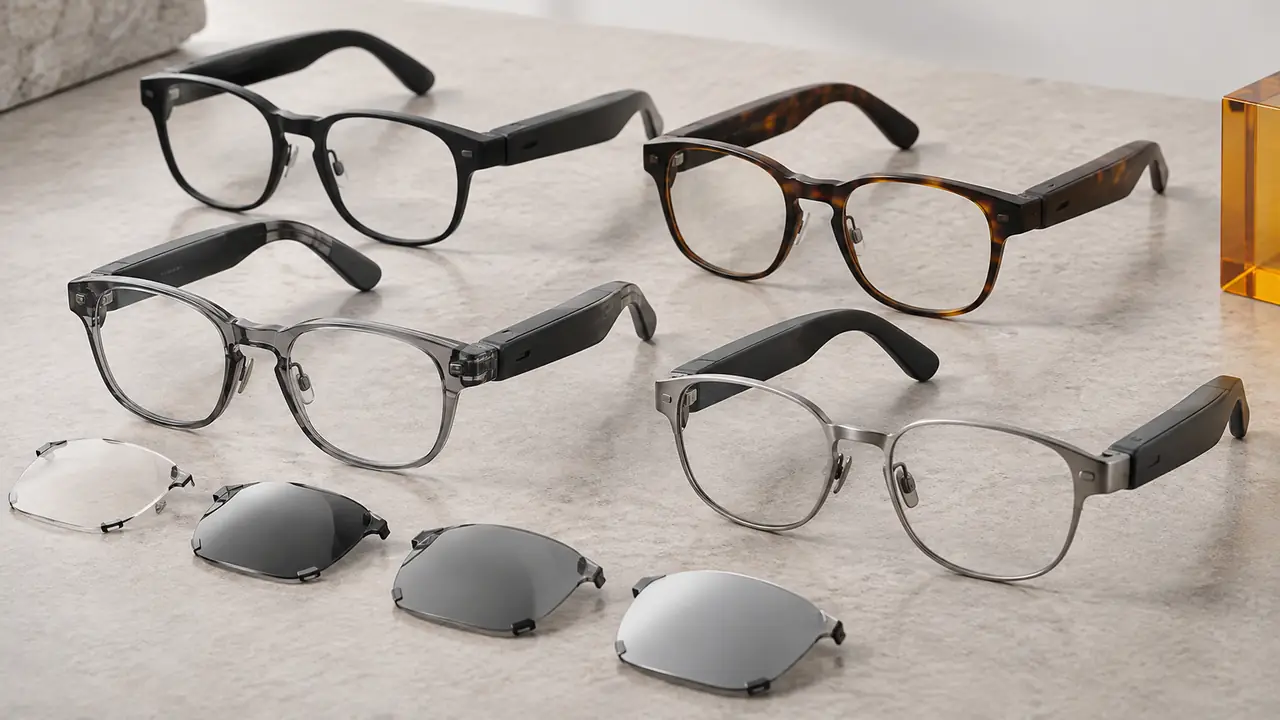
Why finish is harder on smart glasses
An ordinary frame is finished as one object by one frame plant. A smart frame is often finished in two or three places: the front by a frame plant in Shenzhen Henggang or Wenzhou Ouhai, the temple shells by the electronics assembler or its molding supplier in the Shenzhen area, and metal parts such as hinges and end pieces by a plating line. All of them have to match in colour and gloss under shop lighting, and all of them have to survive the same daily contact with skin, sweat, sunscreen and pockets.
The temples add two more constraints. Many smart glasses use a capacitive touch area on the temple, and the coating over it changes how the touch sensor responds. And the temples carry charging contacts and acoustic ports, where coating build-up or peeling causes functional faults, not just cosmetic ones. Finish is therefore part of the electronics specification as well as the look.
The main finishes compared
| Finish | Look and feel | Typical use | Watch points |
|---|---|---|---|
| Gloss lacquer | Shiny, deep colour, easy to clean | Fashion fronts, acetate-look molded temples | Shows scratches and fingerprints; gloss level must match across parts |
| Matte lacquer | Low sheen, technical look, hides fingerprints | Audio, sports and business lines | Can polish to a shine where the hand grips; colour shift between batches |
| Soft-touch coating | Rubbery, warm, premium feel | Temple shells, lifestyle audio frames | Can become sticky or wear through with sweat and sunscreen over time |
| Molded-in colour or texture | Colour in the material, textured tool surface | Kids and value lines, TR90 temples | Limited colour depth; tool texture must be maintained |
| Metal plating and coatings | Metallic colours, brushed or polished | Metal and titanium fronts, hinges, end pieces | Discolouration from sweat, especially at nose pads and temple tips |
Acetate fronts are a special case: their colour is in the sheet, and the finish is a polish rather than a coating, which is one reason acetate ages well. Molded temples paired with acetate fronts then have to be coated to match the polished look. The material side is compared in TR90 vs acetate vs metal frames.
How finishes age
Finishes rarely fail at unboxing. They fail after weeks of wear, which is why sample approval alone is not enough. The usual patterns are:
- Sweat and skin oils. Artificial sweat soak reveals coatings that soften, discolour or lose adhesion. Temple tips and nose pad areas see the most contact.
- Sunscreen and cosmetics. Some sunscreen and cosmetic ingredients attack soft-touch coatings and some lacquers, leaving sticky or dull patches.
- Abrasion. Pockets, cases and hands wear through coatings on edges and corners; matte finishes may turn shiny where they are handled most.
- Plating corrosion. Metal parts with thin or porous plating discolour or corrode, especially on sports lines; the salt spray item catches this.
- Contact contamination. Coating overspray or flakes near charging contacts cause charging faults; sweat residue makes it worse.
The functional side of sweat damage is explained in sweat corrosion on smart glasses.
Finish, touch controls and contacts
Capacitive touch sensors on the temple read a change in capacitance through the shell. The coating thickness and type sit between the finger and the sensor, so a change of coating, or uneven thickness from batch to batch, can make touch controls feel less responsive or trigger by mistake. Touch sensitivity is tuned per firmware for the finish actually used; if the finish changes after tuning, the tuning has to be checked again. The symptoms and fixes are in touch controls misfiring on glasses.
Charging contacts and acoustic ports need masking during coating. The spec sheet should state which areas are masked, the acceptable overspray limit around contacts and ports, and how masking is checked at incoming inspection of temple shells. Acoustic ports are a particular risk with thick soft-touch coatings, which can partly close a small port and change how the speaker sounds; acoustic checks should be repeated on coated shells rather than on bare engineering parts.
Finish choice also interacts with the water resistance rating. Gaps between coated temple halves, and the seal around buttons and ports, are part of what the IEC 60529 test checks, so a coating change that alters how the halves close can change the result. Products are described only as water-resistant per their IPX4 or IP54 rating as tested, and that test should run on parts with the production finish.
Colour matching across plants
Because the front, temples and metal parts are finished in different places, colour matching is a coordination job. The desk works with master colour samples approved by the brand and kept by each plant, checks parts side by side in a light booth under agreed light sources, and records colour and gloss acceptance against the master sample at incoming and pre-shipment inspection. The tolerance is a stated working default, confirmed for each order. New colours on a logo program follow this route; the private label scope is on OEM and private label.
Coatings and paints in skin contact also fall under chemical rules: RoHS for the electronic product as a whole, REACH SVHC declarations for coatings and materials in the EU, and the CPSIA requirements for children's products in the US where a kids line is involved. Partner plants supply material declarations per project, and the desk verifies them against the bill of materials.
Tests to specify and program impact
A finish section in a smart glasses test plan typically includes coating adhesion, abrasion, artificial sweat soak, salt spray on metal parts, resistance to common cosmetics where the line calls for it, and colour and gloss against the master sample after those tests. The number of cycles, durations and pass criteria are stated working defaults confirmed per order, and the whole plan sits within quality control.
A new colour or finish on a catalog frame is usually part of a logo program, typically 500 to 1,000 pairs per model with logo samples in 10 to 15 working days. A new texture in a molded tool or a new metal finish line can move the program toward full custom timelines. Reference ranges are confirmed in writing on MOQ and lead time. Send the finishes and colours you have in mind, ideally with physical references, through the quote form.