
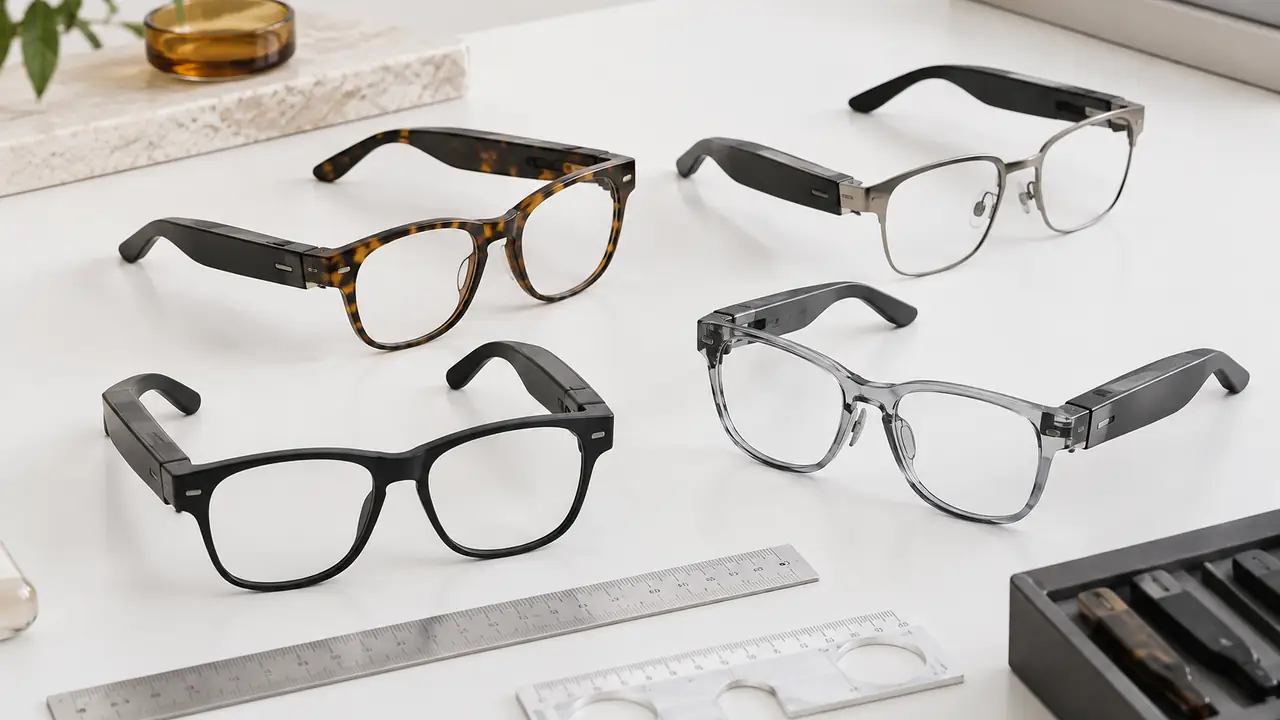
Frame size: three numbers that decide fit
Every frame carries three numbers, usually printed inside a temple: lens width, bridge width and temple length. Across smart glasses, typical values are a lens width of 48 to 56 mm, a bridge of 16 to 20 mm and a temple length of 140 to 150 mm, so a common mid-size pair reads 52-18-145. Smart frames are less forgiving than ordinary eyewear because the temples are thicker and stiffer: they hold cells and boards, so an optician cannot bend them freely to adjust fit. That makes the original size choice more important.
| Measure | Typical range | What it affects on a smart frame |
|---|---|---|
| Lens width | 48-56 mm | Overall front width, face coverage, room for an Rx lens |
| Bridge | 16-20 mm | Where the pair sits on the nose; nose pads widen the usable range |
| Temple length | 140-150 mm | Where the speaker sits relative to the ear and how the weight balances |
For audio models, temple length also positions the speaker port. If the port sits too far forward or back, perceived volume drops and leakage rises, which shows up as a sound complaint even though the cause is fit. A range that covers most adult faces usually offers two front sizes on the same temple, or one size with adjustable nose pads. Sizing detail is in smart glasses sizing.
Front materials: TR90, acetate, titanium
TR90 is a flexible thermoplastic that is light and tolerant of bending, which suits sports, kids and entry models. Acetate gives a richer, fashion-led look and depth of colour, at the cost of weight and a more involved finishing process; it is common in everyday and optical-retail models. Titanium and other metals give thin, light fronts with a technical look, but they are stiffer, more expensive to tool and need care where the hinge carries the flex cable.
| Material | Strengths | Watch points |
|---|---|---|
| TR90 | Light, flexible, wide colour range, good for wraps | Less premium feel; finish quality varies by plant |
| Acetate | Fashion colours and patterns, optical-retail look | Heavier; longer finishing; dimensional stability at the hinge |
| Titanium and metal | Thin, light fronts, technical look | Tooling is a bigger cost factor; hinge and flex routing; nickel content checks |
Frames come mainly from the Shenzhen Henggang and Wenzhou Ouhai clusters; the desk aligns the temple cavity with the electronics supplier before any mould is cut. More detail: TR90 vs acetate vs metal frames.
Lens categories under ISO 12312-1
ISO 12312-1 sorts sunglass and fashion lenses into five transmittance categories, Cat. 0 to Cat. 4, from almost clear to very dark. Cat. 0 and 1 suit indoor and overcast use, Cat. 2 and 3 are the everyday sunglass range, and Cat. 4 is for very bright conditions such as glaciers and high mountains. The standard requires Cat. 4 lenses to be marked as not suitable for driving, and the marking must appear on the product information. In North America, non-prescription sunglasses and fashion eyewear follow ANSI Z80.3, and the US also requires the impact-resistance drop-ball test under 21 CFR 801.410. UV400 labelling describes UV filtering on the lens spec; it is a structural fact, not a health claim.
Polarized, photochromic and Rx-ready lenses
- Polarized. A polarizing film cuts reflected glare from roads and water. Xiamen is a centre for polarized lens supply. Polarized lenses can make some phone and car displays look dark at certain angles, which is worth noting in the listing.
- Photochromic. Lenses that darken in UV light and clear indoors, typically moving across Cat. 0 to Cat. 3 per lens spec. Electrochromic lenses on display models carry the photosensitive epilepsy note that ISO 12312-1:2022 introduces.
- Rx-ready. Fronts designed so an optician or lens lab can cut and fit prescription lenses. The lens power range is per lab, and Danyang supplies much of the prescription lens volume.
- Filter lenses. Optional blue-light filtering lenses are offered as a lens option with no health claim attached.
Lens options by line are on lens options, and the prescription workflow on prescription-ready smart glasses.
Putting fit into the specification
A good spec sheet records the three size numbers, front material and finish, nose pad type, lens category, lens type, UV labelling and the optical standard for each target market, plus the drop-ball test for the US. Fit is then checked on the golden sample on several head sizes before the batch. Catalog fronts typically start at 50-500 pairs per model and new fronts with their own mould fall under full custom programs; all are typical reference ranges confirmed in writing for each program on MOQ and lead time. Send sizes and lens choices through the quote form.