
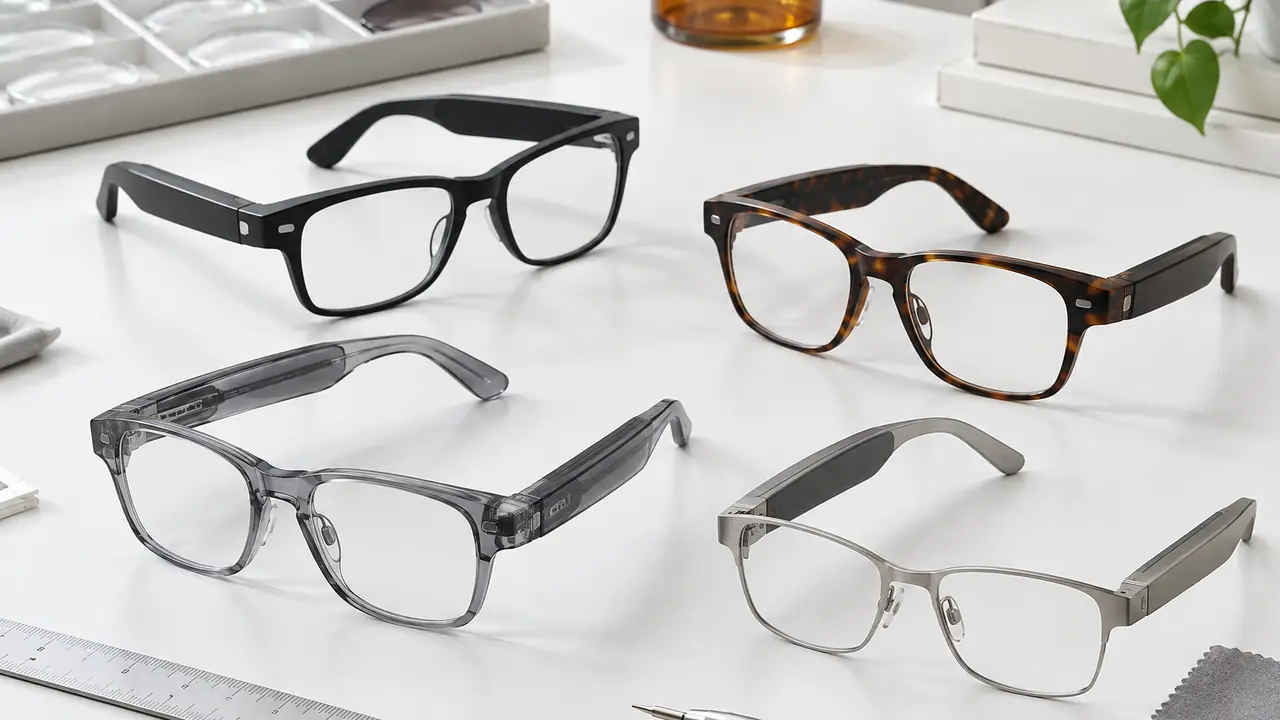
What Rx-ready means on a smart frame
A prescription smart glasses program does not ship finished prescription lenses. It ships an Rx-ready frame: a smart front and two electronic temples, with a lens groove or rim designed so an optician or lens lab can edge and glaze lenses made to each wearer's prescription. The supported lens power range depends on the lab, the lens material and the frame shape, so it is always stated per lab rather than as a property of the frame. What the frame program controls is geometry, rim depth, base curve and how the front behaves when a lab heats or flexes it during glazing.
The temples are the same modules used across the audio line: a Bluetooth audio SoC, two small cells, a directional open-ear speaker and microphones on each side. Because the electronics stop at the hinge, the front can be treated like a normal optical frame. The point the desk checks first is the hinge, since the flex cable that links both temples runs through it and must survive a lab's adjustment as well as daily wear. Background for buyers new to the topic is in smart glasses for glasses wearers.
Three ways to serve prescription wearers
Brands choose one of three formats, sometimes two in the same range. The table compares them.
| Format | How lenses are fitted | Strength | Watch point |
|---|---|---|---|
| Rx-ready fixed front | Optician or lab edges and glazes lenses into the front | Looks and wears like a normal optical frame | Front must tolerate heat and flex during glazing without stressing the hinge flex |
| Swappable front | Wearer keeps one temple set and changes fronts, Rx or sun | One electronics set serves several fronts | Connector or hinge latch wear; spare fronts need their own stock plan |
| Magnetic lens or clip-on | Rx insert or sun clip attaches to the front with magnets | Simple switch between clear and sun use | Magnet placement near the temple electronics and clip fit tolerance |
For optical retailers the fixed front is the natural fit, because it slots into the fitting service they already run. DTC brands often prefer the swappable front, since a wearer can order a second front without a second pair of electronics. Fronts and inserts as separate stock are covered under smart glasses accessories.
Frame sizes and fit
Rx-ready smart frames follow the same size conventions as optical frames, written as lens width, bridge and temple length. Across the category, common sizes run 48-56 mm lens width, 16-20 mm bridge and 140-150 mm temple length; a 52-18-145 mm frame is a typical medium. Smart temples are thicker and heavier than plain acetate temples, so the balance point sits further back, and the nose pads and temple tips carry more of the load. Finished pairs weigh about 27 to 50 grams before prescription lenses are added; high-power lenses add weight, which is one reason labs advise on lens material.
Two sizes of the same front, or adjustable nose pads and temple tips, cover most adult faces. The full sizing logic is on the lens and frame fit guide.
Where the lenses come from
Prescription lenses are a different supply chain from the electronics. Danyang in Jiangsu is the largest lens base in China: local reporting puts its output at more than 400 million pairs of lenses a year, roughly three quarters of the national total, with estimates of its global share ranging from about 40 to 50 percent depending on the source (People's Daily, CCTV and Securities Times, 2023). Its plants supply finished single-vision and other lens types, lens blanks and edging services, as well as photochromic and polarized lenses.
A program can go two ways. The brand or its optical partner can source lenses locally and receive only Rx-ready frames, which is common for optical chains. Or the desk can coordinate a Danyang lens partner for clear plano lenses and, where the market allows, stock lenses in standard powers. Either way, the frame plant and the lens supplier need the same base curve, rim profile and edging notes, and that alignment is what the desk manages. The process is described under lens options.
Tests and documents
The electronics follow the same route as any Bluetooth glasses: FCC Part 15.247 and Part 15 Subpart B for the US, CE under the Radio Equipment Directive with EN 300 328, EN 301 489, EN 62368-1 and EN 18031 for the EU, Bluetooth SIG qualification, and a UN 38.3 summary for the cells. Prescription lenses are generally regulated where they are dispensed, so the lab or optician that cuts them handles their documents. Plano lenses supplied with the frame follow ANSI Z80.3 or ISO 12312-1 as applicable, and the US drop-ball impact test under 21 CFR 801.410. Frame-specific tests on the order usually include hinge cycling, a glazing trial with a partner lab and temple adjustment after heating.
Quantities and timing are typical reference ranges, confirmed in writing for each program on MOQ and lead time. To brief the desk, use the quote form.