
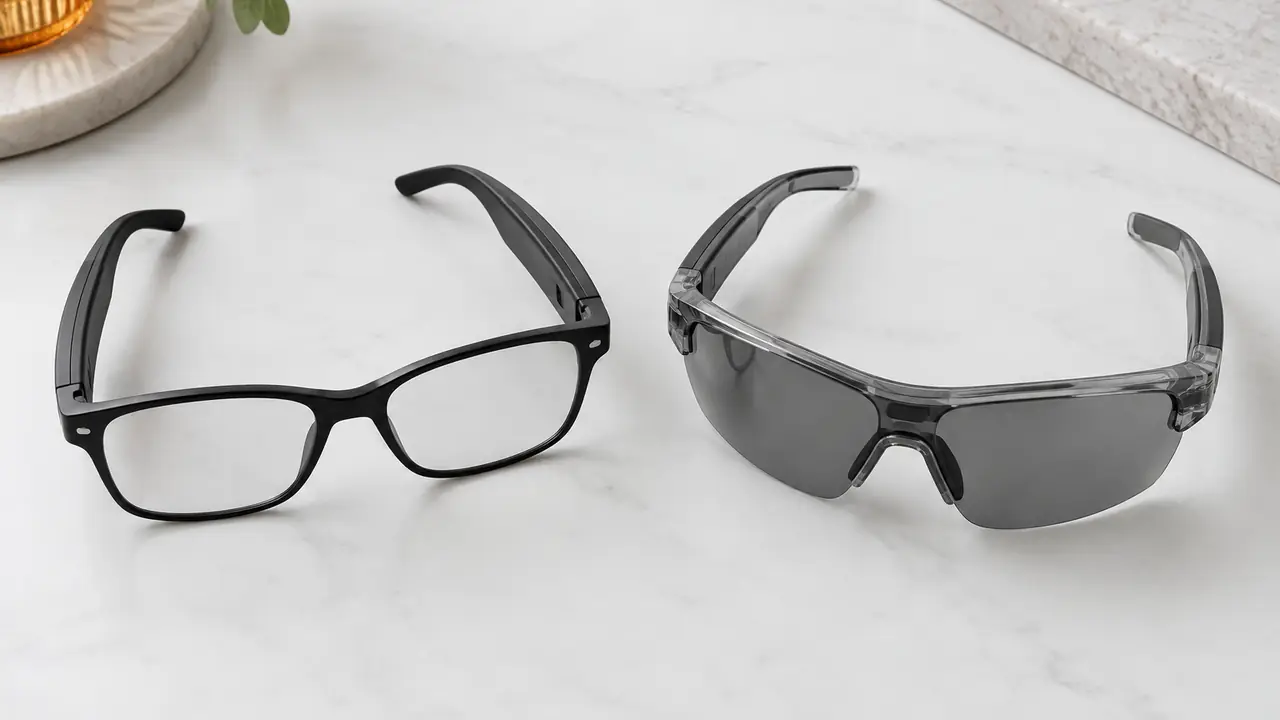
Two materials, two ways of making a frame
TR90 is a thermoplastic based on a nylon-type polymer, injection-moulded into fronts and temples. It is light, flexible and tolerant of being bent or sat on, which is why it is widely used for sports and kids frames. Colour is usually moulded in or applied by coating, and the material can be finished matte, gloss or soft-touch.
Titanium frames are metal. Fronts and temples are made from titanium or titanium alloy wire and sheet, shaped by stamping, bending and machining, then joined and finished by polishing, plating or coating. Titanium is strong for its weight, allows very thin profiles and gives a premium feel that suits office and optical retail.
On smart glasses the choice is never only about the front. The temples carry the battery, speaker, microphones and board, so they are almost always moulded plastic housings, whatever the front is made of. A titanium smart frame is in practice a titanium front, and sometimes titanium temple tips or cores, combined with plastic electronic temples. That hybrid is where most of the engineering effort goes.
Side-by-side comparison
| Dimension | TR90 | Titanium |
|---|---|---|
| Process | Injection moulding | Stamping, bending, machining, welding or brazing |
| Feel | Light, slightly flexible, warm to the touch | Light and rigid, thin profiles, cool metal feel |
| Flex and impact | Bends and returns; tolerant of rough use | Strong but can be bent out of shape; adjustable by an optician |
| Interaction with the antenna | Plastic does not shield radio signals | Metal near the antenna can detune it; layout matters |
| Hinge and flex cable | Moulded hinge seats; flex routed inside | Metal-to-plastic joint at the hinge needs careful design |
| Fit adjustment | Limited adjustment by heating | Optician can adjust fit more easily |
| Finishes | Moulded colour, matte, gloss, soft-touch coating | Polished, brushed, plated or coated |
| Main setup cost | Injection moulds for front and temples | Tooling for stamping and forming, plus joining and finishing steps |
| Typical lines | Sports, kids, mainstream audio | Business call, Rx-ready, premium office ranges |
The antenna row is specific to smart glasses and often overlooked. Bluetooth antennas are small and sit in or near the temples. A metal front or a metal temple core close to the antenna changes its tuning and can reduce range or cause dropouts. Programs using titanium keep metal away from the antenna area or retune the antenna on the actual frame, and verify range on the engineering sample.
Weight, feel and fit
Finished smart glasses across the category weigh about 27-50 grams per pair. Most of that weight is in the temples - the cells, speakers and board - so changing the front material changes the total less than many buyers expect. Where titanium helps is balance and profile: a thin front lets the overall look stay close to ordinary eyewear, which matters for office and optical channels. TR90 helps where flex matters: a sports frame that is pulled on and off with one hand, or a kids frame that gets dropped and bent.
Fit follows frame sizing. Common sizes run 48-56 mm lens width, 16-20 mm bridge and 140-150 mm temples. Titanium fronts are easier for an optician to adjust, which supports prescription smart glasses sold through optical retail. TR90 fronts rely more on choosing the right size and adding adjustable nose pads. The lens and frame fit guide explains size planning.
Cost drivers, not prices
The cost difference between the materials shows up in different places. A TR90 program needs injection moulds for the front and temples; for a custom shape that is a fixed setup cost, after which parts are quick to produce. Custom tooling usually sits inside the ODM engineering sample stage of 30-60 days, with moulds taking about 25-45 days. A titanium program needs forming tools and more process steps per part - cutting, forming, joining, polishing and finishing - so labour and yield weigh more heavily, and finish quality varies more between plants. Plating and coating also bring their own sweat and salt spray tests.
For buyers starting with a catalog model, the material is already fixed and no tooling is needed. Moving to a custom front in either material pushes the program toward full custom volumes, typically from 3,000 pairs per model, confirmed in writing per program. The note on tooling and molds covers timelines and ownership, and what drives smart glasses costs sets out the wider picture.
Sourcing clusters
Both materials are well served in China's eyewear clusters. Shenzhen's Henggang cluster produces mid- to high-end frames and complete eyewear, with local reporting putting it at around 1,200 eyewear companies; it is close to the Shenzhen electronics base, which helps when the frame and the temple electronics have to be matched. Wenzhou's Ouhai cluster is known for metal and acetate frames, hinges and export private label. The desk shortlists frame plants by material and finish and coordinates them with the electronics plant on a single spec sheet.
Durability testing differs by material and should be written into the order. For both, the usual items are hinge opening and closing cycles, temple bending, salt spray, artificial sweat immersion and drop tests, with the number of cycles and pass criteria set as a stated working default and confirmed per order. TR90 programs pay extra attention to colour stability and coating adhesion after sweat exposure. Titanium programs pay extra attention to plating wear at the nose pads and temple tips, and to the joint where the metal front meets the plastic electronic temple, because that joint carries the flex cable through the hinge. Results are checked on the golden sample and again on a batch sample during quality control.
Which to choose
Choose TR90 for sports, kids and mainstream audio lines where flex, low setup risk and colour range matter - it suits sports smart glasses and value tiers. Choose a titanium front for business, optical and premium ranges where a thin profile, optician adjustment and a metal finish justify more process steps, as on business call glasses. In either case, insist on antenna range testing on the real frame and on hinge cycle tests at the metal-to-plastic joint. Share the target channel and finish on the quote form.