
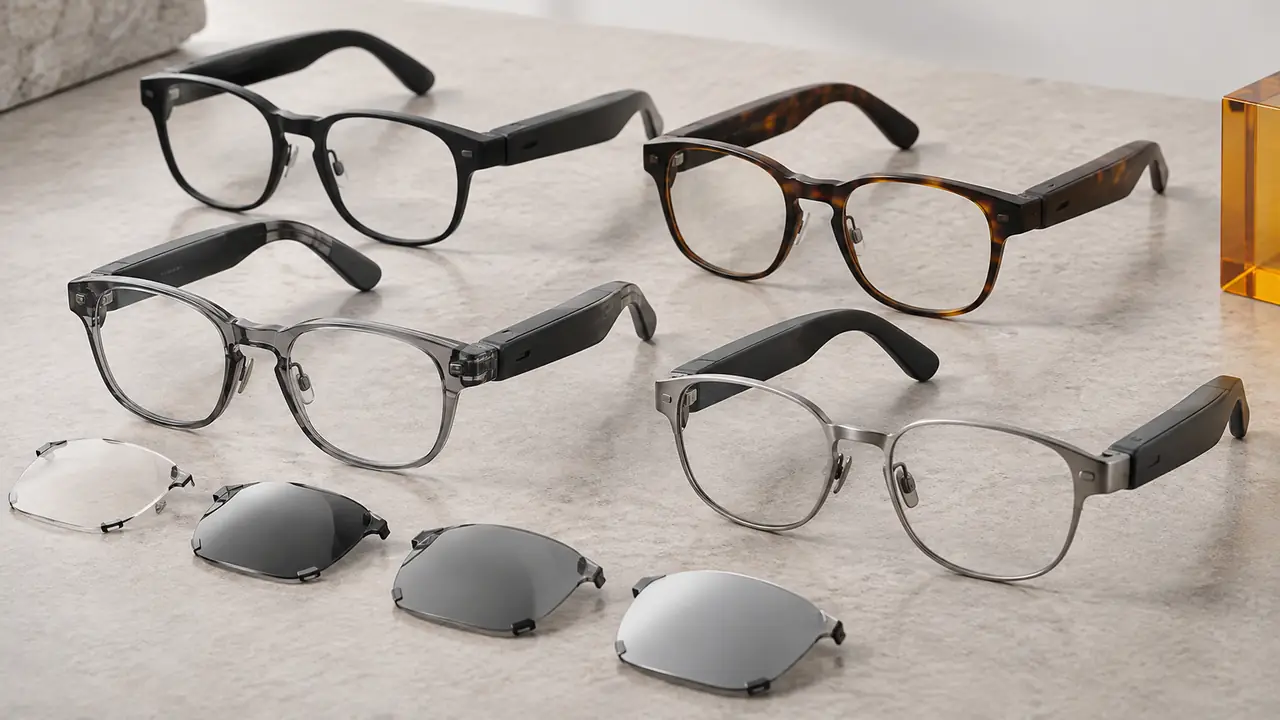
Why frame material matters more in smart glasses
In ordinary eyewear the frame material is mostly a question of look, feel and price band. In smart glasses it is also a structural decision. The temples have to hold a battery, a board, a speaker and microphones; the hinge has to pass a flexible circuit from one side to the other; and the front has to stay rigid enough that the lenses sit correctly while the wearer folds and unfolds the pair many times a day. A finished smart pair typically weighs 27 to 50 grams across the category, so every gram the frame saves is a gram the electronics can use, and every millimetre of wall thickness the material needs is a millimetre the temple has to grow.
Three material families cover almost every program: TR90 and similar injection-molded nylons, cellulose acetate, and metal - usually stainless steel, alloy or titanium - often combined with a plastic temple. Each has a different relationship with the electronics, and each comes from a slightly different corner of the eyewear supply base in China. The notes on frame materials go deeper on grades; this article is about the trade-offs a buyer actually decides.
The three materials at a glance
| Property | TR90 | Acetate | Metal or titanium |
|---|---|---|---|
| How it is made | Injection molded in a steel tool | Cut and milled from sheet, then polished | Stamped, machined or wire-formed, then plated or coated |
| Weight feel | Light | Heavier for the same shape | Light front; total depends on the temple |
| Flex | High, returns to shape | Low, adjustable with heat | Moderate; titanium springs back well |
| Housing electronics | Natural fit: the temple is molded as a hollow shell | Needs a separate inner housing or molded temple | Usually paired with a molded plastic temple shell |
| Colour options | Molded colour, paint or coating | Deep, layered colours and patterns in the sheet | Plating and coating colours |
| Custom tooling | Mold needed for new shapes | CNC programs for the front | Dies and fixtures for new shapes |
| Typical lines | Sports, kids, everyday audio | Fashion and Rx-styled fronts | Business and minimalist lines |
The table simplifies, but the pattern holds across most spec sheets the desk reviews: TR90 dominates audio and sports lines because the temple shell and the frame can be one molded system, while acetate and metal appear where the front has to look like premium optical eyewear.
TR90: light, flexible and made for molded temples
TR90 is a thermoplastic nylon-type material known in the trade for flexibility and low density. For smart glasses its main advantage is not the weight itself but the process. The temple is injection molded as two halves that close around the battery, board and speaker, with screw bosses, a channel for the flex cable and acoustic ports molded in. That makes TR90 the default for audio, sports and kids lines, where integrated temple shells and resilience in daily handling matter more than surface depth.
The trade-offs are cosmetic and dimensional. Molded surfaces look flatter than acetate unless they are coated, and thin sections can warp if the mold is not balanced. Material grade and drying matter as well: a plant that skips drying before molding gets brittle parts, which show up later as cracked hinge bosses. On an audit, ask how resin is dried and how incoming lots are recorded, and ask to see a temple shell after the temple bending test. The hinge is still metal in almost every TR90 smart frame; the note on hinges and flex cables explains where it tends to fail.
Acetate: depth of colour, and the electronics question
Cellulose acetate is the material most people picture when they think of a well-made optical frame: layered colours, tortoiseshell patterns and a warm, polished surface. It is cut from sheet and milled, so a new front shape needs CNC programs rather than a full injection mold, and an optician can adjust it with heat - useful for Rx-styled lines sold through optical retail.
The difficulty is the temple. Solid acetate temples cannot easily be hollowed to hold a battery and speaker with enough wall strength, so most acetate smart frames pair an acetate front with a molded temple shell, or embed an inner housing in a thicker acetate temple. Both approaches add weight compared with an all-TR90 design, and both create a joint where materials with different expansion behaviour meet. Ask the plant how the front-to-hinge joint is reinforced, and keep hinge fatigue and temple bending in the test plan rather than assuming that a heavier frame is a stronger one. Acetate fronts are a strength of the Wenzhou Ouhai cluster, where local reporting counted 595 eyewear enterprises in 2020 and exports to more than 100 countries.
Metal and titanium: thin fronts, strong hinge mounts, careful finishing
Metal fronts - stainless steel, alloys and titanium - give the thinnest rims and a clean, technical look that suits business and minimalist lines. They also make the strongest hinge mounts, because the hinge can be welded or riveted to a metal end piece rather than screwed into plastic. Titanium in particular springs back well after flexing and is light for its strength; the comparison TR90 vs titanium smart frames covers weight and cost drivers in detail.
Metal brings its own constraints. A metal front near the antenna can change Bluetooth performance, so antenna placement and the radio test should be done on the real front, not a plastic stand-in. Plating and coatings must survive artificial sweat soak and salt spray testing, because a frame that discolours at the nose pads is returned quickly. Metal temples are rarely used to house electronics directly; the usual design is a metal front with molded temple shells, which again creates a material joint at the hinge. Metal frame work is strong in the Shenzhen Henggang cluster, which local reporting describes as roughly 1,200 eyewear enterprises producing about 125 million mid-to-high-end pairs a year.
Choosing by line, channel and timeline
The material should follow the line and the channel, not the other way round. A short way to decide:
- Sports, kids and value audio lines: TR90 or a similar molded nylon, for weight, flex and integrated temple shells. Kids frames typically land under 30 grams per model.
- Fashion and optical-retail lines: acetate fronts with molded temples, accepting a little extra weight for colour depth and adjustability.
- Business and minimalist lines: metal or titanium fronts, with radio testing on the final front and a coating spec tied to sweat and salt spray results.
Material also changes the route and the timeline. Catalog models already have their materials fixed, which is one reason typical catalog quantities start around 50 to 500 pairs per model. A new molded front or temple is full custom work: typically from 3,000 pairs per model, with engineering samples in 30 to 60 days including 25 to 45 days for tooling. Those are reference ranges, confirmed in writing for each program on MOQ and lead time. Fit matters as much as material, so check the size table in the lens and frame fit guide before choosing a front. When the line, channel and material are clear, the quote form collects what partner plants need to shortlist frames.