
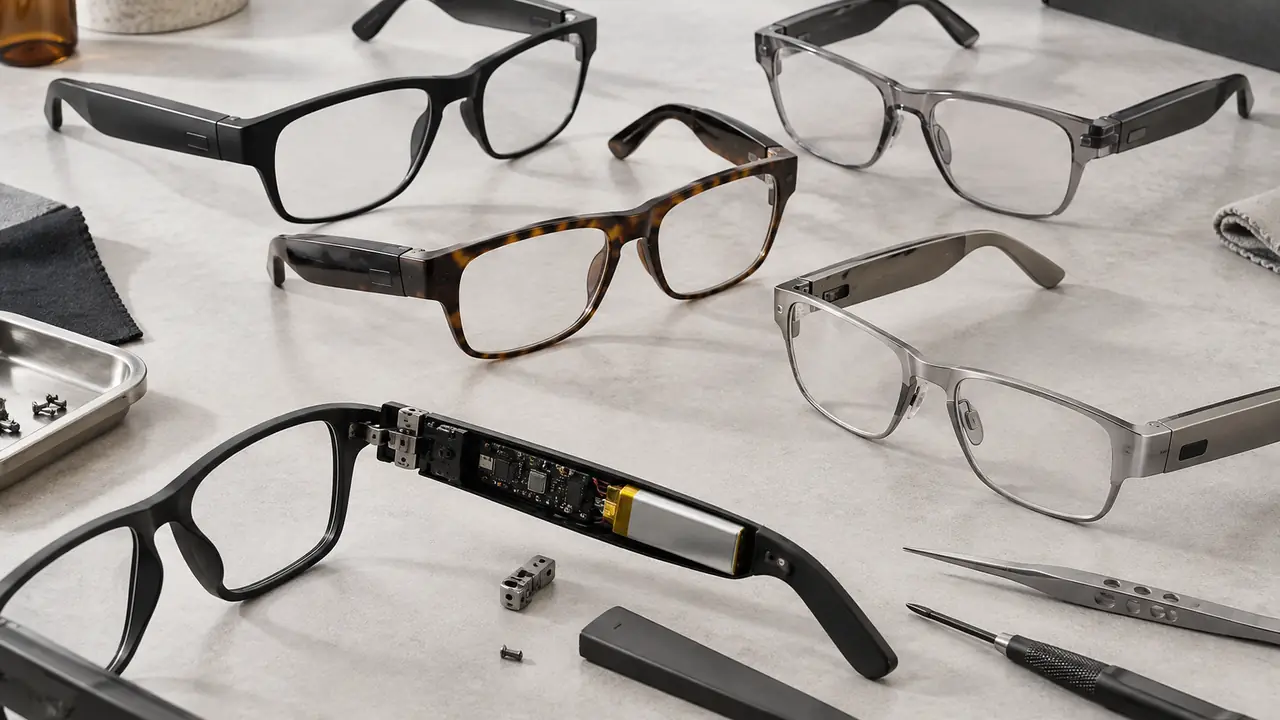
How hinge failures show up
Hinge problems arrive in several forms. The temple may snap at the hinge barrel after a drop or a sit-on; the hinge may loosen so the temple swings freely and the frame slides down the nose; the hinge may feel fine while one temple stops working, because the flexible circuit inside has cracked; or the screw may back out over a few weeks. Only the first is obvious to the customer as a breakage. The third is usually reported as 'one side has no sound' or 'only charges on one side', and support teams often misread it as a speaker or battery fault.
The reason is structural. Most smart glasses split the electronics between two temples - a cell, a speaker and microphones on each side, with the main board on one. Power and audio must cross from one temple to the other through the front, and that means passing through two hinges. Each time the glasses fold, the flex circuit or fine wires bend at the hinge. The hinge is therefore an electrical part as much as a mechanical one.
Root causes
| Layer | Typical root cause | Typical result |
|---|---|---|
| Design | Flex bend radius too tight at the hinge; no strain relief; hinge stop that allows over-opening | Flex cracks after repeated folding; one temple dies |
| Design | Hinge barrel or boss too thin for the temple's weight and leverage | Barrel cracks on drop or sideways load |
| Materials | Frame plastic grade or wall thickness below spec; metal hinge plating poor; screws without thread lock | Cracks at moulded bosses, corrosion, loosening |
| Assembly | Flex pinched or twisted during assembly; screw torque inconsistent; adhesive in the hinge gap | Unit-specific failures in a lot |
| Use | Glasses pushed up on the head, removed with one hand, stored folded under load, sat on | Bent temples, over-opened hinges |
Smart temples are heavier than ordinary ones because they hold cells, drivers and boards, so the leverage on the hinge is greater. Spring hinges, which let the temple flex outward, reduce stress on wide heads but add parts and need room for the flex. Frame material also matters: TR90 and similar nylon blends flex without cracking; acetate and metal behave differently; the trade-offs are in TR90 vs acetate vs metal frames.
Field triage for returns
- Look before testing. Photograph the hinge on both sides: cracks, white stress marks in plastic, a gap between barrel and front, a protruding screw.
- Check the swing. Open and close each temple. Note whether it is loose, gritty or opens past its normal stop.
- Power both sides. After charging, play audio and check that both temples produce sound and that both indicator lights behave as expected.
- Flex while playing. With audio playing, slowly fold and unfold each temple. Sound that cuts in and out at a particular angle points to a cracked flex or wire.
- Ask about the event. A drop, a sit-on or a sudden failure after normal use point to different causes. Record the answer.
- Record the lot. Note serial number and lot so a pattern in one production batch can be traced.
A cluster of intermittent one-side failures within one lot usually means an assembly issue - pinched flex or wrong routing. A pattern across lots after months of use points to a design limit in bend radius or hinge strength, which is a change for the next engineering round.
Keep the returned units. A cracked flex is often invisible from outside, and the plant can only confirm the cause by opening the temple. Sending a handful of failed units back with their photos, lot numbers and the customer's description lets the plant section the hinge area and see whether the crack sits at the bend, at a solder joint or where the flex leaves the board. That evidence decides whether the corrective action is an assembly fixture, a routing change or a new flex design.
Spec lines that prevent it
- Hinge type and materials. Name the hinge type (standard or spring), the hinge metal and plating, screw type and the use of thread lock.
- Flex routing and bend radius. Ask the plant to show the flex path through the hinge on the engineering sample and confirm the minimum bend radius agreed with the flex supplier.
- Opening stop. Require a positive stop that prevents over-opening beyond the design angle.
- Hinge cycle test. Specify a hinge open-close endurance test with an electrical check at the end, with the cycle count as a stated working default confirmed per order.
- Temple bend test. Specify a temple deflection test and a check that both temples still work afterwards.
- Drop test. Include a drop test from an agreed height on a stated surface, with a functional check after.
- Spare parts. Decide whether replacement temples or hinge screws are part of the after-sales plan; see warranty and spare parts planning.
Inspection and test items
The checks below are the desk's typical working default, confirmed per order; the frame side of the process is on frame materials and the lot routine on testing and inspection.
- Hinge cycling on samples from each lot, followed by audio and charging checks on both temples.
- Visual and tactile check of every sampled unit: hinge swing, screw seating, gaps, stress marks.
- Audio continuity while folding and unfolding.
- Temple bending and drop tests on samples at the golden sample stage and after any material or supplier change.
- Salt spray on metal hinge parts where the range is aimed at outdoor or coastal use.
For eyewear sold in the United States, the lenses and frame are also subject to the drop ball impact test under 21 CFR 801.410, which concerns lens impact resistance rather than hinge life; the scope is explained in the FDA drop ball test.
Bringing it into the program
Hinge durability links three supply chains: the frame plant in Shenzhen Henggang or Wenzhou Ouhai, the hinge and screw suppliers, and the temple electronics from Shenzhen. A failure often sits at the interface between them - a flex designed by the electronics team routed through a hinge designed by the frame team. The desk's job is to put both on one drawing and one test plan. MOQ and lead time for a new hinge or frame tooling follow the custom route on MOQ and lead time; the quote form asks which frame material and size range you have in mind.