
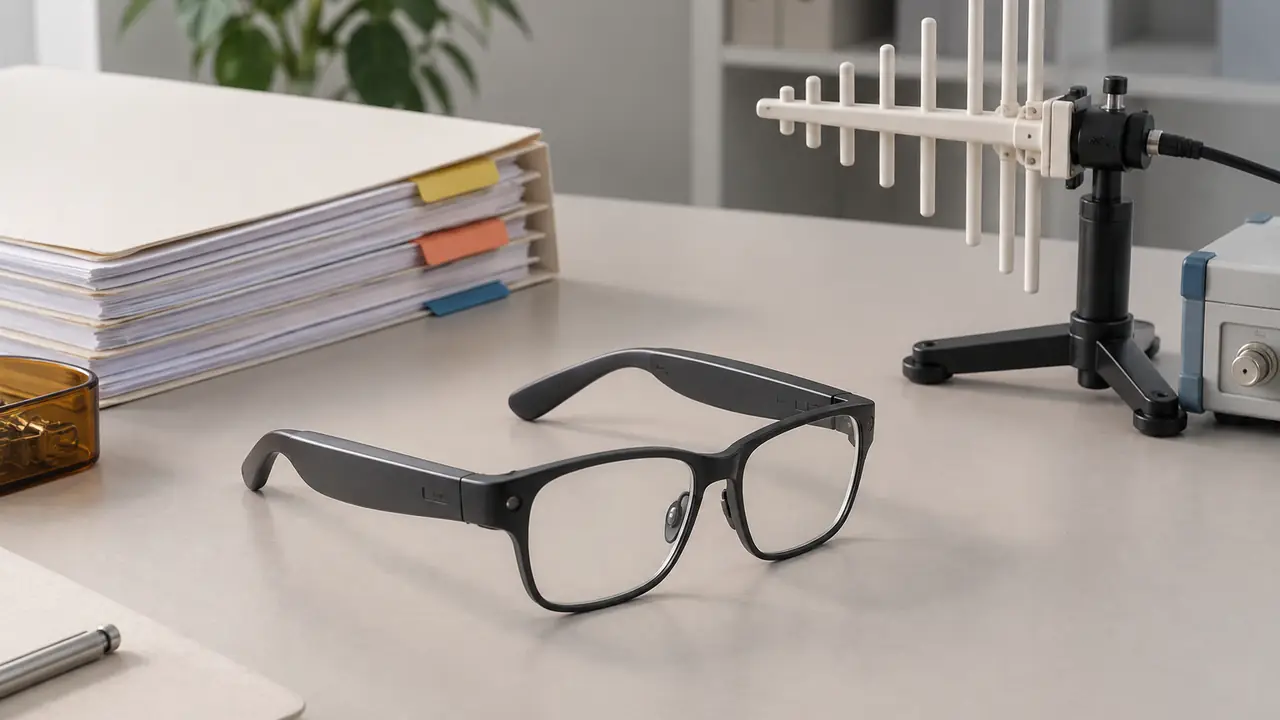
Three regulatory areas in one product
A pair of smart glasses falls under three sets of rules at the same time. As a radio product, it needs authorisation for its Bluetooth transmitter and evidence that it does not disturb other equipment. As a product with built-in lithium-ion cells, it needs battery safety and transport testing. As eyewear, its lenses must meet the optical and impact rules for glasses and sunglasses in each market. On top of these sit materials rules, take-back rules, and for children's models, children's product rules.
Certificates and test reports are issued by accredited test labs to the partner plant or to the brand, per project. Templora does not hold certificates in its own name. The desk plans the route, coordinates the samples and documents, and verifies that each report covers the model, firmware and configuration actually being bought. It does not give legal conclusions: final scope should be confirmed with your test lab, customs broker or counsel.
Route by market
| Market | Radio and EMC | Battery | Optics and other |
|---|---|---|---|
| United States | FCC Part 15.247 for the 2.4 GHz transmitter with an FCC ID; Part 15 Subpart B for digital circuitry; RF exposure under 47 CFR 1.1307, 1.1310 and 2.1093 | UN 38.3 for transport; IEC 62133-2 commonly requested | ANSI Z80.3 for non-prescription sunglasses and fashion eyewear; 21 CFR 801.410 drop ball impact; CPSIA with a CPC for children's models up to 12 |
| European Union | CE under RED 2014/53/EU: EN 300 328, EN 301 489-1 and -17, EN 62368-1, EN 50566 or EN 62479; cybersecurity under EN 18031-1, -2 and -3 | EU Battery Regulation 2023/1542; UN 38.3; IEC 62133-2 | EN ISO 12312-1 for sunglass lenses; RoHS 2011/65/EU; REACH SVHC; WEEE; GPSR |
| United Kingdom | UKCA route for radio equipment, confirmed per project | UN 38.3; IEC 62133-2 | Optical and materials rules confirmed per project |
| Japan | MIC radio certification (TELEC), confirmed per project | UN 38.3 for transport | Confirmed per project |
| South Korea | KC certification, confirmed per project | UN 38.3 for transport | Confirmed per project |
| All markets | Bluetooth SIG qualification with a QDID or Declaration ID for the brand | UN3481 under PI 967 Section II by air | Labels and user instructions per market |
Radio and cybersecurity
In the US, the transmitter is authorised under FCC Part 15.247 and the label carries the FCC ID with the Part 15 statement. In the EU, CE marking under the Radio Equipment Directive covers spectrum, EMC, electrical safety and RF exposure. Since 1 August 2025, Article 3(3)(d), (e) and (f) of RED also apply cybersecurity requirements: Delegated Regulation (EU) 2022/30 names glasses as wearable radio equipment, and the harmonised standards are EN 18031-1, -2 and -3. From 11 December 2027 these requirements pass to the Cyber Resilience Act, under Delegated Regulation (EU) 2026/339. Bluetooth SIG qualification is a separate listing that the brand needs to use the Bluetooth name on its product. Detail is in RED cybersecurity and EN 18031.
Battery safety and transport
The cells inside the temples need a UN 38.3 test summary before the product can be shipped, and IEC 62133-2 is commonly requested by buyers and platforms as evidence of battery safety. By air, the glasses ship as lithium-ion batteries contained in equipment, UN3481, under PI 967 Section II: each cell at or below 20 Wh and each battery at or below 100 Wh, with lithium battery marks and the waybill statement. IATA guidance recommends a state of charge at or below 30 percent. In the EU, the Battery Regulation 2023/1542 adds labelling and other obligations. Charging cases with their own battery are assessed per Wh. See battery and charging.
Optics, materials and children's products
Sunglass lenses are tested under EN ISO 12312-1 in Europe, which sets UV requirements and transmission categories 0 to 4; Category 4 lenses must be labelled as not suitable for driving. In North America, ANSI Z80.3 covers non-prescription sunglasses and fashion eyewear, and the FDA drop ball impact test under 21 CFR 801.410 applies to glasses and sunglasses. Materials are covered by RoHS and REACH SVHC declarations in the EU, with WEEE take-back and GPSR general safety duties. Children's models sold in the US fall under CPSIA, with a Children's Product Certificate and lead and phthalate testing. Lens choices are on lens options.
Timing and documents
Lab testing for FCC and CE typically takes 3-6 weeks per lab and scope, and it runs outside the batch lead time. The document set shipped with each order lists the reports and declarations that apply, matched to the model and firmware; quantities and timing follow MOQ and lead time. The order-level test list is on testing and inspection. To plan the route for your market, use the quote form.