
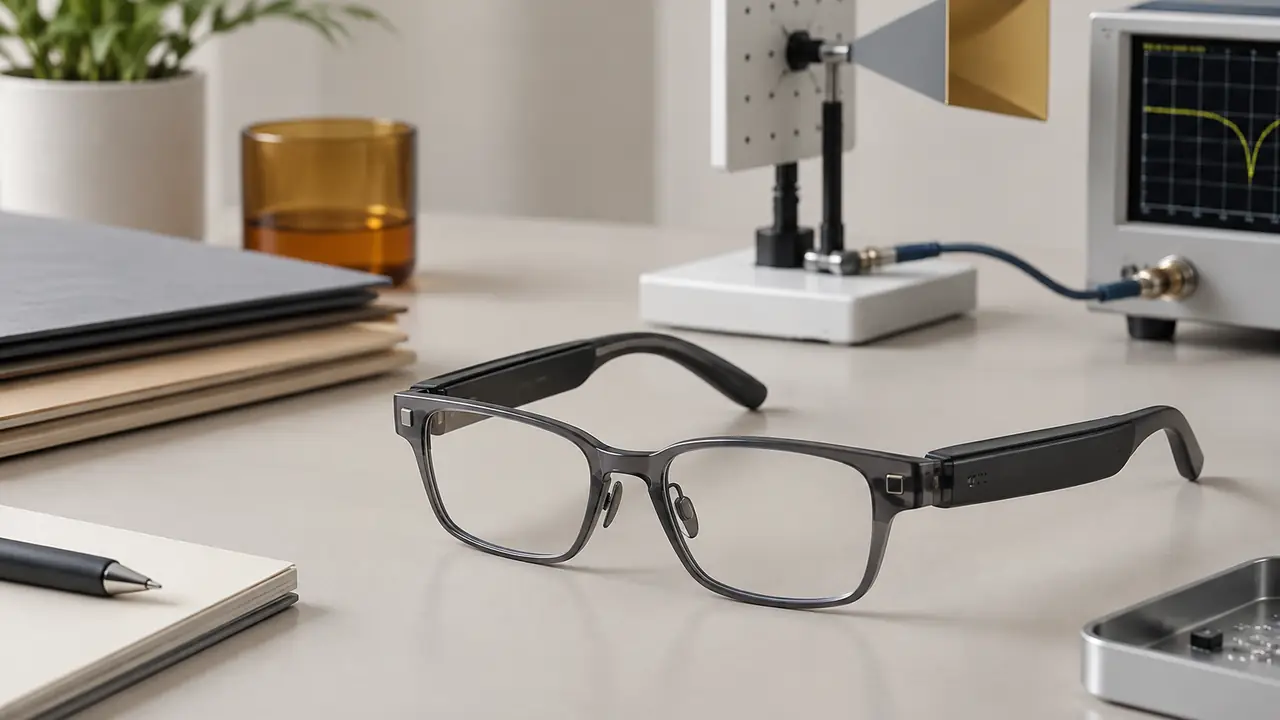
Why optical standards apply to smart glasses
A pair of audio glasses with tinted lenses is, from the point of view of eyewear rules, a pair of sunglasses that happens to contain a speaker. A pair with clear lenses is fashion eyewear. Either way, the lenses sit in front of the wearer's eyes, and regulators and retailers expect them to meet the same optical rules as ordinary eyewear. Electronics test labs do not always cover this side, so it is often handled by a separate optical lab or by the lens plant's own test file.
Two standards come up most. ANSI Z80.3 is the American standard for nonprescription sunglass and fashion eyewear. EN ISO 12312-1 is the European standard for sunglasses and related eyewear for general use; the current edition is ISO 12312-1:2022. Both deal with how lenses filter light, how they are labelled and how the finished pair is built. In the US, the separate FDA impact rule, 21 CFR 801.410, also applies; it is covered in the drop ball test note.
Filter categories 0 to 4
EN ISO 12312-1 sorts sunglass lenses into filter categories by how much visible light they let through. The bands are defined in the standard; the table summarises how they are typically used in smart glasses ranges.
| Category | General description | Typical use in smart glasses ranges |
|---|---|---|
| 0 | Clear or very light tint | Clear lenses on office, call and Rx-ready fronts; optional blue-light filtering lenses (no health claim) |
| 1 | Light tint | Fashion tints, the light state of many photochromic lenses |
| 2 | Medium tint | General sunglass lenses on audio and commuting models |
| 3 | Dark tint | Sports and outdoor lenses, polarized options |
| 4 | Very dark tint | Rare in this category; must carry the warning that it is not suitable for driving |
The category 4 warning is the rule most often missed. The standard requires category 4 lenses to be marked as not suitable for driving, and the warning has to reach the user through the product information. Most smart glasses ranges stay within categories 0 to 3 for this reason. Photochromic lenses move between categories as they darken, so their labelling depends on the range the lens covers per its spec; see photochromic lenses in smart glasses.
UV, labels and the 2022 edition
Both standards set requirements for ultraviolet transmittance alongside visible light. Many lens plants also mark lenses UV400, an industry label that refers to filtering ultraviolet up to 400 nanometres. UV400 is useful shorthand on a spec sheet, but it is not a substitute for a test against the standard for the target market; the label should be backed by a lens test report. The label's meaning is explained in UV400 on smart glasses lenses.
The 2022 edition of ISO 12312-1 also addresses lenses whose tint changes electrically. For electrochromic lenses it includes a note relevant to photosensitive epilepsy, because a lens that flickers or changes quickly could be a trigger. This is relevant to some AR and display programs and to any design that dims lenses from the app. Programs considering electrochromic lenses should ask the lab how the 2022 edition treats them before the design is fixed.
Frame construction and the finished pair
Optical standards are not only about lens material. They also look at the finished pair: whether lenses are free of defects that would distort vision, whether the frame holds the lenses securely, and whether materials in contact with the skin are suitable. Smart glasses add complications here. Temples are thicker and heavier than on ordinary frames, which changes balance and how lenses sit; fronts often carry a hinge with a flexible circuit; and some ranges use interchangeable magnetic fronts. These designs should be tested as finished pairs rather than as lens blanks, and the samples should be built on production parts. The frame side is covered on frame materials.
Prescription use is a separate route. Rx-ready fronts are designed so an optician or lens lab can fit prescription lenses, and those lenses follow the prescription eyewear rules in each market rather than the sunglass standard. A brand selling Rx-ready frames should make clear in product information who fits the lenses and under which rules.
Who tests, and what to ask for
In practice, lens test reports usually come from the lens plant, often in the Danyang or Xiamen clusters, and cover the lens type, tint and coating. A brand building a range should ask for reports that match the exact lens specification used in production, including tint, polarization and coating, rather than a generic report for the material. Where a range has several lens options, each option needs its own evidence.
The supply chain makes this a coordination task. The temples come from electronics plants around Shenzhen, the fronts from frame makers in Henggang or Wenzhou's Ouhai cluster, and the lenses from Danyang or Xiamen. The optical test file has to describe the lenses that are actually fitted at final assembly, so the desk ties lens part numbers on the spec sheet to the lens plant's reports and checks them again when a lens supplier or coating changes.
- List every lens option by material, tint, filter category, polarized or photochromic, and coating.
- Request a report per option against EN ISO 12312-1, ANSI Z80.3 or both, depending on the markets.
- Check labels and manuals for the filter category and, where relevant, the category 4 driving warning.
- Add the impact test under 21 CFR 801.410 for the US.
- Verify per lot during inspection that the shipped lenses match the tested option.
The full certification map is in the certifications checklist. Lens test timing sits beside the ranges on MOQ and lead time, and the quote form asks which lens options and markets you plan, so the desk can request the right reports at sampling stage. As always, confirm the scope and labelling for your markets with your test lab.