
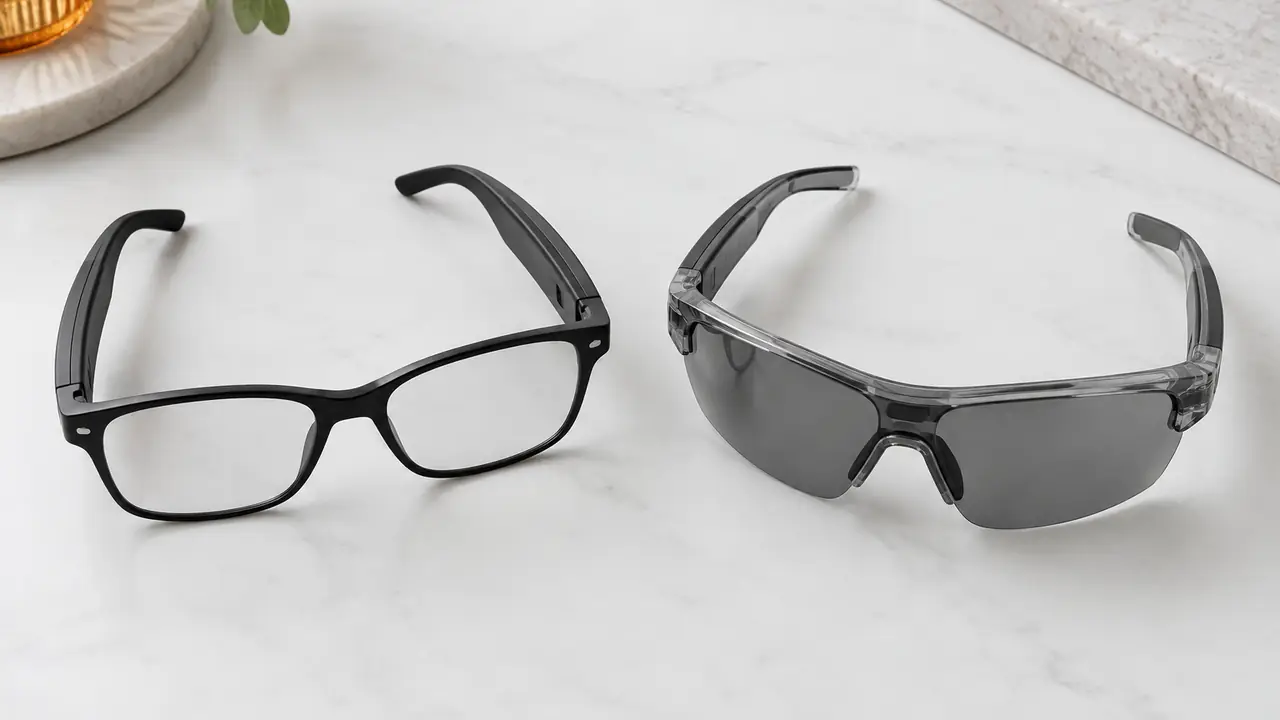
Two different lens technologies
A polarized lens contains a filter layer that blocks light vibrating in one direction. Light reflected from flat surfaces such as water, wet roads, snow or a car bonnet is largely polarized horizontally, so a lens with a vertical polarizing filter cuts that glare sharply. The tint itself is fixed: a polarized lens is as dark indoors as it is outdoors.
A photochromic lens changes its tint. Molecules in the lens material or coating darken when exposed to ultraviolet light and fade back when the UV level drops. A photochromic lens can be close to clear indoors and darken to a sunglass tint outside, moving across transmission categories, commonly Cat. 0 to Cat. 3 depending on the lens spec. It does not, by itself, filter polarized glare.
Both technologies are available on smart glasses fronts, and both can be combined with UV400 filtering. Some lens suppliers also offer polarized photochromic lenses that do both, at a higher lens cost and with more complex specification. The choice between them is less about which is better and more about which customer the line is for.
Side-by-side comparison
| Dimension | Polarized | Photochromic |
|---|---|---|
| What it does | Cuts reflected glare from flat surfaces | Darkens with UV, fades indoors |
| Tint | Fixed, set by lens category | Dynamic, commonly Cat. 0-3 per lens spec |
| Indoor use | Too dark for most indoor wear | Close to clear indoors on most specs |
| Behind a car windscreen | Works; glare reduction unaffected | Darkens less, because many windscreens block much UV |
| Phone and dashboard screens | Some screens look dim or dark at certain angles | No polarization effect on screens |
| Speed of change | Not applicable | Darkening and fading take time and depend on temperature |
| Common materials | TAC, PC and nylon polarized lenses | Photochromic PC, nylon and other substrates per supplier |
| Standards to cite | ISO 12312-1, ANSI Z80.3, UV400 per test | Same, with category range per lens spec |
| Best fit | Fishing, water, driving, cycling, snow | All-day wear, commuting, in-and-out use |
Two rows cause most complaints. Polarized lenses can make some phone screens, car displays and bike computers look dark when tilted, which matters on a product that is controlled with a phone app. And photochromic lenses are often bought for driving and then disappoint, because the windscreen blocks much of the UV that triggers darkening. Both points belong on the listing.
Standards, categories and labels
Sunglass lenses in Europe follow EN ISO 12312-1, which sets UV requirements and transmission categories from Cat. 0 (very light) to Cat. 4 (very dark). A Cat. 4 lens must carry a marking that it is not suitable for driving. In North America, non-prescription sunglasses and fashion eyewear follow ANSI Z80.3, and in the US eyeglasses and sunglasses also need the impact resistance drop ball test under 21 CFR 801.410. For photochromic lenses, the category is stated as a range across the faded and darkened states. ISO 12312-1:2022 also includes a warning relating to photosensitive epilepsy for electrically switched tint lenses, which matters for AR and electrochromic fronts rather than for UV-activated photochromic lenses.
UV400 is a common label for lenses that block UV up to 400 nm; it should be backed by a test report for the lens supplied. The details are in lens categories under ISO 12312-1 and UV400 explained.
Sourcing and range impact
Lenses for smart glasses come mostly from two Chinese clusters. Danyang in Jiangsu is the largest lens base, with local reporting putting output at more than 400 million pairs of lenses a year, including prescription, photochromic and polarized lenses. Xiamen in Fujian is strong in mid- to high-end sunglasses and polarized lenses. A program coordinates the lens plant with the frame and temple electronics plants so the lens shape, edge thickness and front groove match the frame and the hinge flex is not stressed during glazing.
For range planning, lens choice multiplies SKUs fast. Two frame sizes in two colours with three lens options is twelve SKUs before packaging variants. Many brands control this by offering one sun lens as the default and selling the others as replacement lenses or interchangeable fronts, which also gives customers a reason to come back. Replacement lens programs typically start at 500-1,000 pieces, per reference range confirmed in writing per program.
Lens choice also affects testing. Each lens variant needs its own UV and transmission results, and photochromic lenses add a check of the faded and darkened states. Plan these into the sample stage so they do not delay the batch.
The smart glasses context adds two practical checks that ordinary sunglasses do not need. First, lenses are glazed into a front that carries a flex cable or sits close to the hinge electronics, so edge thickness and the fitting process must not put stress on the hinge area; the lens plant and the frame plant agree the groove and lens shape before samples. Second, many listings show the pair being used with a phone app, so the lens has to work with the screens customers will look at. A short test of the app on two or three common phone screens through a polarized lens, at several angles, takes minutes and avoids a recurring review complaint. For photochromic lenses, a simple outdoor and indoor timing check on the golden sample gives the listing an honest description of how quickly the tint changes.
Which to stock
Stock polarized lenses when the line is for water, driving, cycling or snow - the customer is mostly outdoors and glare is the problem. Pair them with a note about screens and test the app screen and common bike computers with the lens. Stock photochromic lenses when the line is for all-day wear and commuting, where the customer moves in and out of buildings and wants one pair. They suit photochromic smart glasses and office or travel ranges. For sports smart glasses, polarized is the usual default with photochromic as an option. If the budget allows only one, choose by channel: outdoor and sports retail leans polarized, optical and lifestyle retail leans photochromic. Logo programs typically start at 500-1,000 pairs per model, as a reference range confirmed in writing per program on MOQ and lead time. List the lens options you want on the quote form and the desk will match lens suppliers to the frame.