
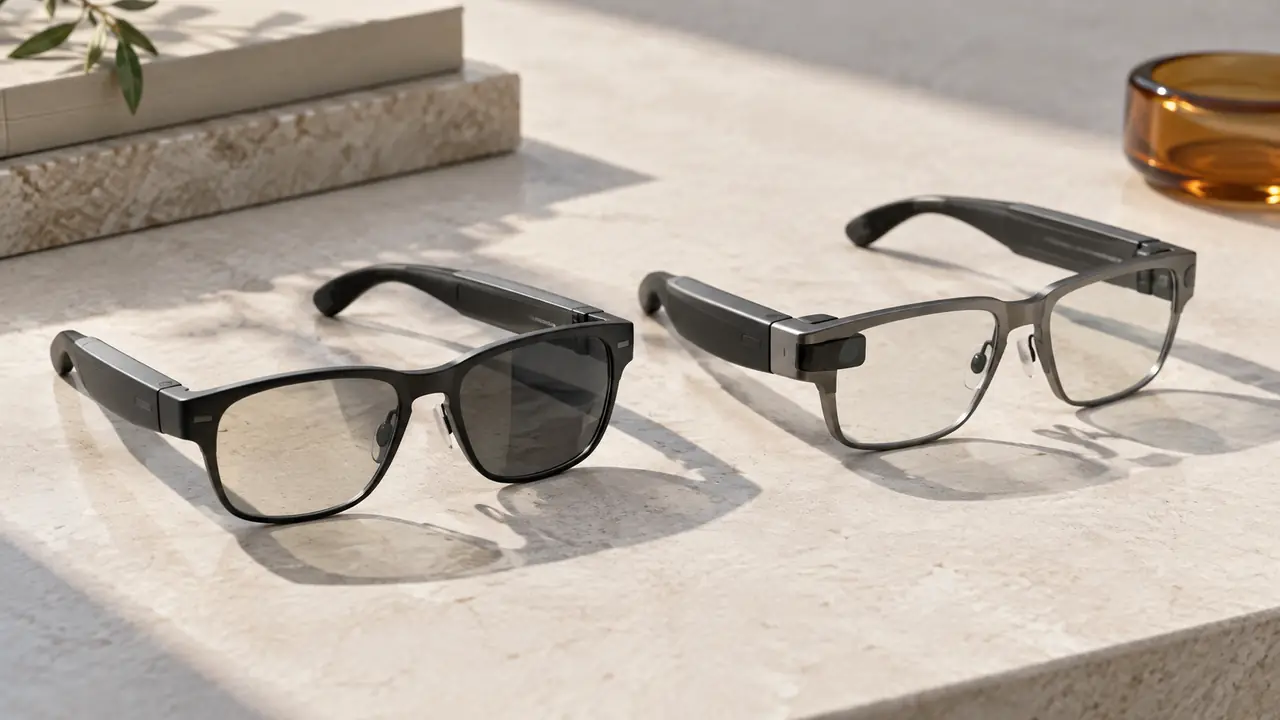
Two routes on one line
This line covers two different technologies that buyers often group together because both change the view through the lens. The first is the photochromic lens: a lens that darkens under ultraviolet light and clears again indoors. Across the category, photochromic lenses move dynamically within Cat. 0 to Cat. 3 under ISO 12312-1, per the lens spec. Built on an audio or translation platform, they give a brand one pair for indoor and outdoor wear without swapping fronts. The second is the display or AR model: a small display module and optical combiner that place text, navigation arrows or translation captions in the wearer's field of view, as a monocular or binocular head-up display.
The two can be combined, but they are specified, tested and costed differently. Display models remain a small share of the market: Omdia reported that AI and AR glasses with a display rose from 3.3% to 8.4% of AI glasses shipments in 2025, roughly 730,000 units. For most brands the photochromic route is the lower-risk entry, while display models suit programs with a clear use case and a longer timeline. The difference is set out in AR glasses vs AI glasses.
On the supply side, photochromic lenses come from the Danyang and Xiamen lens clusters, fronts from the Shenzhen Henggang and Wenzhou Ouhai eyewear clusters, and temple electronics and display modules from Shenzhen. The desk aligns lens curve, edging and front geometry with the temple electronics in one program, so the lens supplier and the frame plant work from the same drawing and the same golden sample.
Photochromic, electrochromic and display options
| Option | How it works | Typical reference range | What to check |
|---|---|---|---|
| Photochromic lens | Lens darkens under UV, clears indoors | Cat. 0-3 dynamic per lens spec | Category marking, behaviour behind a car windscreen, UV400 |
| Electrochromic lens | Lens tint switched electrically by the glasses | Tint steps per lens spec and firmware | ISO 12312-1:2022 warning items, power draw, switching behaviour |
| Monocular HUD | Display in one lens, usually right side | Per program | Weight balance, brightness outdoors, content readability |
| Binocular HUD | Display in both lenses | Per program | Weight, heat, runtime, alignment between eyes |
| Birdbath optics | Curved combiner reflects a micro-display | Per program | Thickness, see-through brightness |
| Waveguide optics | Light guided through a thin lens plate | Per program | Tooling, yield, cost drivers, Rx compatibility |
Lens choices and their standards are covered on lens options, and display optics on HUD, birdbath and waveguide basics.
Optical standards and the electrochromic warning
Sunglass-type lenses follow EN ISO 12312-1 in Europe and ANSI Z80.3 in North America, with the FDA drop-ball impact test under 21 CFR 801.410 for the US. ISO 12312-1 sets transmittance categories from Cat. 0 to Cat. 4 and requires a not-for-driving marking for Cat. 4; photochromic lenses on this line stay within Cat. 0-3 per lens spec. A further point applies to electrochromic lenses, whose tint is switched electronically: ISO 12312-1:2022 includes a photosensitive epilepsy warning for this lens type. The user information and packaging must carry the required wording, which your test lab should confirm against the current edition.
Display models: weight, power and content
A display module adds a micro-display, a driver, optics and more power draw to a frame that must still feel like glasses. Buyers should fix in the spec the target weight and balance, outdoor brightness, how content reaches the display (phone app, SDK or both), and which data the app sends to the cloud. Radio and cybersecurity rules follow the rest of the family: FCC Part 15, CE RED 2014/53/EU with EN 300 328, EN 301 489, EN 62368-1 and EN 18031, Bluetooth SIG qualification, plus UN 38.3 and IEC 62133-2 for the cells. Display content often includes captions from translation or notifications, so privacy terms for the app belong in the same spec block as for other AI lines.
Program route
Photochromic models usually start from a catalog audio or translation platform with a lens swap, at 50-500 pairs per catalog model or 500-1,000 pairs with a logo. Display models are typically ODM programs: engineering samples in 30-60 days including tooling, and batches in 45-75 days excluding certification queues, from 3,000 pairs per model. These are typical reference ranges, confirmed in writing for each program on MOQ and lead time. To brief either route, use the quote form.