
The short answer
A blue light filtering lens reduces the share of short-wavelength visible light that passes through it. That is a measurable optical property, and a transmittance curve from a test lab can show it for a specific lens. Everything a smart glasses brand prints about the lens should be traceable to that curve or to the lens construction. Statements that go further - anything about what the lens does for the person wearing it - are health claims, and Templora programs sell blue light filtering lenses with no health claim at all.
This is not caution for its own sake. Health claims on eyewear can change how a product is regulated, can require evidence that a lens plant cannot supply, and are a frequent reason for listing removals and advertising complaints. A lens option that is described accurately sells perfectly well on its own terms: a slightly different tint, a filtered band shown on a curve, and a choice for people who prefer it.
How a blue light filtering lens is built
Lens plants use two main approaches, often combined. Each leaves a visible signature on the lens, which is useful because the customer can see what they are buying.
| Construction | How it filters | Visible signature | Watch points |
|---|---|---|---|
| Absorber in the lens material | A dye or absorber in the monomer absorbs part of the blue band | A slight yellow or amber tint | Stronger filtering means a stronger tint and more colour shift |
| Reflective coating | A multilayer coating reflects part of the blue band | A blue or violet reflection on the lens surface | Coating adhesion and scratch resistance after sweat soak |
| Combined | Absorber plus coating | Light tint plus surface reflection | Both report lines and both cosmetic standards must be agreed |
The physical trade-off is unavoidable: filtering part of the blue band changes colour rendering. A lens with a stronger filter looks warmer and shifts colours, which matters for anyone doing colour-critical work. That trade-off is a fact worth telling buyers, because it explains why the filter level is a choice rather than a case of more being better.
What the test report can support
The right evidence is a spectral transmittance curve for the lens as supplied, measured by the lens plant or a test lab and verified by the desk against the golden sample. From that curve, and from the construction, a listing can honestly state the following.
- The lens filters part of the blue band of visible light, as shown in the transmittance curve in the test report.
- The lens uses an absorber, a reflective coating or both, and has a slight tint or a visible surface reflection.
- The lens also blocks UV radiation up to 400 nm, if and only if the UV line in the same report supports a UV400 label; see UV400 explained.
- The lens is offered as an option with no health claim.
Be careful with single percentage figures. A phrase like blocks a given percent of blue light means nothing without the wavelength band and the weighting used, and different labs and lens plants compute it differently. If a percentage is printed at all, it must come from the report, state the band it refers to and match the lens in the box. Most programs are safer printing the construction and a reference to the curve than a headline number.
What should not be printed
The other side of the line is just as clear. Any statement about effects on the wearer's body, comfort, rest or long-term condition is a health claim. That includes softer phrasing that implies benefit without stating it, and it includes claims made through images, icons or comparison charts rather than words. Templora programs do not use health claims for blue light filtering lenses, on any line, in any market.
| Claim type | Example basis | Used in Templora programs |
|---|---|---|
| Construction | Absorber in lens material, reflective coating | Yes |
| Measured optics | Transmittance curve in the test report | Yes, with the band stated |
| UV blocking | UV line in the same report | Yes, only if the report supports UV400 |
| Appearance | Tint and reflection seen on the golden sample | Yes |
| Health claims of any kind | Would need clinical evidence and may change regulatory status | No |
Why so strict? Depending on the market, a lens marketed with health claims may fall under medical device rules or require substantiation under advertising law, and marketplaces apply their own policies on top. None of that is a legal conclusion for your case; confirm the wording for each market with counsel. The point is that the construction-and-curve approach works everywhere without changing the product's status.
Where blue light lenses fit in smart glasses ranges
In smart glasses, blue light filtering lenses usually appear as an option rather than a line in their own right:
- Business and call glasses. Office users who wear audio glasses at a desk all day often choose a clear lens with a filtering coating; the line is on business call glasses.
- Kids smart glasses. The kids line offers UV400 lenses and an optional blue light filtering lens with no health claim, alongside screen-time reminders in the parent app per firmware and volume limits per firmware. Details are on kids smart glasses.
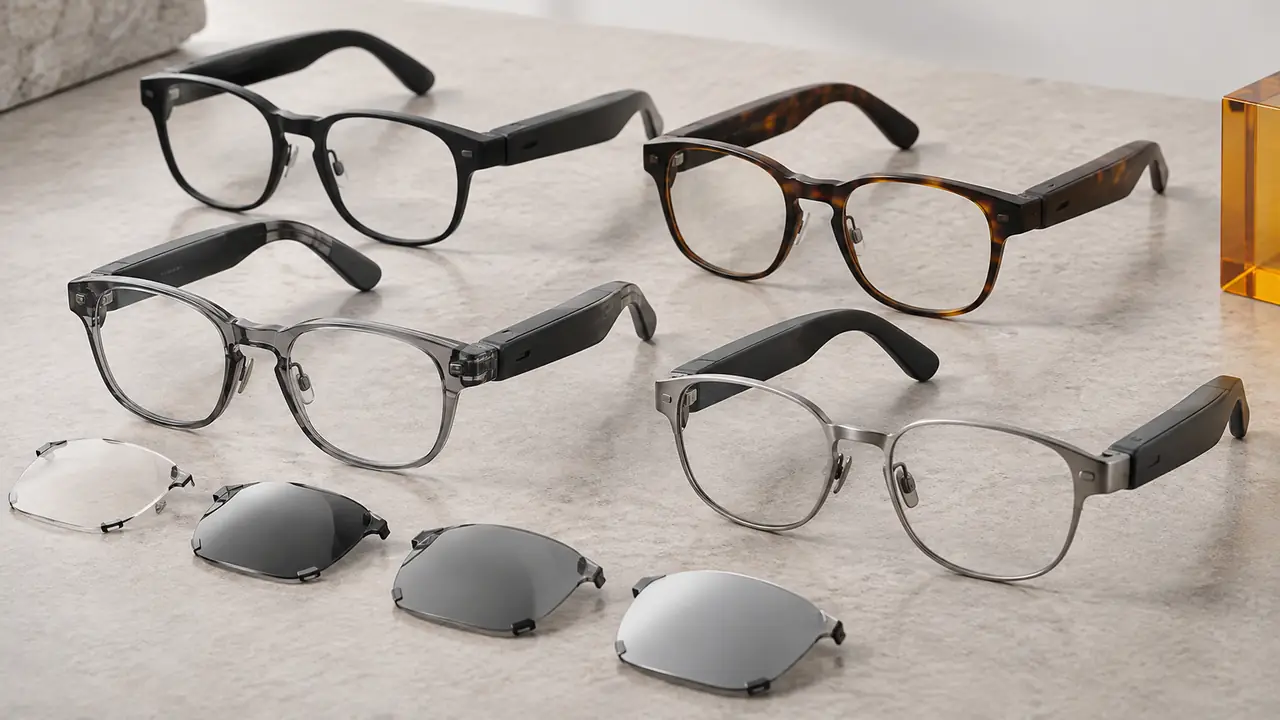
- Replacement lens sets. A filtering clear lens is a natural member of an interchangeable set next to polarized and photochromic lenses.
For listings, describe the option the way the spec sheet describes it: construction, tint, curve reference and UV line. The note on smart glasses listing content shows how to lay out lens options so buyers can compare them.
Adding the option to a program
On catalog fronts, a blue light filtering lens is usually a lens swap in a standard shape, so it rarely changes the program route; on a custom lens shape it follows the custom lens timeline. At incoming inspection, lenses from the lot are compared with the golden sample for tint and reflection colour, left and right lenses are matched, and coated lenses go through the sweat soak agreed in the test plan. Replacement lens accessories typically start at 500 to 1,000 pieces, a reference range confirmed in writing on MOQ and lead time. List the front, the construction you prefer and the markets on the quote form, and the desk will request the transmittance curve with the lens samples.