
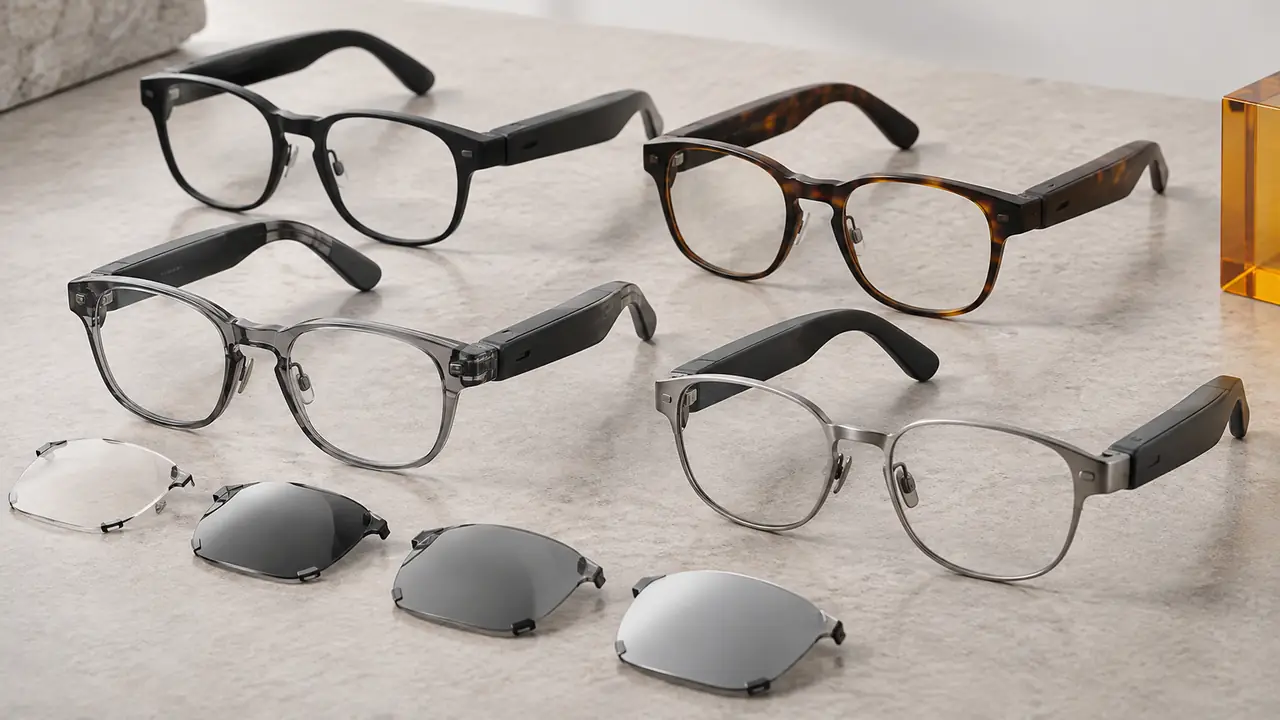
What Rx-ready means
An Rx-ready smart frame is a frame designed so that prescription lenses can be made and fitted by an optician or lens lab, using normal optical processes, without opening the temples or exposing the electronics. The frame plant and the electronics plant supply the finished smart frame, usually with plano clear lenses or blank lenses in place; the optician removes those and fits lenses made to the wearer's prescription. The prescription range that can be fitted depends on the frame and on the lab, so it is stated per lab rather than as a frame specification.
Rx-ready is a design discipline, not a label. A frame that merely has a removable lens is not necessarily Rx-ready: the rim has to hold edged lenses of different thicknesses, the frame shape has to be available as tracing data, and the parts an optician normally heats or bends must be kept away from the battery and board. Programs that skip these points find out at the optician's counter, which is the most expensive place to discover a design gap.
Four routes to prescription lenses
Smart glasses ranges use four main routes. Many brands offer more than one, because customers and channels differ.
| Route | How it works | Best for | Watch points |
|---|---|---|---|
| Direct edging into the front | The lab edges Rx lenses to the frame shape and mounts them in the rim | Optical retail, wearers who want one pair | Rim depth, lens thickness at high powers, no heating near temples |
| Interchangeable Rx front | A separate front holds the Rx lenses and clips to the smart temples | Brands selling fronts as accessories | Connector or hinge design between front and temples |
| Magnetic clip-in or clip-on | An Rx insert or a sun clip attaches magnetically | Sports and outdoor lines | Retention, weight, extra lens surfaces to clean |
| Lens carrier insert | A small carrier behind the main lens holds Rx lenses | Wrap frames with strong curves | Field of view and fogging; carrier fit |
Direct edging gives the most natural look and suits optical retailers. Interchangeable fronts and clip systems suit DTC brands that want to sell lens upgrades online; they are covered in interchangeable lenses and fronts.
Frame design points that make fitting work
Most of the work happens before the first sample. The desk asks the frame and electronics plants to confirm these points on the spec sheet:
- Standard sizes. Common Rx-ready frames sit within lens widths of 48 to 56 mm, bridges of 16 to 20 mm and temples of 140 to 150 mm. Sizes outside these bands are possible but narrow the lab options. The sizing method is in the lens and frame fit guide.
- Rim and groove. A full rim with a groove deep enough for thicker lenses, or a semi-rim with a nylon line, chosen with the lab's edging capability in mind.
- Base curve. A moderate front curve is easier for prescription lenses than a strong sports wrap; wrap frames often use a carrier insert instead.
- Tracing data. The frame shape provided as tracing data, or a frame that a lab tracer can read, so lenses can be edged accurately.
- Electronics clearance. Battery, board and flex cable kept away from the areas that opticians adjust, with the hinge and temples labelled as not to be heated.
What opticians need to know
An optician who receives a smart frame for the first time will treat it like any other frame unless told otherwise. A one-page fitting card in the box and on the retailer portal prevents most damage:
- do not heat the temples or temple tips, because they contain a lithium-ion cell and electronics;
- adjust only the parts marked as adjustable, such as nose pads or the front on acetate models, using the method stated;
- do not use ultrasonic cleaners on the temples;
- keep the charging contacts dry and clean after fitting;
- return the frame to the brand's service channel, not to a general repair bench, if the temple is damaged.
Optical retailers also need display and training material: which sizes are available, which prescription ranges labs have fitted successfully on this frame, and how to explain charging and pairing at the counter. The channel is covered in smart glasses for optical retailers, and retail program needs on retailers.
Lens supply and compliance
Prescription lenses for smart frames are usually made by the optician's own lab or by a contracted lens lab in the destination market, because the prescription is personal and local rules apply to dispensing. For brands that want to supply finished Rx lenses directly, lens plants in Danyang are the usual source; local reporting describes the city as producing more than 400 million pairs of lenses a year, including prescription, photochromic and polarized lenses.
Compliance splits along the same line. The smart frame as supplied carries the radio, battery and product safety documents for its markets, such as FCC Part 15 or CE RED, UN 38.3 for the cells and the relevant optical standard for the plano lenses fitted at the plant. Prescription lenses fitted later fall under the rules for prescription eyewear and dispensing in the market where they are fitted, and in the US the impact requirement under 21 CFR 801.410 applies to eyeglass lenses. Confirm the split of responsibilities with your test lab and counsel; the market overview is on compliance and certifications.
Setting up an Rx-ready program
An Rx-ready line can start from a catalog frame that already meets the design points, typically 50 to 500 pairs per model, or from a logo program at 500 to 1,000 pairs per model. A new Rx-ready front is full custom work, typically from 3,000 pairs per model with 30 to 60 days for engineering samples. Interchangeable fronts and Rx inserts as accessories typically start at 500 to 1,000 pieces. All are reference ranges confirmed in writing on MOQ and lead time.
Before mass production, send golden samples to two or three of the labs your retailers use and ask them to fit a range of prescriptions; their notes become the fitting card. The background for consumers is in smart glasses for glasses wearers. When you know the sizes, routes and channel, the quote form collects the rest.