
What the categories measure
EN ISO 12312-1 is the European and international standard for sunglasses and sunglare filters for general use. One of its central ideas is the filter category: a number from 0 to 4 that describes how much visible light a lens lets through, measured as luminous transmittance. The lower the transmittance, the darker the lens and the higher the category. The current edition is ISO 12312-1:2022.
The category is not a quality grade and not a UV rating. A Category 3 lens is darker than a Category 2 lens, not better made, and either may or may not carry a UV400 label depending on its separate UV result. For smart glasses, where many lines ship with clear or lightly tinted lenses for all-day wear, the category is often 0 or 1, and the choice of tint is a design decision linked to the use case rather than a sign of quality.
Why does this matter so much for smart glasses in particular? Because the lens is the part of the product that buyers, marketplaces and market surveillance authorities can check most easily. A radio test needs a lab; a transmittance check needs only a meter, and a lens that is darker or lighter than the printed category is an easy finding. Smart glasses also tend to be sold with several lens options on one frame, so a single program can involve four or five categories at once. Getting the category right on every lens, every label and every listing line is basic hygiene, and it costs far less than relabelling a lot that has already shipped.
Categories 0 to 4 at a glance
| Category | Luminous transmittance | Description | Typical smart glasses use |
|---|---|---|---|
| 0 | Over 80 up to 100 percent | Clear or very light tint | All-day audio and AI glasses, office and call lines |
| 1 | Over 43 up to 80 percent | Light tint, reduced sunlight | Fashion tints, commuting, faded photochromic states |
| 2 | Over 18 up to 43 percent | Medium tint, medium sunlight | Everyday sun lenses, many polarized lifestyle lines |
| 3 | Over 8 up to 18 percent | Dark tint, bright sunlight | Sports, beach and water use, darkened photochromic states |
| 4 | Over 3 up to 8 percent | Very dark, exceptional brightness | Specialist mountain or glacier lenses; rare on smart glasses; not for driving |
The Category 4 driving warning
Category 4 lenses let through so little light that they are not suitable for driving or road use, and ISO 12312-1 requires that this is stated in the information supplied with the product. For smart glasses, which many customers wear while commuting, cycling or driving, Category 4 lenses are rarely the right default; the desk usually recommends Category 2 or 3 for sun lenses, with Category 4 only for specialist lines and with the warning printed on the insert and in the listing.
The standard also includes requirements relating to suitability for driving for other categories, such as how lenses render signal colours. If a line is marketed for drivers or riders, ask your test lab to include the driving-related checks in scope, and phrase any claim exactly as the report allows.
Photochromic, polarized and electrochromic lenses
Lenses that change or filter light need extra care with categories:
- Photochromic lenses have a faded and a darkened state, and the report should give the category for both. Across the category they typically move within Categories 0 to 3, per the lens specification. The mechanism is explained in photochromic lenses explained.
- Polarized lenses are categorised by their tint like any other lens, and the standard adds requirements for polarizing filters. See polarized lenses for smart glasses.
- Electrochromic lenses, which switch darkness with a voltage, are addressed in ISO 12312-1:2022 with an information requirement related to photosensitive epilepsy, because rapid or repeated switching acts as a flashing light. Firmware behaviour and user information must match the report.
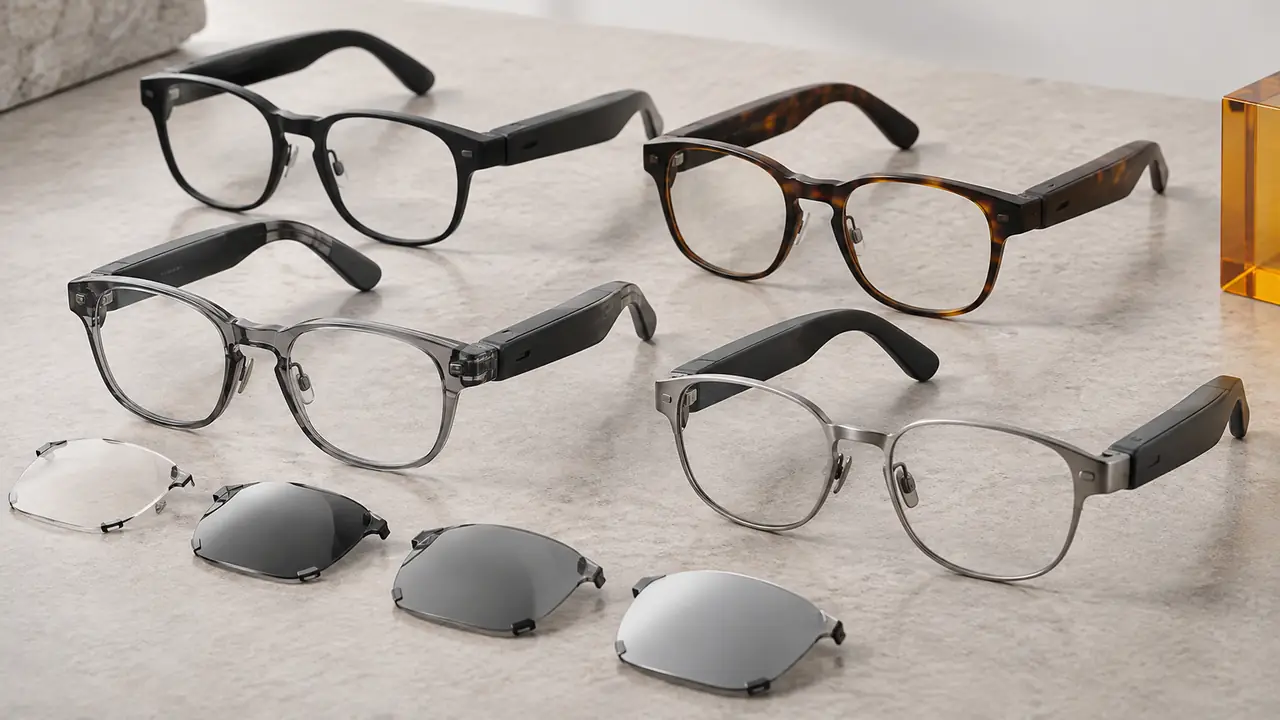
Interchangeable lens sets need a category for every lens in the set. A smart frame sold with a clear, a Category 2 and a Category 3 lens needs all three on the report and on the label.
Labels, listings and the North American side
The category number belongs on the product or its information, together with the manufacturer details and the standard reference required by the market. In listings, the category should appear in the same words as the report, for example Category 3 sun lens per ISO 12312-1, and never as a vague strength claim. UV wording is separate and comes from the UV result; see UV400 on smart glasses lenses.
Mirror coatings and colours deserve a note. A mirror layer reflects part of the light and lowers transmittance, so a mirrored lens may fall into a darker category than the same tint without the mirror. Colour also matters: a blue, green or rose tint at the same darkness can sit in a different category from a grey one. Every colour and mirror variant in the range is therefore its own line on the report, not a cosmetic variation of a tested lens.
In North America, non-prescription sunglasses and fashion eyewear are referenced to ANSI Z80.3, which uses its own transmittance and labelling requirements, and the US drop ball test under 21 CFR 801.410 applies to the lenses. A program selling in both regions usually tests to both; the comparison is in ANSI Z80.3 and ISO 12312-1.
How the desk handles categories in a program
Category decisions sit on the spec sheet next to lens material and coating, and they are confirmed on the golden sample. A typical sequence:
- Brief. Use case and markets decide the target category for each lens in the line.
- Lens samples. The lens plant supplies tinted samples with its own transmittance data.
- Test report. A test lab measures the lens as supplied and states the category, UV result and any polarizing or driving checks in scope.
- Labels and copy. Insert, label and listing text are drafted from the report wording.
- Lot inspection. Each lot is compared with the golden sample for tint, and the inspection record notes the lens batch so it can be traced back to the report.
Lens tests run alongside radio and battery testing and are part of the scope on testing and inspection. Tinted lens changes on catalog fronts rarely change quantities; reference ranges are on MOQ and lead time. Send the categories you need per market through the quote form.