
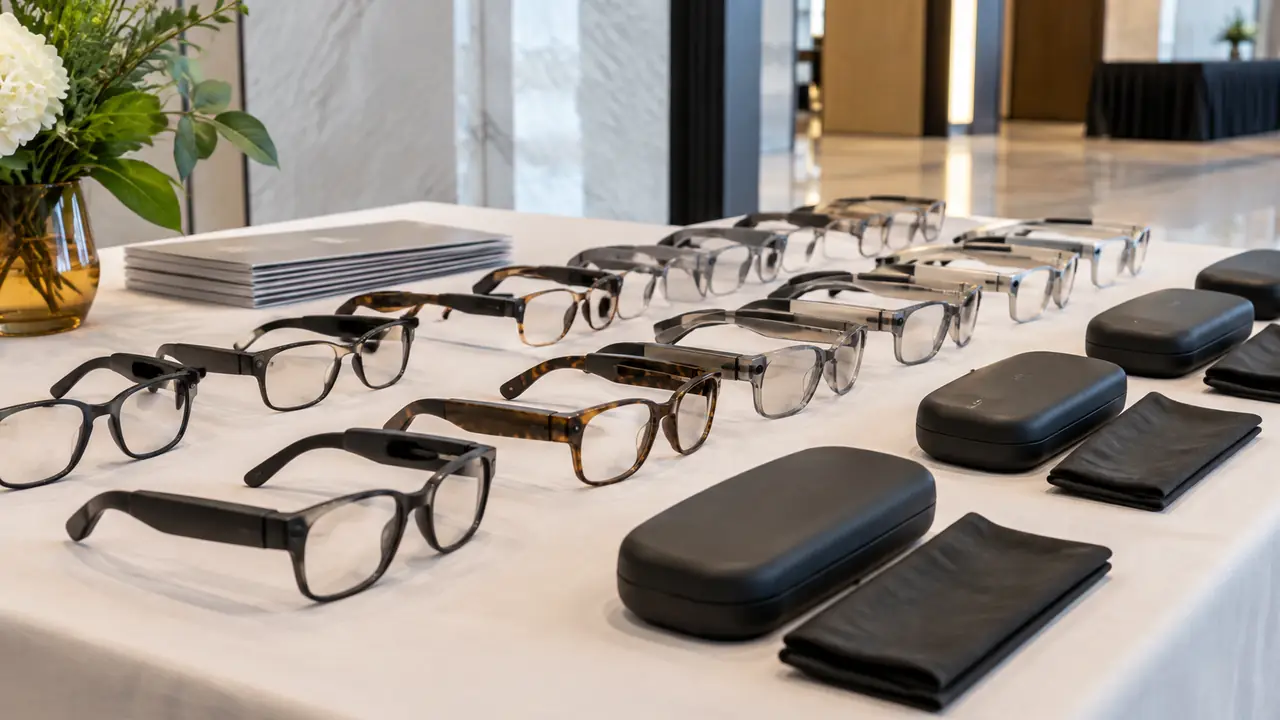
What enterprise and project buyers need
Enterprise and project buyers are not reselling glasses; they are deploying them. A corporate purchasing team equips a sales force with call glasses. A tour operator or trade-fair organiser hands translation glasses to a group for a week. A field service company wants hands-free calls for technicians on site. A marketing team orders branded glasses as gifts for clients. The pain points follow from that: the glasses must work on day one for everyone, charge reliably as a group, run the same firmware on every unit, and be repairable or replaceable without a long wait. Who manages the app accounts and what data the app handles also matter more than for consumers, because the buyer is responsible for its staff and guests.
Recommended lines and why
- AI translation glasses: for tour groups, trade fairs and business travel. Language count is per app and translation engine, and typical cloud latency is 0.5-3 s per network and language pair; only a few language packs work offline. Venue Wi-Fi or mobile data should be planned for.
- Business call glasses: for sales teams and field crews who need hands-free calls, with multi-mic arrays, noise reduction per firmware and multipoint connection. Meeting software compatibility is checked per project.
- Developer smart glasses: for projects that need their own software, with open SDK, BLE GATT or serial debugging per solution provider, optional Wi-Fi, camera and IMU, and firmware OTA.
Use cases are covered in travel and translation use.
Order routes and quantities
Most projects use catalog or logo hardware, because timing is set by an event or a roll-out date. Ranges are typical across the category and confirmed in writing per program.
| Project type | Usual route | Typical quantity | Points to settle early |
|---|---|---|---|
| Corporate purchase | Catalog model | 50-500 pairs per model | Meeting software check, app accounts, warranty |
| Tour or trade-fair translation sets | Catalog or logo | Per group size and rotation | Languages per app, network, charging between sessions, hygiene parts |
| Field hands-free calls | Catalog with project accessories | Per crew | Noise conditions, water resistance per IP rating, spares |
| Corporate gifting | Logo program | 500-1,000 pairs per model | Gift box, delivery date, personalisation |
| Software project | Developer line, small engineering batches | Per project | SDK access, firmware ownership, data handling |
Catalog samples typically take 5-10 working days and batch production 20-35 days; work back from the event date. See MOQ and lead time, and for gifting corporate gifting smart glasses.
Fleet charging, firmware control and spares
Three items turn a box of glasses into a working fleet:
- Fleet charging: a charging rack or multi-port station with numbered positions, sized so a full set recharges between sessions; magnetic charging typically takes 1-2 h per pair. Cases with their own cells add transport paperwork per Wh.
- Firmware control: every unit ships on the same firmware version, recorded at pre-shipment inspection. Updates are approved by the buyer before roll-out, not pushed automatically, and app accounts and data permissions are documented.
- Spares: a spares kit of nose pads, temple tips, cables and a few complete units, with the spares ratio set per project from group size and rotation, so a failed unit is swapped on the spot.
Firmware and app options are on firmware and app.
Documents and inspection
Enterprise buyers usually need the standard file plus project records: FCC Part 15 or CE under RED with EN 18031 cybersecurity, which matters for connected devices handed to staff; Bluetooth SIG; UN 38.3, IEC 62133-2 and safety data sheets for cells and cases; lens reports to ISO 12312-1 or ANSI Z80.3; and an app data-handling description for the buyer's privacy team. Certificates are held by partner plants or test labs and verified per project; confirm scope with your test lab or counsel. Pre-shipment inspection adds a fleet check: every unit powered, paired and logged by serial number and firmware version, labels per position, and the charging rack tested with a full set.
Illustrative case: translation sets for a trade-fair delegation
This is an illustrative, anonymous example. An event agency needed translation glasses for a delegation visiting a trade fair abroad. The desk proposed a catalog translation model, checked that the app supported the delegation's language pairs per translation engine, and briefed the agency on typical cloud latency and the venue network. Units shipped with one firmware version, numbered cases, a charging rack and a small spares kit. To plan a project, send the date, group size and languages through the quote form.