
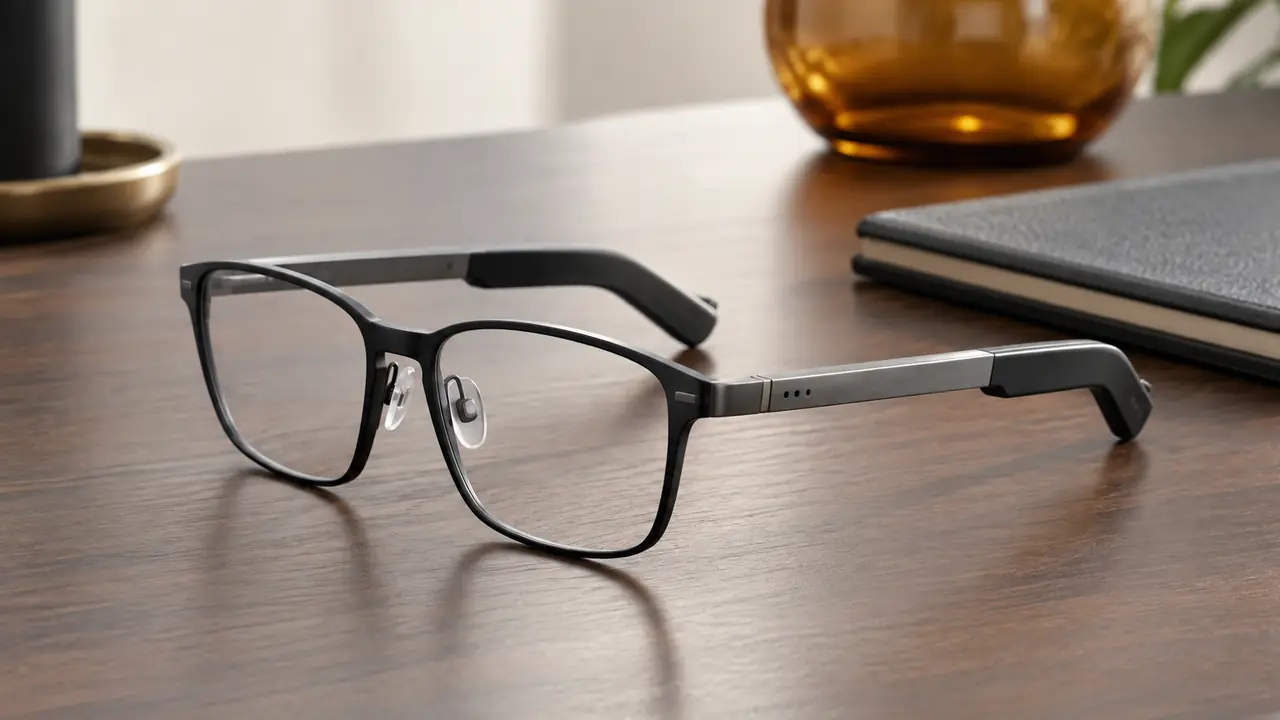
What makes a pair of glasses a call device
Business call glasses use the same skeleton as the rest of the audio family - a front, a hinge with a flexible circuit and two temples holding cells, a Bluetooth board and directional open-ear speakers. The difference is where the engineering budget goes. On a music-first model the speaker chamber gets the attention; on a call model it is the uplink, the voice the other person hears. That means more microphones, careful placement along the temple, noise reduction firmware tuned for speech and a pairing stack that handles two devices at once.
The buyers for this line are different too. They are wholesalers serving office supply channels, distributors with corporate accounts and enterprise or project buyers equipping staff who spend the day on calls or need hands-free communication on site. For them, the decisive question is whether a colleague on the far end can hear the wearer clearly in a busy office, a car or a street, and whether the glasses switch cleanly from a laptop meeting to a phone call. The use case is described on office calls and meetings.
Microphone arrays and noise reduction
Across the category, call glasses carry a multi-microphone array with environmental noise cancellation (ENC) or AI-based noise reduction, per firmware. With two or more mics per temple, the firmware can apply beamforming: it combines the signals to favour sound arriving from the direction of the mouth and suppress sound from other directions. Results depend heavily on three things - mic spacing along the temple, distance from the speaker (to limit echo) and the quality of the tuning in firmware. None of these show up on a spec sheet as a single figure, so the desk treats call quality as a test result on the golden sample, recorded in noise, wind and a reverberant room.
The engineering background is in microphone arrays for call glasses, and the common failure modes - wind noise, echo, a voice that sounds distant - are covered in call quality problems on glasses.
Multipoint and meeting software
Multipoint means the glasses stay connected to two source devices, typically a laptop and a phone, and switch to whichever one starts a call. It is implemented per firmware on the chipset and behaves differently across operating systems and software versions. Compatibility with specific meeting software is therefore verified per project, on the devices and versions your customers use, rather than promised in advance. The desk builds this into the sample stage as a checklist: pairing both devices, joining a meeting on the laptop, taking a phone call during the meeting, muting from the glasses and returning to the meeting.
| Call feature | Typical implementation | How it is verified |
|---|---|---|
| Uplink noise reduction | Multi-mic array, ENC or AI noise reduction per firmware | Recorded call test in noise and wind on the golden sample |
| Echo control | Mic placement away from the speaker plus firmware echo cancellation | Far-end listening test at set volume steps |
| Multipoint | Two active connections, per firmware | Switching test across laptop and phone |
| Meeting software | Standard Bluetooth headset profiles | Compatibility checklist per project on target devices |
| Mute and call control | Touch strip or button, per firmware | Function test and app check |
| Talk time | 3-9 h calls across the category | Runtime test on the golden sample |
Fronts and lenses for office wear
Because these glasses are worn at a desk for hours, the front usually follows office eyewear rather than sports styling: metal or acetate frames, a neutral colour range and Rx-ready fronts so an optician can fit prescription lenses. A blue-light filtering lens is a common option for screen work; it is offered as a lens specification only, with no health claim. Clear and filter lenses follow ANSI Z80.3 in North America and ISO 12312-1 where a sunglass lens is fitted, plus the FDA drop-ball impact test under 21 CFR 801.410 for the US. The lens choices are compared on lens options.
Documents, tests and program path
Radio and safety follow the family route: FCC Part 15.247 and Part 15 Subpart B for the US; CE RED 2014/53/EU with EN 300 328, EN 301 489, EN 62368-1 and EN 18031 cybersecurity for the EU; Bluetooth SIG listing; and a UN 38.3 summary with IEC 62133-2 for the cells. Water resistance, where stated, is an IPX4 to IP54 rating tested per IEC 60529. Enterprise buyers often also ask for firmware OTA support and a documented pairing reset procedure, both of which are written into the spec sheet.
A logo program on a catalog model typically starts at 500-1,000 pairs per model, with logo samples in 10-15 working days and batch production in 20-35 days. A new mic layout or custom call tuning is full OEM work, typically from 3,000 pairs per model and 45-75 days in batch. These are typical reference ranges, confirmed in writing for each program on MOQ and lead time. Send the target devices and use case through the quote form.