
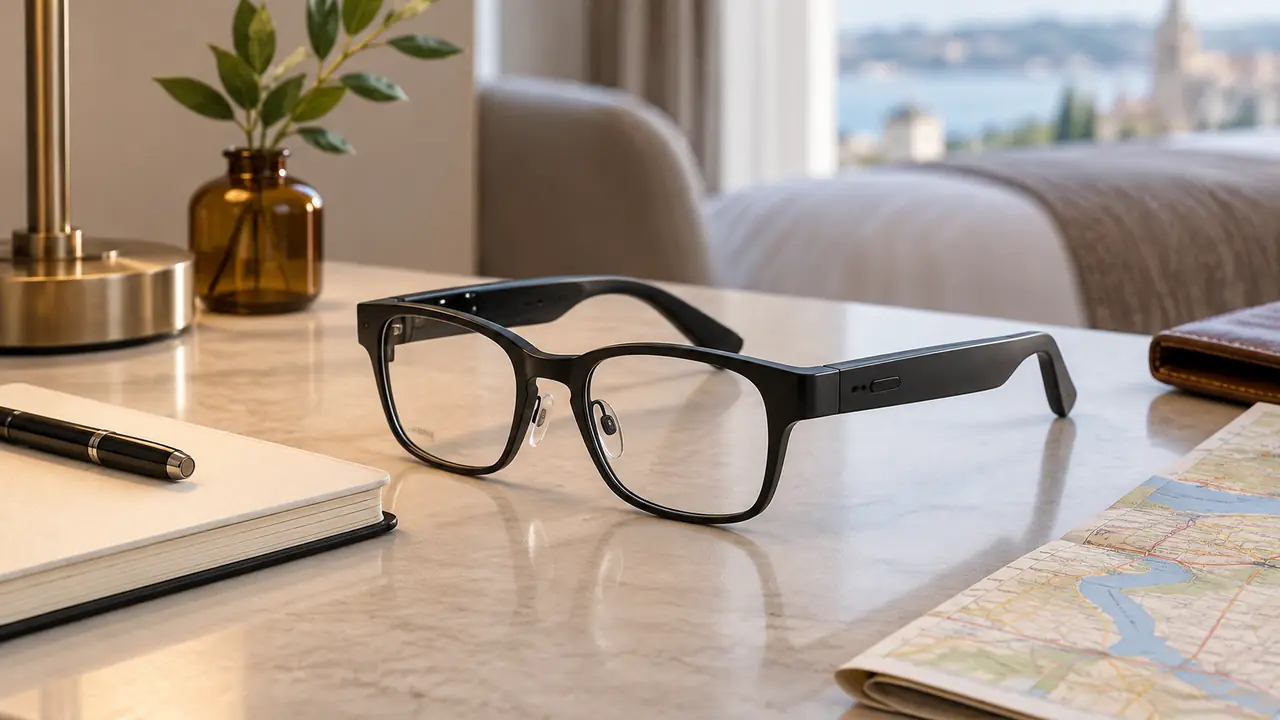
How translation glasses actually work
Translation glasses are audio glasses with a different job description. The temples carry the same building blocks - a Bluetooth audio system-on-chip, two small lithium-ion cells, directional open-ear speakers and a touch strip - but the microphones matter far more. A small array of microphones along the temple picks up the wearer's voice and, on some models, the voice of the person opposite. The glasses do not translate on their own in most designs. They capture audio, send it over Bluetooth to a phone app, the app passes it to a translation engine (usually in the cloud), and the translated speech or text comes back to the temple speakers and the phone screen.
That chain explains every figure a buyer will see. The number of languages depends on the app and the engine behind it, not on the glasses: across the category, mainstream apps offer roughly 6 to 60 or more languages, and cloud services may list more. Typical cloud latency runs from about 0.5 to 3 seconds, depending on network quality, the language pair and how long the speaker talks before a pause. Offline packs exist for only a few languages. A step-by-step walk-through is in how AI translation glasses work.
Where the seconds go
Buyers often ask for lower latency without knowing where it comes from. The table breaks the chain into its stages. None of these figures is a measured value for a specific product; they show which part of the system owns each delay.
| Stage | What happens | Who controls it |
|---|---|---|
| Pickup | Temple mics capture speech; noise reduction cleans it up | Mic layout and firmware on the glasses |
| Bluetooth link | Audio travels from temple to phone | Chipset, codec and phone |
| Speech recognition | Speech is turned into text, often after the speaker pauses | Translation engine chosen by the app |
| Translation | Text is translated into the target language | Translation engine and language pair |
| Network | Requests travel to and from cloud servers | Mobile network, Wi-Fi, server region |
| Playback | Synthesised speech returns to the temple speakers | App, chipset and speaker tuning |
Most of the delay sits in recognition, translation and network, so the glasses hardware alone cannot remove it. Honest marketing describes translation as conversational with short pauses, quoting latency as typical cloud latency of 0.5-3 seconds per app and network. More detail is in translation glasses latency explained, and the offline trade-off in offline vs cloud translation.
Options buyers usually specify
- Microphone array. Dual or quad microphone layouts across the pair, placement along the temple and the noise reduction profile per firmware. More microphones help in trade-fair halls and street noise but add board space and power draw.
- App and engine. A white-label app with your logo and colours, the translation engine behind it, the list of supported language pairs, and which pairs work offline. The engine contract and data terms belong to the app provider; the desk records them in the spec.
- Conversation modes. Wearer-only, face-to-face with the phone speaker, or both parties on glasses. Each mode changes how the microphones and app are configured.
- Front and lenses. Clear, filter, polarized or Rx-ready lenses on TR90 or acetate fronts; the lens and frame fit guide covers the trade-offs.
Privacy, data and compliance
A translation app processes voice, and often the voice of people who have not agreed to anything. The spec sheet should state where audio is processed, which server region hosts it, how long transcripts are kept and whether they are used to improve the engine. In the EU, glasses are named as wearable radio equipment, so cybersecurity requirements under RED Article 3(3)(d)(e)(f) apply from 1 August 2025, with EN 18031 as the harmonised standard family. Radio and battery rules follow the audio line: FCC Part 15.247 and Subpart B, CE RED with EN 300 328, EN 301 489 and EN 62368-1, Bluetooth SIG qualification, UN 38.3 and IEC 62133-2. Confirm the scope with your test lab and the data terms with counsel.
Who buys this line and how it ships
Translation glasses sell to travel retailers, DTC brands and enterprise buyers such as tour operators and exhibition teams; the use case is described on travel and cross-language use. A catalog model with a logo and app skin is the common start, at 500-1,000 pairs per model, with logo samples in 10-15 working days and batches in 20-35 days. A full custom program with new tooling and app work starts at 3,000 pairs. These are typical reference ranges, confirmed in writing for each program on MOQ and lead time; send your brief through the quote form.