
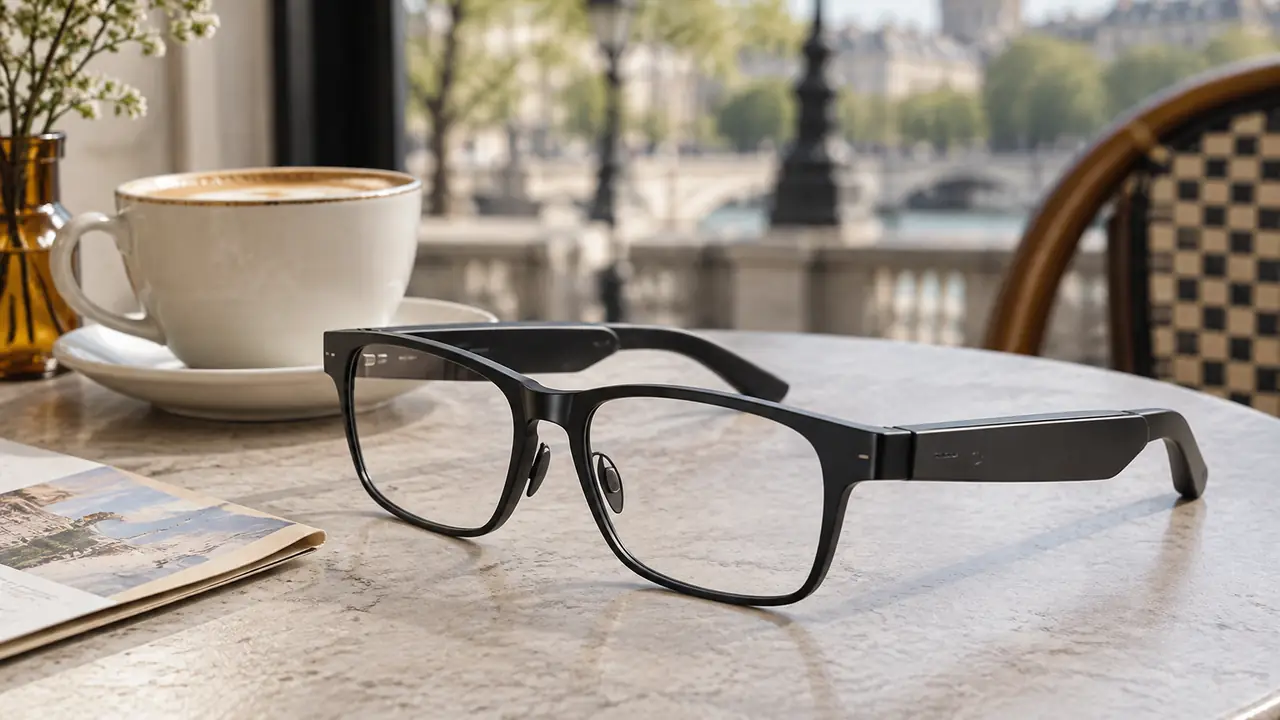
How translation glasses work on the road
Translation glasses are audio glasses with a different job. The microphones in the temples pick up speech, the glasses send audio over Bluetooth to a phone app, the app passes it to a speech recognition and translation engine - usually in the cloud - and the result comes back as audio in the open-ear speakers or as text on the phone. The glasses themselves rarely translate anything. That has two consequences for a travel program: performance depends as much on the app, the engine and the network as on the hardware, and every claim about languages or speed has to be framed per app and per network. The chain is explained step by step in how AI translation glasses work.
Travel settings test each link in that chain. A fair hall has crowd noise and PA announcements; a taxi has road noise and a driver who faces away; an airport has patchy roaming data. The desk plans the program around those conditions rather than a quiet-room scenario.
What to specify for noisy places
| Factor | Typical across the category | What the buyer should ask for |
|---|---|---|
| Pickup | Mic array in the temples, noise reduction per firmware | Recordings in a defined crowd or road noise condition |
| Languages | Mainstream 6-60+, cloud engines may list more, per app | The language list of the exact app version shipped |
| Latency | Typical cloud latency 0.5-3 s, per network and language pair | Measured timings on Wi-Fi and on mobile data |
| Offline | Offline packs for a small set of languages only | Which pairs work offline and how quality compares |
| Runtime | Lower than plain audio use because the link stays active | Runtime in translation mode, not only music playback |
Pickup is the part the hardware controls. Two microphones per temple and beamforming in firmware help the glasses focus on the wearer's voice; picking up the other person is harder, especially when they stand at an angle. Many apps therefore offer a mode where the other person speaks toward the phone. Listing copy should describe the mode that the tested setup actually supports.
Latency and language claims, stated honestly
Every translation program meets the same pressure to promise speed and breadth. Across the category, typical cloud latency is 0.5 to 3 seconds, depending on the network, the engine and the language pair; it rises on weak roaming data and with long sentences, because many engines wait for a phrase to end before translating. Language counts follow the app and the engine: mainstream apps cover 6 to 60 or more languages, and cloud services may list more. The desk writes both into the spec sheet as per app and per network, and recommends that listings do the same. Where the seconds go is broken down in translation glasses latency explained.
Offline packs for patchy networks
Travellers lose data at border crossings, in rural areas and underground. Offline packs let the app run recognition and translation on the phone, but only for a small set of languages, usually with simpler models than the cloud engine. For a travel range, the useful questions are which language pairs are available offline, how large the downloads are, and whether the app switches between online and offline cleanly. The trade-offs are in offline vs cloud translation glasses.
Where the speech data goes
Translation means recording and sending speech, often of people who did not choose to use the product. A buyer should know which servers receive audio, whether recordings or transcripts are stored and for how long, which permissions the app requests and how a user deletes history. In the European Union, glasses are named as wearable radio equipment under Delegated Regulation (EU) 2022/30, so the cybersecurity requirements of the Radio Equipment Directive apply from 1 August 2025, with EN 18031 as the harmonised standard; the Cyber Resilience Act takes over from 11 December 2027. The desk collects the data flow description from the app provider per project; legal conclusions on data protection are for your counsel. A checklist is in smart glasses data and app permissions.
Program route for travel ranges
A catalog translation model with a logo and packaging change follows the catalog or logo route: 50-500 pairs per catalog model, 500-1,000 with logo, samples in 5-10 or 10-15 working days and batch production in 20-35 days. A white-label app, custom tuning or a new front moves to full custom ODM, typically from 3,000 pairs per model with 30-60 day engineering samples. Figures are typical reference ranges, confirmed in writing for each program on MOQ and lead time. Enterprise buyers equipping tour groups or fair teams can also read enterprise projects, then brief the desk on the quote form.