
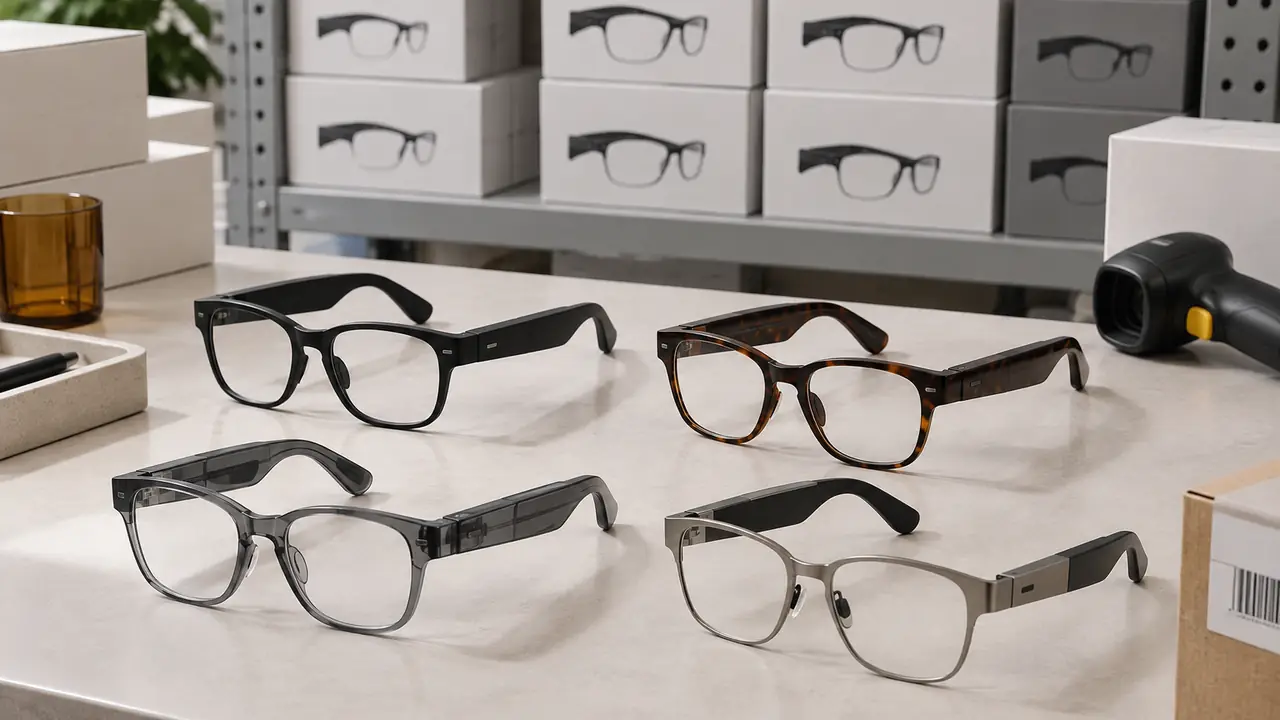
Two kinds of enterprise buyer
Enterprise orders for smart glasses usually fall into one of two patterns, and the specification differs between them. The first is gifting: a company wants a branded item for clients, staff or event guests that feels current and gets used after the event. The second is deployment: an organisation equips a group of people - tour guides and their groups, trade fair teams, field staff, warehouse or site supervisors - with glasses that do a job, usually hands-free calls, open-ear audio or translation.
Gift programs care about presentation, branding, delivery date and a product that works out of the box for any recipient. Deployment programs care about fleet charging, firmware control, data handling, durability and a replacement route. Many orders are a mix, so it helps to decide early which pattern leads, because it decides the line, the packaging and the support plan.
Choosing the line
The table below maps common enterprise uses to the lines that usually suit them. Figures are typical across the category, per spec sheet, and every value is confirmed on the sample for each program.
| Use | Suitable line | What to specify |
|---|---|---|
| Client or staff gift | Bluetooth audio glasses | Neutral frame shape, two or three colours, clear and sun lens options, gift box |
| Office and remote teams | Business call glasses | Multi-mic ENC per firmware, multipoint, blue-light filtering lens option with no health claim |
| Tour groups and trade fairs | AI translation glasses | Languages per app and translation engine, typical cloud latency 0.5-3 s, network plan for venues |
| Field and site teams | Business call or sports frames | Wind-resistant call pickup, water resistance per IPX4-IP55 test, secure fit |
| Developer or pilot teams | Developer smart glasses | SDK, BLE GATT access and OTA per solution provider |
For gifts, the audio line is usually the safest choice: it works with any phone, needs no account for basic use and suits most face sizes in a standard frame. Camera models are rarely a good gift in corporate settings because recipients may work in places where recording is restricted. For deployment, the use case decides; the scenario pages for field work and travel and translation map the modules and tests that matter.
Branding options
Enterprise buyers usually want the brand visible but discreet. Common options, all agreed per program, include:
- Logo on the temple by pad printing, laser marking or a small metal badge, usually on the outer face near the hinge.
- Custom box and sleeve in the company's colours, with a card or insert carrying a message.
- Pouch or case printed or debossed with the logo, which is often seen more than the glasses themselves.
- Quick start card in the recipient's languages, with the company's support contact if it will handle first-line questions.
- Voice prompts or app branding in deeper programs, per firmware and app white-label options.
Logo and packaging programs typically start at 500 to 1,000 pairs per model. Smaller gift runs can use a catalog model with a logo on the box and pouch only, which keeps quantities nearer the catalog range of 50 to 500 pairs per model. Both are reference ranges, and the choice between them usually comes down to how visible the brand needs to be on the product itself.
Fleet considerations for deployment
Deploying glasses to a team turns a consumer product into managed equipment. Four questions come up in almost every project.
- Charging. How a group of pairs is charged overnight - multi-port charging stations with pogo cables, or charging cases - and who checks them before use.
- Firmware. Whether all pairs can be kept on the same firmware version, how updates are rolled out and whether updates can be held until tested.
- Data and app permissions. What the companion app collects, whether accounts are needed and where voice or translation data is processed; the questions are listed in data and app permissions.
- Spares and swaps. A pool of spare pairs and parts, and a simple swap process when a pair fails during an event or shift.
Translation deployments need extra planning. Translation runs per app and translation engine, typical cloud latency is 0.5 to 3 seconds depending on network and language pair, and offline packs cover only some languages. Venue connectivity therefore matters as much as the glasses; trade fair halls are a known challenge. The practical side is covered in translation glasses for business travel.
Timing, delivery and documents
Gift programs often have a hard date: a conference, a year-end event, a product launch. Working back from that date, a logo program typically needs 10 to 15 working days for logo samples, approval time, 20 to 35 days of batch production and then shipping - 5 to 10 days by courier or air with lithium batteries declared under UN3481 and PI 967 Section II, or 15 to 25 days by sea to the US west coast and 30 to 45 days to Europe. These are reference ranges confirmed in writing for each program on MOQ and lead time; a gift order placed late in the season usually ends up on air freight.
Compliance follows the destination, not the buyer. Pairs given to recipients in several countries need the radio approvals for each - FCC Part 15 for the US, CE under RED 2014/53/EU with EN 18031 for the EU, UKCA for Great Britain and other marks per project. Catalog models with existing approvals make multi-country gifting much simpler. Delivery to many addresses is another common request; splitting a batch across destinations is possible but should be planned with the forwarder before production, since each parcel carries its own battery marks.
Starting an enterprise brief
A useful enterprise brief states the pattern - gift or deployment - the number of recipients or users, the countries involved, the delivery date, the branding wanted and who will handle first-line support. With that, the desk shortlists partner plants with suitable catalog models, gathers samples for review and builds a schedule from the delivery date backwards. Line details are on business call glasses and AI translation glasses. Send the brief through the quote form.