
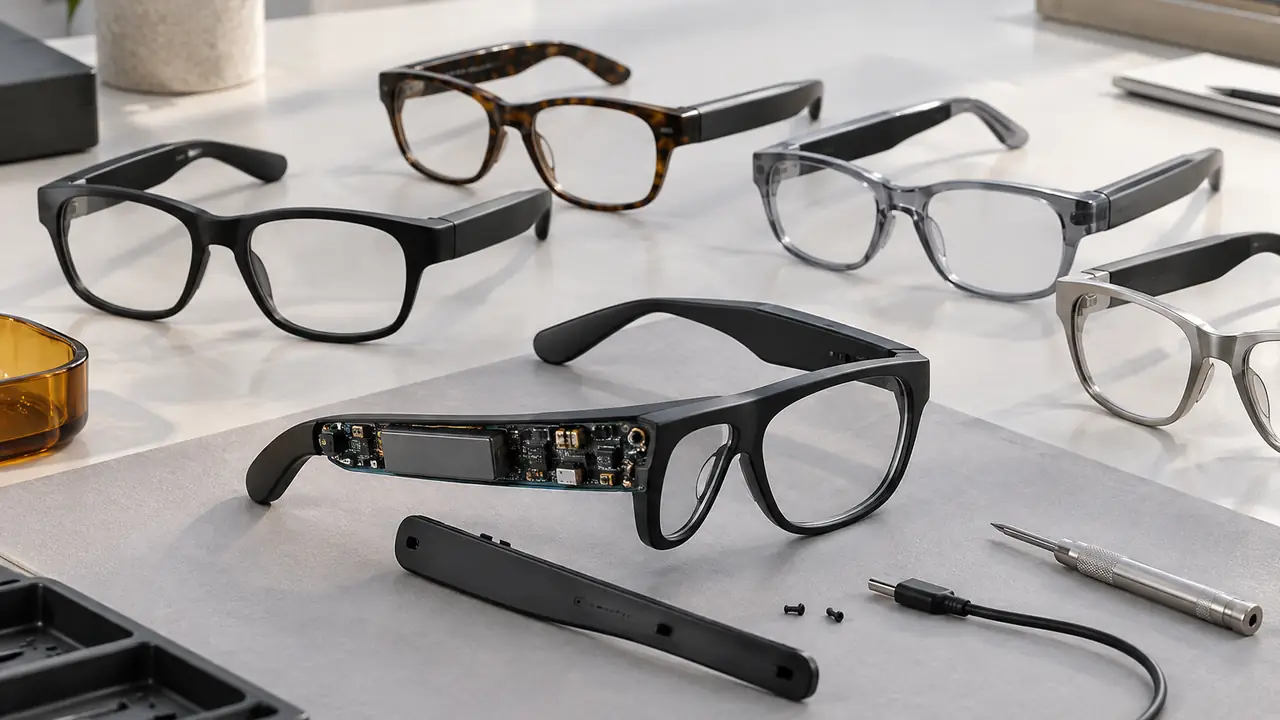
What makes a pair of glasses a developer platform
Most smart glasses ship with a closed app and closed firmware: the brand can change the logo and the colours, but not what the glasses do. Developer smart glasses are the exception. The solution house behind the board publishes an SDK, documents the Bluetooth Low Energy GATT services the glasses expose, and in some cases opens serial debug access and an OTA path for signed firmware. That lets an app team read touch events, stream microphone audio, push notifications or captions, read sensors and update features without waiting for the original vendor.
The hardware is the same skeleton as the rest of the family - a front with lenses, a hinge with a flex cable, two temples with a board, cells, open-ear speakers and microphones - with options added per program: Wi-Fi for higher-bandwidth transfer, a camera module, or an inertial measurement unit (IMU) for head motion and gesture input. What changes most is the documentation. A developer platform is only as useful as its interface specification, sample code and firmware support. The developer SDK guide walks through what to ask for. Typical buyers are enterprise project teams, app start-ups and research groups that need a stable hardware base and a supplier willing to keep interface documentation current across firmware releases.
Interfaces and options compared
| Interface or option | What it gives your team | What to confirm in writing |
|---|---|---|
| Open SDK | Libraries and sample code for phone apps | Supported phone platforms, licence terms, update policy |
| BLE GATT services | Direct read and write of glasses features over BLE | Service and characteristic list, pairing and bonding security |
| Serial debug | Logs and low-level access during development | Whether debug is locked on mass-production units |
| OTA firmware | Field updates for features and security fixes | Signing keys, rollback, who builds and releases images |
| Wi-Fi | Higher-bandwidth transfer for media or logs | Wider radio test scope, EN 18031 documentation |
| Camera or IMU | Capture, head tracking, gesture input | Recording indicator for cameras; sensor data rates |
Firmware and app responsibilities are set out on firmware and app, and OTA risks in firmware update failures.
Security and compliance when the platform is open
Opening interfaces does not remove the manufacturer's obligations; it spreads them. In the EU, glasses are wearable radio equipment under Delegated Regulation (EU) 2022/30, so the RED cybersecurity requirements of Article 3(3)(d)(e)(f) have applied since 1 August 2025, with the EN 18031 family as harmonised standards; the Cyber Resilience Act takes over from 11 December 2027. For a developer platform that means locked debug ports on shipped units, authenticated BLE pairing, signed OTA images and a clear owner for security fixes. Radio, battery and optical rules are as for other lines: FCC Part 15.247 and Subpart B, CE RED with EN 300 328, EN 301 489 and EN 62368-1, Bluetooth SIG qualification, UN 38.3 and IEC 62133-2, and ISO 12312-1 or ANSI Z80.3 for lenses. If a camera is fitted, the recording indicator expectations of the EDPB statement of October 2026 apply in the same way as on camera glasses.
Engineering samples and small batches
Developer programs usually begin with a small batch of engineering samples so the app team can build against real hardware. From a catalog platform, samples ship in 5-10 working days. An ODM program with new tooling, a camera or IMU layout, or a custom board runs through EVT and DVT stages, with engineering samples in 30-60 days including 25-45 days of tooling. Catalog platforms start at 50-500 pairs per model; full custom OEM or ODM programs from 3,000 pairs, with batches in 45-75 days excluding certification queues.
- Brief: target use case, interfaces needed, phone platforms, optional sensors and markets.
- Shortlist: the desk compares solution houses on SDK depth, GATT documentation and firmware support.
- Engineering samples and interface documents delivered; your team validates the integration.
- Golden sample signed with firmware version, debug lock and OTA process recorded.
- Certification, batch production and pre-shipment inspection including firmware checks.
These are typical reference ranges, confirmed in writing for each program on MOQ and lead time. Enterprise use cases are on enterprise projects; send a brief through the quote form.