
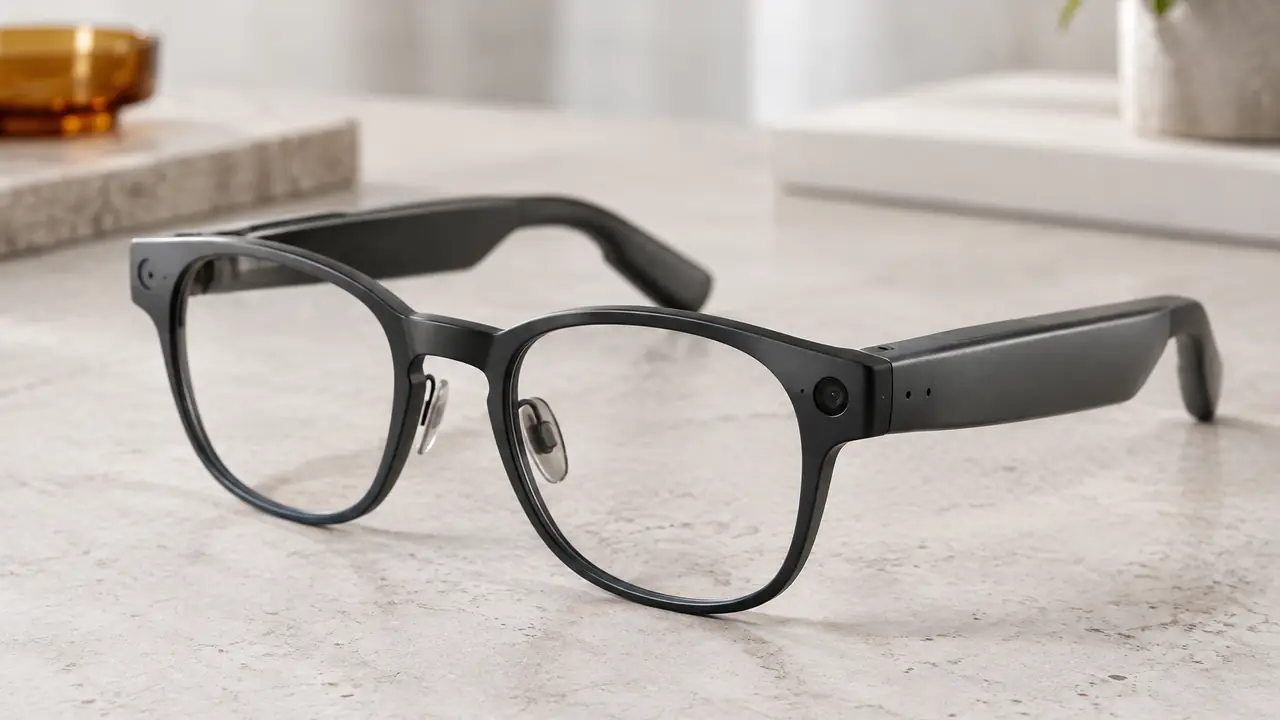
What business users expect
A tourist using translation glasses wants directions, menus and small talk. A buyer at a trade fair wants to discuss specifications, quantities, delivery terms and prices with a supplier who speaks another language, often across a noisy stand, for hours. A delegation travelling to visit partners needs to follow meetings and factory tours. These users judge a product on three things: whether it captures speech reliably in real environments, whether numbers and technical terms come through correctly, and whether it lasts through a full working day.
The glasses are only part of the answer. As with all translation glasses, recognition and translation run in a phone app and, for most language pairs, on a cloud translation engine; language coverage is per app and translation engine, and typical cloud latency is about 0.5 to 3 seconds per network and language pair. A business-focused program chooses hardware, app and usage guidance together. The signal chain is explained in how AI translation glasses work.
Trade fair conditions: noise and networks
Exhibition halls are among the hardest settings for any voice product. Background noise is constant and loud, with announcements, machinery on stands and many conversations at once. Microphone pickup becomes the deciding factor: arrays of two or four microphones with beamforming, tuned per firmware, give the recognition engine cleaner audio. A conversation mode that listens outward to the person across the counter, and a clear way to switch between that mode and the wearer's own voice, matter more here than anywhere else.
Networks are the second problem. Venue Wi-Fi is often congested and mobile networks slow down when thousands of visitors share a hall. Roaming adds further variation. Cloud translation slows or fails under those conditions, so business users benefit from an offline pack for their main language pair as a fallback, even if offline coverage is limited to a few languages. The trade-off is explained in offline vs cloud translation glasses, and test methods in translation glasses latency.
A specification checklist for business use
The table lists the features that matter most for business travel and trade fairs, why they matter and how to state them on a spec sheet.
| Need | Why it matters | How to specify |
|---|---|---|
| Pickup in noise | Halls and factory floors are loud | Microphone count and positions, beamforming per firmware, tested in a noisy room |
| Outward listening mode | The other speaker is the one being translated | Mode name, switching gesture, behaviour at counter distance |
| Numbers and terms | Quantities, model numbers and dates must survive translation | Test script with numbers and trade terms in target pairs |
| Offline fallback | Venue networks fail | Offline pairs listed per app, tested in airplane mode |
| Text view | Some lines are easier to check on screen | Transcript on the phone in parallel with audio |
| Runtime in translation mode | Fair days are long | Hours measured in translation mode, charging case or quick top-up option |
| Call quality | The same glasses serve calls between meetings | ENC call noise reduction per firmware, multipoint pairing |
Runtime deserves special attention. Translation keeps the microphones and the Bluetooth link busy, so translation-mode runtime is lower than the music figure on most spec sheets. A charging case or a short top-up between meetings often makes more difference than a slightly larger cell. Note that charging cases with their own battery have shipping and carry-on rules of their own, per Wh.
Conversation habits that improve results
Good habits close much of the gap between a product's best and worst performance. Business users get better results when they speak in shorter sentences, pause between ideas, state numbers clearly and repeat key figures, and confirm critical details such as quantities and dates in writing or on the phone screen. Showing the transcript to the other party is a simple way to check that a figure came through correctly. Brands can include these tips in the quick-start guide and the app onboarding; they reduce disappointment far more cheaply than any hardware change.
Confidential meetings raise data questions. Cloud translation sends speech to a remote service, so users discussing sensitive terms should know where audio is processed and whether transcripts are stored. Offline packs keep processing on the phone, according to the app documentation. Corporate buyers usually ask for this information before approving a device for staff.
Fleet programs for organisers and companies
Event organisers, tour operators, trade delegations and companies sending staff abroad often buy translation glasses as a fleet rather than as individual devices. Fleet programs have their own requirements:
- Charging and storage. Multi-unit charging and storage cases, with clear labelling and numbering of each pair.
- Setup between users. A simple way to reset pairing and clear transcripts when a pair is handed to the next user.
- Language presets. Pre-set language pairs for a given event or delegation, set in the app.
- Hygiene. Replaceable nose pads and temple tips, and cleaning guidance compatible with the frame finish.
- Branding. Logo on the temple, branded packaging and a branded app where the program allows it.
These points are covered on enterprise projects, and gift programs for clients and partners in corporate gifting smart glasses.
Sourcing a business translation program
Templora shortlists catalog translation models and solution providers against the business checklist, runs side-by-side tests in noisy conditions with your language pairs, and writes the agreed results onto the spec sheet. Logo programs typically start at 500 to 1,000 pairs, catalog models at 50 to 500 pairs, with logo samples in about 10 to 15 working days and batches in about 20 to 35 days - reference ranges confirmed in writing per program. Send your language pairs, markets and event dates through the quote form, allowing time for sampling before the event.
Timing is the most common planning mistake in event programs. Work back from the event date: allow for sample comparison and sign-off, for any logo or packaging work, for batch production and inspection, and for shipping. Glasses with lithium-ion cells ship by air under UN3481 with PI 967 Section II declarations, which typically takes 5 to 10 days door to door, while sea freight is slower. If the event is fixed, start the program early enough that a failed sample round can be repeated without missing the date. The full timing ranges are on MOQ and lead time.