
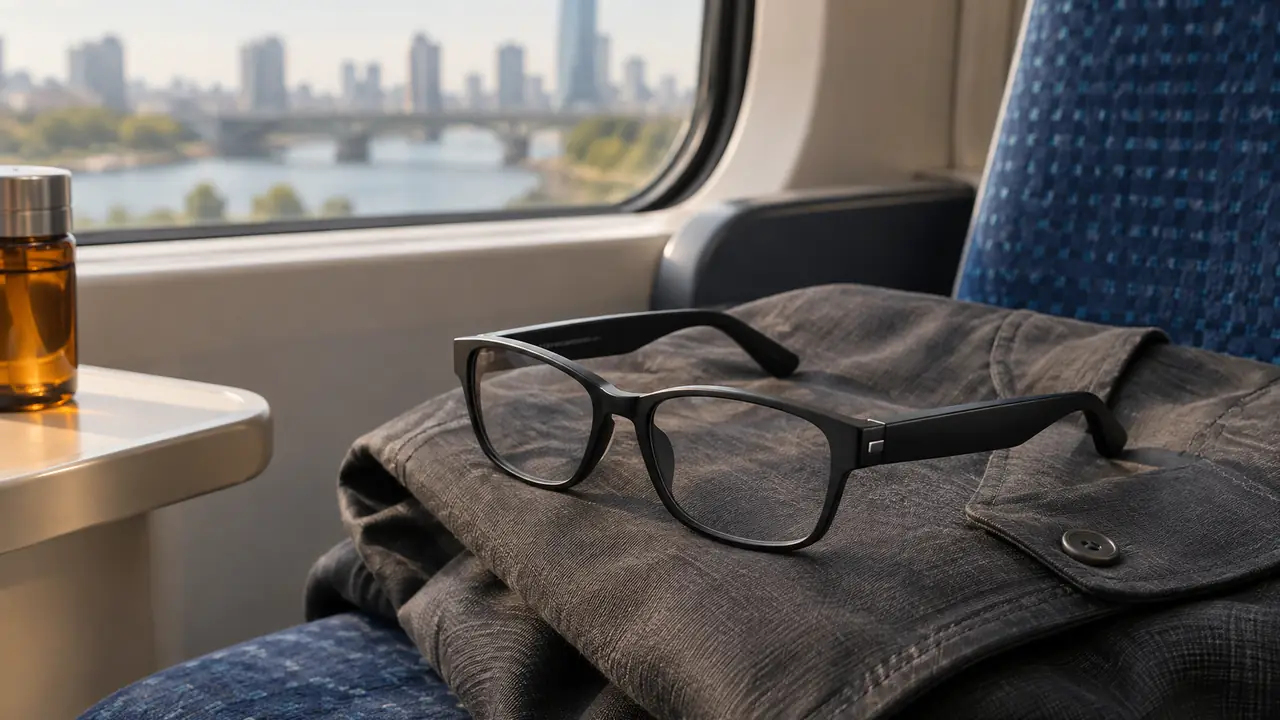
A pair that is worn all day
Commuting and daily wear is the broadest use case and the one where smart glasses compete most directly with ordinary glasses. The wearer puts them on in the morning, listens to music or a podcast on the train, takes a call on the walk to the office and keeps them on at the desk. That pattern rewards a pair that looks like normal eyewear, takes the wearer's prescription, copes with indoor and outdoor light, and lets the wearer hear the street, the station and the people nearby. Novelty features matter less than comfort, a reliable connection and a battery that lasts through the commute and the working day.
Because the frame is worn as everyday eyewear, fit and lens choices drive returns more than electronics. The main specification questions are set out below.
| Daily need | Spec to set | Note |
|---|---|---|
| Wear with a prescription | Rx-ready front, lens fitted by an optician or lab | Prescription range per lab and frame |
| Indoor and outdoor light | Photochromic lens, Cat. 0-3 dynamic per lens spec | Darkening speed and range per lens spec |
| Hear surroundings | Open-ear temple speakers | Ear canal stays open; volume is the wearer's choice |
| Fit for many faces | Two front sizes from one board | Lens 48-56 mm, bridge 16-20 mm, temple 140-150 mm typical |
| Runtime | Cell size and chipset matched to daily use | 4-13 h music, 3-9 h calls across the category |
| Driving | Lens category marked per ISO 12312-1 | Cat. 4 lenses are not for driving |
Rx-ready fronts
People who already wear prescription glasses will not swap them for a pair of plano audio glasses. Rx-ready fronts solve this: the frame is designed so an optician or lens lab can edge and fit prescription lenses, while the temples carry the electronics as usual. Some lines use interchangeable fronts or magnetic lens clips so that one set of temples can carry a prescription front for the office and a sun front for the weekend. Typical frame sizes run 48 to 56 mm lens width, 16 to 20 mm bridge and 140 to 150 mm temples, so a commuter range often offers two front sizes on one board. The prescription range depends on the lab and the frame; the line page is prescription-ready smart glasses, and the workflow is in prescription lenses for smart frames.
Photochromic lenses for changing light
Commuters pass from platforms to streets to offices. Photochromic lenses darken under UV and clear indoors, moving dynamically across transmittance categories 0 to 3 according to the lens specification. The speed and depth of darkening, and how the lens behaves behind a car windscreen that filters UV, should be read from the lens spec rather than assumed. Electrochromic lenses, which switch electrically, are covered in ISO 12312-1:2022 with a note on photosensitive epilepsy, and that note belongs in the user information. Lens sourcing for daily lines usually draws on Danyang, the main lens cluster for prescription, photochromic and polarized lens work. More on lens options and in photochromic lenses explained.
Hearing the street: open-ear audio
Open-ear temple speakers aim sound at the ear without sealing the ear canal, so the wearer keeps hearing traffic, station announcements and colleagues. That is a design property, not a safety feature: how much of the surroundings the wearer notices still depends on the volume they choose and the noise around them. Product copy should describe it in those terms. Sound leak to people nearby is reduced by the acoustic chamber and port design and checked per acoustic test; the comparison with sealed earbuds is in audio glasses vs earbuds.
Durability for daily handling
Everyday pairs are folded, pushed onto the head, dropped into bags and charged every night. The order-level test plan for a commuter line usually includes hinge cycling, temple bending, charging contact insertion life, drop, spray to the stated rating (IPX4 to IP54 per test, tested per IEC 60529, across the audio lines) and pairing stability over repeated connect and disconnect. In the US, lenses also go through the drop-ball impact test under 21 CFR 801.410. The hinge is the critical part because the flex cable to the far temple runs through it.
Program route and timing
A daily range usually starts from a catalog audio board and an Rx-ready catalog front: 50-500 pairs per catalog model, 500-1,000 with a logo, samples in 5-10 or 10-15 working days and batch production in 20-35 days. Adding a photochromic lens option or a second front size is often possible without leaving the catalog route; a new front shape moves to full custom at typically 3,000 pairs per model. Figures are typical reference ranges, confirmed in writing for each program on MOQ and lead time. Start on the quote form.