
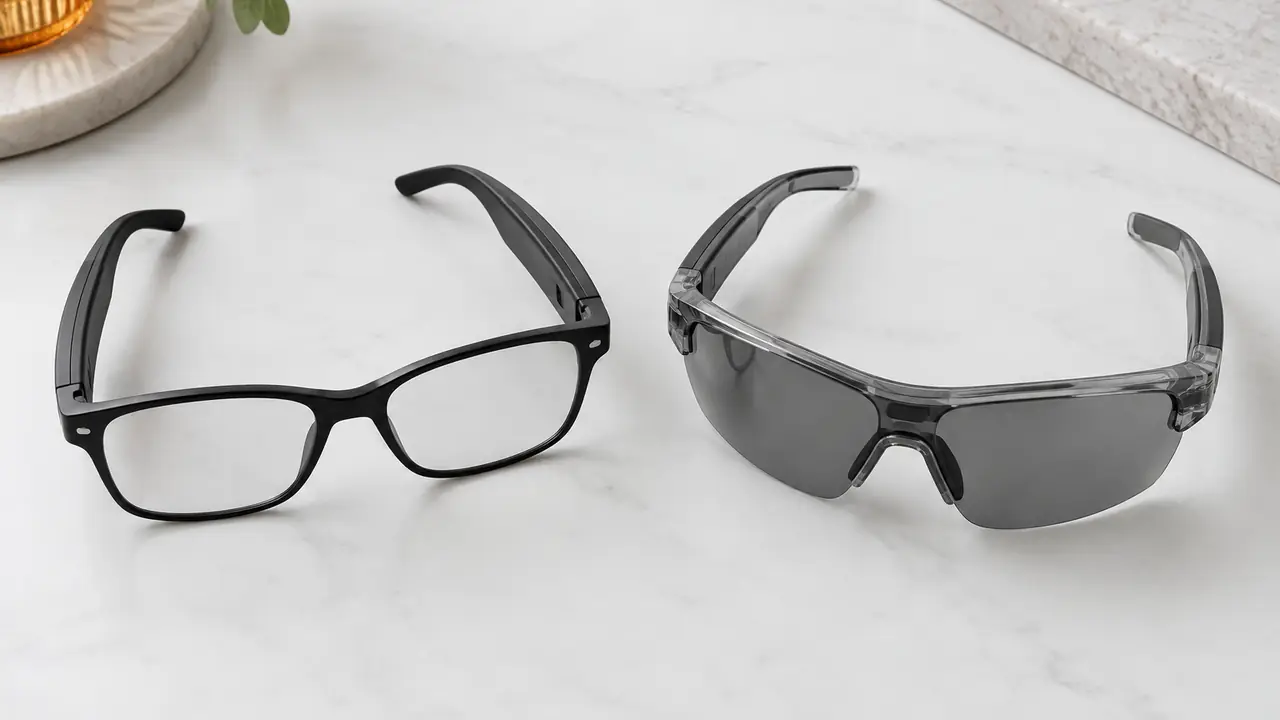
Two ways to put sound near the ear
Earbuds sit in or at the entrance of the ear canal. Most rely on a seal with a silicone or foam tip, which gives them strong bass, high isolation from outside noise and, on many models, active noise cancellation. Audio glasses take the opposite approach. A small directional speaker in each temple sits just in front of the ear and fires sound toward the ear canal without touching or blocking it. Nothing goes in the ear, and the ambient world stays audible.
That one design difference drives almost every other line on the comparison. It decides how the product sounds, how long people are willing to wear it, what kind of calls it handles well, how much sound other people can hear, and why customers send it back. For a buyer it also decides which customers the product is for: earbuds compete on isolation and sound quality, while audio glasses compete on awareness, comfort over a long day and the fact that the user is wearing glasses anyway.
Neither category is a substitute for the other in every case. Many end users own both and pick by situation. The question for a brand or retailer is which job the range is being built to do, and how to describe that job honestly on the listing.
Side-by-side comparison
The table compares the two categories at the level a range plan needs. Figures for audio glasses are typical across the category per spec sheets; earbuds are described qualitatively because their spec ranges vary too widely to summarise in one line.
| Dimension | Audio glasses | Earbuds |
|---|---|---|
| Where sound is produced | Directional speaker in the temple, open-ear | Driver in or at the ear canal, usually sealed |
| Ambient awareness | Ambient sound stays audible by design | Reduced by the seal; transparency modes on some models |
| Isolation and bass | Limited; bass depends on port and cavity tuning | Strong, especially with a good seal |
| Sound leakage | Present at higher volume; controlled by anti-phase and port design per acoustic test | Low |
| Peak level | About 75-90 dB SPL per manufacturer figures | Varies widely by model |
| Music playback | About 4-13 h per charge, typical | Varies; charging case extends total time |
| Call pickup | Two to four mics in the temples with ENC per firmware | Mics in the bud stem or shell, beamforming per model |
| Weight and wear | 27-50 g per pair, spread across nose and ears | Small per bud, concentrated in the ear |
| Extra function | Doubles as sunglasses, clear or Rx-ready frames | Audio only |
| Main return causes | Fit, lens choice, leakage expectations, connection | Fit of tips, ear fatigue, lost buds |
Two rows deserve emphasis. Leakage is the trade-off for open-ear awareness: at moderate volume in a quiet office, people sitting nearby may hear something, and the acoustic design described on acoustic design exists to reduce that, not to remove it. And the extra-function row is often the real reason to buy - a customer who already wears sunglasses on a bike or glasses all day at a desk gets audio without adding a second device to the ear.
Comfort, awareness and calls in practice
Comfort is where audio glasses usually win for long sessions. Nothing presses into the ear canal, and the weight sits on the nose pads and over the ears like any frame. The catch is that comfort becomes an eyewear question: lens width, bridge and temple length must suit the face, and a heavier pair with the battery placed badly will slide down the nose. Common frame sizes in the category run 48-56 mm lens width, 16-20 mm bridge and 140-150 mm temples; the lens and frame fit guide explains how to cover a customer base with two or three sizes.
Awareness is the main functional difference. Cyclists, runners, commuters walking in traffic and staff who need to hear colleagues or customers generally prefer open-ear sound. That is also why many sports retailers stock audio glasses alongside rather than instead of earbuds. Copy should describe this as hearing your surroundings, not as any kind of hearing benefit; the category makes no medical or hearing claims.
Calls depend on microphone placement and processing. Temple microphones sit further from the mouth than an earbud stem, so programs specify two to four mics with environmental noise cancellation per firmware, and test wind noise for outdoor lines. In a quiet room both categories can sound similar to the far end; on a windy street the result depends on tuning, mesh and port design rather than on the category. The note on microphone arrays for call glasses covers what to test.
Battery, charging and what customers expect
Battery design follows form. Earbuds carry very small cells and rely on a charging case to extend use across a day. Audio glasses carry larger cells in the temples, commonly about 85-235 mAh in total across both sides, and charge through magnetic pogo contacts in about one to two hours. Typical playback runs 4-13 hours of music and 3-9 hours of calls, per spec sheet and at the volume stated on it.
Customer expectations differ too. Earbud users are used to dropping buds into a case several times a day. Glasses users expect to wear the pair all day and charge overnight, so a model at the short end of the runtime range needs clear copy about realistic use. Glasses also cannot be charged while worn on most designs, which matters for long shifts. The battery runtime guide shows how to state runtime conditions so the listing matches what the customer will see.
Which customers each category suits
Earbuds remain the better choice for customers who want isolation: commuters on loud trains, people who want deep bass, and anyone who wants to block out an open-plan office. They are also easier to slip into a pocket, and a lost bud is a smaller loss than a lost pair of glasses.
Audio glasses suit customers who wear glasses already or want sunglasses outdoors, who need to stay aware of traffic or colleagues, and who find in-ear products tiring over long sessions. They fit naturally into eyewear and sports channels, optical retail with Rx-ready fronts, and office ranges built around calls. For a marketplace seller, they also carry a distinct listing angle that avoids competing head-on in a crowded earbud category.
Which to stock
If the range is for isolation and pure audio quality, stay with earbuds. If the customer already wears eyewear, needs awareness or wants one device for sun and sound, build an audio glasses line. A practical starting point for most buyers is one Bluetooth audio glasses catalog model in two frame sizes with polarized and clear lens options, then add open-ear or call-focused variants once return reasons are known. Catalog models typically start at 50-500 pairs per model and logo programs at 500-1,000 pairs, as reference ranges confirmed in writing per program on MOQ and lead time. Send the target channel and use case through the quote form and the desk will shortlist suitable models.