
How a photochromic lens darkens
A photochromic lens contains dye molecules that change shape when they absorb ultraviolet light. In their resting form they are nearly colourless; under UV they switch to a form that absorbs visible light, so the lens darkens. When the UV source goes away, the molecules relax back and the lens clears. The process is continuous rather than on or off: the lens settles at a darkness that depends on how much UV reaches it and on temperature.
That simple mechanism explains most of the behaviour customers notice. Outdoors on a bright day the lens darkens noticeably; indoors under electric light it stays close to clear; and on an overcast day it sits somewhere in between, because UV still passes through cloud. For a smart glasses brand the attraction is clear: an audio or AI pair can be worn from the office to the street without swapping to sunglasses, which suits all-day lines and commuters. The commuting scenario is described on commuting and daily use.
Build methods lens plants use
Photochromic dyes can be put into a lens in several ways. The method affects colour, speed, durability and which lens materials can be used, so it belongs on the spec sheet rather than being left to the plant.
| Method | How it works | Typical use | Watch points |
|---|---|---|---|
| In-mass | Dye mixed into the lens monomer before casting | Plano and Rx lenses in suitable materials | Thicker areas can look darker than thin areas on strong prescriptions |
| Surface imbibing | Dye absorbed into the front surface layer of a finished lens | Rx and plano lenses, wide material range | Coating sequence must be controlled to keep the layer intact |
| Coating | A photochromic layer applied to the lens surface | Rx lenses and premium plano lenses | Coating adhesion and scratch resistance; check after sweat soak |
| Laminated film | A photochromic film layer between lens layers | Sunglass-style plano lenses, some polarized combinations | Edge sealing and delamination, as with polarized laminates |
For catalog smart glasses, the lens plant usually offers one or two photochromic options in standard shapes and colours, commonly grey and brown. A custom lens shape or colour moves the program toward full custom sampling. Danyang is the main source of photochromic lenses in China; local reporting describes the city as producing more than 400 million pairs of lenses a year, roughly three quarters of the national total by one count.
Real-world behaviour: temperature, windscreens and time
Three effects cause most photochromic complaints, and all three are normal behaviour that should be explained in the listing.
- Temperature. In cold weather the lens tends to darken more and clear more slowly; in hot weather it darkens less. The same pair can look different in winter and summer.
- Car windscreens. Most windscreens absorb much of the UV that triggers the change, so a photochromic lens may stay light inside a car. For driving use, a fixed tint or a polarized lens can suit better; the trade-offs are in polarized vs photochromic smart glasses.
- Clearing time. Darkening is quicker than clearing. Walking indoors from bright sun, the lens takes some time to return to clear, which customers notice when reading a phone.
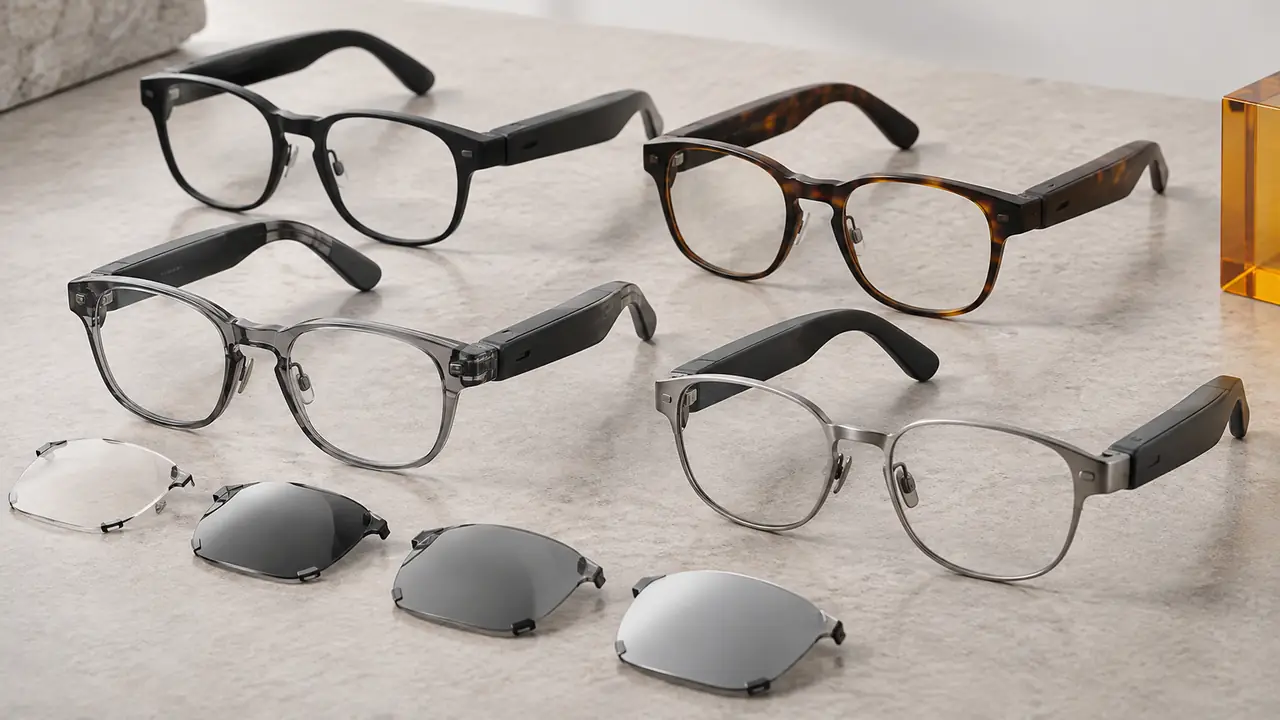
Over a long period, repeated UV exposure gradually reduces how dark a photochromic lens gets. Lens plants describe this in their own data, and it is a reason to offer replacement lenses as an accessory. Interchangeable fronts and lens sets, covered in interchangeable lenses and fronts, make that practical.
Categories in two states
Under ISO 12312-1, a sunglass lens is placed in a luminous transmittance category from 0 to 4. A photochromic lens has two relevant states - faded and darkened - and the test report should give the category for each. Across the category, photochromic lenses typically move dynamically within Categories 0 to 3, per the lens specification. That two-state result is what supports any wording such as clear indoors, darker outdoors; the general category system is explained in lens categories under ISO 12312-1.
For the US market, the reference for non-prescription sunglasses and fashion eyewear is ANSI Z80.3, and the drop ball test under 21 CFR 801.410 applies to the finished lenses. A photochromic coating or film does not change the need for the impact result.
Electrochromic lenses: switching by voltage
Some AR and premium smart glasses use electrochromic lenses instead: a thin cell in the lens darkens when a voltage is applied, controlled by a button, the app or a light sensor per firmware. The change is faster than a photochromic dye and works behind a windscreen, but it adds power draw, a connection through the hinge and another component that can fail.
ISO 12312-1:2022 addresses electrochromic lenses with an information requirement related to photosensitive epilepsy, because a lens that changes darkness rapidly or repeatedly is a flashing light source for the wearer. If a program uses electrochromic lenses, the switching behaviour in the firmware, the user information and the test report must be aligned; confirm the exact wording with your test lab. Display and AR options are covered on photochromic and AR glasses.
Specifying a photochromic smart glasses line
A workable spec sheet for a photochromic line has these lines, each tied to a sample or report:
- Lens material and build method. For example, polycarbonate with a photochromic coating, or a laminated film lens.
- Colour. Grey or brown, with faded and darkened colour approved on the golden sample.
- Categories. Faded and darkened categories as stated in the test report.
- UV result. The UV line from the report that supports any UV400 label.
- Markets. ISO 12312-1, ANSI Z80.3 and 21 CFR 801.410 as relevant, confirmed with your test lab.
- Accessory plan. Whether replacement lenses are offered, and in what quantity.
Replacement lenses as accessories typically start at 500 to 1,000 pieces, and logo programs on existing fronts at 500 to 1,000 pairs per model; these are reference ranges, confirmed in writing on MOQ and lead time. Send the front, lens choice and target markets through the quote form and the desk will align the lens plant with the frame and temple assembly.