
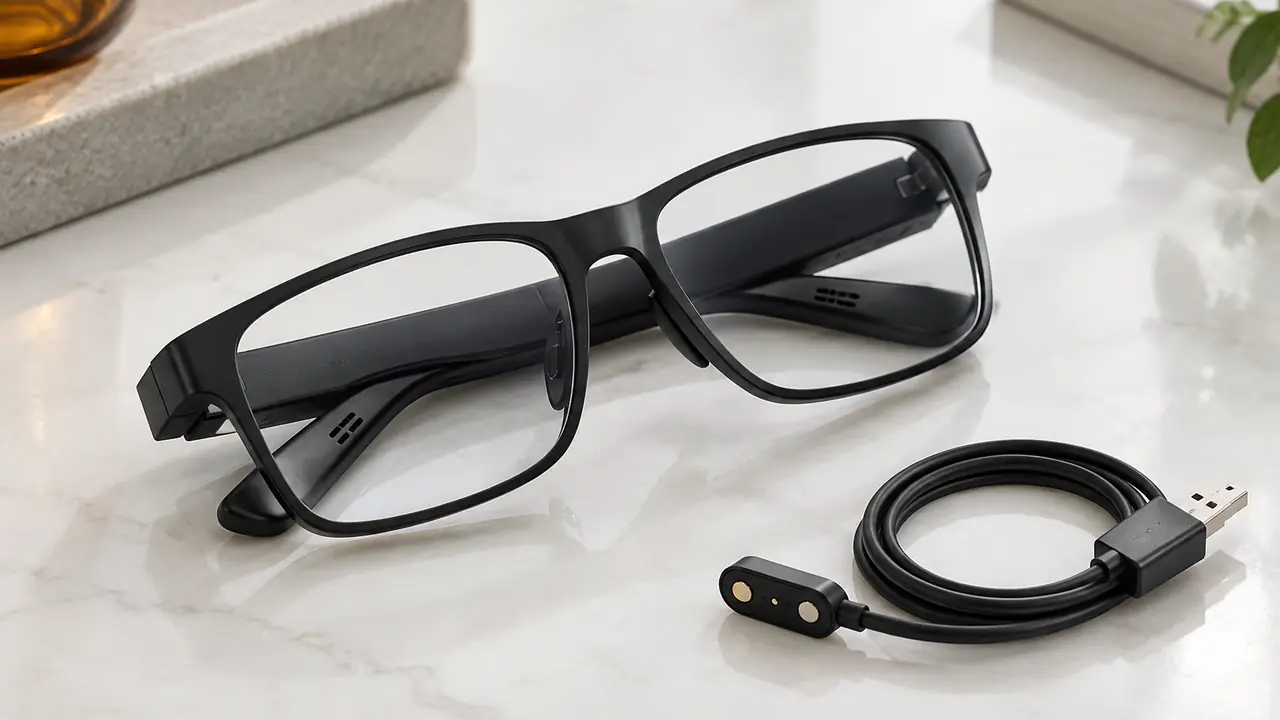
What a Bluetooth audio glasses unit is made of
Bluetooth audio glasses look like ordinary frames until you open a temple. Inside each arm sits a slice of a headset: a small lithium-ion cell, a board with the Bluetooth audio system-on-chip, a directional speaker aimed at the ear canal, one or two microphones and a touch strip on the outside. The two temples talk to each other through a thin flexible circuit that runs through the hinge, which is why the hinge is the most important mechanical part of the whole product. Across the category, finished pairs weigh about 27 to 50 grams, carry roughly 85 to 235 mAh of battery split between the temples and play music for 4 to 13 hours depending on cell size, volume and chipset.
That modular build is useful for a buyer. Each layer can be specified separately: a brand can keep a proven board and change the front shape, or keep the frame and move to a newer chipset. The six rows of the teardown card follow the order a partner plant assembles them, and the same order is used on the spec sheet the desk prepares for every program. For the full anatomy, read inside a smart glasses temple.
Options buyers usually specify
Most programs start from a catalog model and change three or four things. The table shows the usual choices and what each one affects downstream.
| Module | Common options | What it changes |
|---|---|---|
| Front | TR90, acetate, metal; round, square, browline | Weight, fit range, mould cost if the shape is new |
| Lens | Clear, filter, polarized, photochromic, Rx-ready | Market positioning and the optical standard that applies |
| Chipset | BT 5.2, 5.3 or 5.4; multipoint; LC3 support per firmware | Pairing behaviour, latency, power draw |
| Speaker | Single port or ported acoustic chamber | Loudness and how much sound escapes to people nearby |
| Microphones | One or two per temple with noise reduction per firmware | Call quality in wind and traffic |
| Branding | Temple print, laser mark, box, app skin | Lead time and the minimum for custom packaging |
Frame and lens choices are covered in the lens and frame fit guide; the acoustic trade-offs are on acoustic design.
Where the line fits in a range
Audio glasses are the entry and volume tier of most smart eyewear ranges. They need no camera or display, so they avoid the privacy questions camera models raise, and they are the easiest to certify and ship. Industry trackers report strong growth in the wider category: IDC expected China's smart glasses shipments to reach about 2.9 million units in 2025, with audio and audio-camera glasses accounting for most of that volume. For a brand, the audio line is also where returns are decided, because comfort, sound leakage and pairing reliability are judged in the first week of wear.
A typical range pairs one everyday audio model with a sunglass version on the same board, then adds open-ear or business call models as the second tier.
Tests and documents the desk plans for
A Bluetooth glasses program crosses three regulatory areas: radio, battery and optics. In the United States the transmitter is authorised under FCC Part 15.247 and the digital circuitry under Part 15 Subpart B; the label carries the FCC ID. In the European Union, CE marking under the Radio Equipment Directive covers spectrum (EN 300 328), EMC (EN 301 489), safety (EN 62368-1) and, since 1 August 2025, cybersecurity under EN 18031, because glasses are named as wearable radio equipment in Delegated Regulation (EU) 2022/30. Cells need a UN 38.3 test summary and, for most buyers, IEC 62133-2. Lenses follow ISO 12312-1 in Europe and ANSI Z80.3 in North America, with the FDA drop-ball impact test under 21 CFR 801.410 for the US.
On top of compliance, the order-level test plan usually covers hinge cycling, sweat soak on the charging contacts, spray to the stated IP rating, drop, runtime and pairing stability. Details are on testing and inspection.
From brief to container
- Brief: target market, price band, frame style, lens type and certification needs.
- Shortlist: the desk matches two or three partner plants with catalog models close to the brief.
- Samples: catalog samples in 5-10 working days, logo samples in 10-15 working days.
- Golden sample and spec sheet signed, including the six modules on the card and the test plan.
- Batch production in 20-35 days for catalog and logo programs, with pre-shipment inspection.
- Shipping under UN3481 by air or in consolidated sea cartons, with the document set attached.
Quantities and timing are typical reference ranges, confirmed in writing for each program; the current table is on MOQ and lead time. To start, use the quote form.