
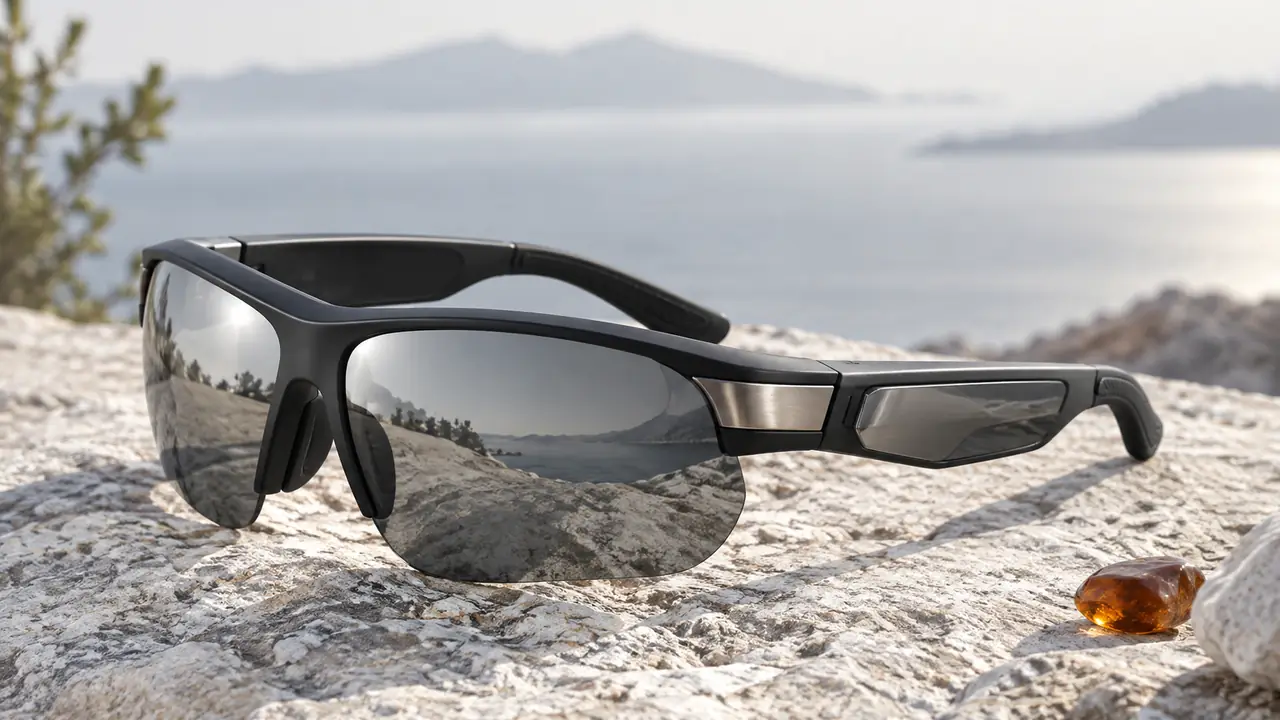
What makes a smart frame a sports frame
Sports smart glasses use the same temple electronics as everyday audio glasses - a Bluetooth audio SoC, two small lithium-ion cells, directional open-ear speakers and microphones - but wrap them in a frame built for movement. The front is curved to follow the face, usually moulded in polycarbonate or TR90 nylon, and the lens covers more of the side field. Nose pads and temple sleeves are made from grippy rubber or silicone so the pair stays put when the wearer sweats, and the temples are shaped to sit under a helmet strap or cap. Across the category, finished pairs weigh about 27 to 50 grams and play music for 4 to 13 hours, depending on cell size, chipset and volume.
The design work is in the trade-offs. A deeper wrap gives more side coverage but needs a lens with the right base curve and can trap heat; a lighter frame is comfortable over long rides but leaves less room for cells. The desk sets those priorities with the buyer at brief stage, then matches partner plants that already make wrap fronts in the Shenzhen Henggang or Xiamen eyewear clusters. Xiamen is known for sunglasses: its trade authorities report more than 300 eyewear companies and over 80 percent of China's mid to high-end sunglass market (Xiamen investment promotion, 2025).
Lens options and what each implies
Lenses decide how a sports model is positioned. The table lists the usual options and the rules that follow.
| Lens | Typical use | What to specify |
|---|---|---|
| Polarized PC or TAC | Road cycling, water, bright open terrain | Lens category under ISO 12312-1; polarizing efficiency per lens spec |
| Photochromic | Changing light, early and late training | Category range, for example Cat. 0-3 per lens spec; activation and fade times per lab |
| Clear or light tint | Night running, indoor training, trail under cover | UV400 marking and impact testing |
| Dark mirror | High-altitude or very bright conditions | Cat. 4 lenses must be labelled as not suitable for driving under ISO 12312-1 |
Most ranges offer one polarized and one photochromic version on the same frame, with a clear spare lens as an accessory. Lens structure and standards are covered under lens options and polarized vs photochromic smart glasses.
Sweat, rain and IP ratings
Sports models carry higher water-resistance ratings than everyday frames, typically IPX4 to IP55 tested per IEC 60529. IPX4 covers splashing water from any direction; IP55 adds a level of dust protection and resistance to water jets. Neither rating covers immersion, so sports glasses are water-resistant rather than sealed for swimming, and a rating applies to the unit as tested, not after months of wear. Sweat is the harder problem: salt and acid attack the charging contacts and button seals over time. The order-level test plan therefore adds an artificial sweat soak on the pogo contacts, salt spray on metal parts and spray to the stated IP rating on samples from the batch. Contact coatings are discussed in sweat corrosion on smart glasses.
Wind noise and open-ear listening
Open-ear speakers leave the ear canal open, so the wearer still hears ambient sound while listening to music or taking a call. That is why the format is popular for cycling and running, although local rules on audio while riding vary and are for the wearer to check. Wind is the main enemy: at riding speed, air flow over the temples masks quiet passages and floods the microphones. Partner plants handle this with mesh or foam over the mic ports, ports angled away from the airflow, and noise reduction tuned per firmware. Speaker loudness is set by the acoustic chamber, with peak sound pressure typically quoted around 75-90 dB SPL by manufacturers; the trade-off is sound leakage at higher volume. The acoustic side is on acoustic design.
Tests, documents and timing
Radio and battery documents follow the standard route: FCC Part 15.247 and Part 15 Subpart B for the US, CE under the Radio Equipment Directive with EN 300 328, EN 301 489, EN 62368-1 and EN 18031 for the EU, Bluetooth SIG qualification and a UN 38.3 summary for the cells. Sun lenses follow ISO 12312-1 in Europe and ANSI Z80.3 in North America, with the drop-ball impact test under 21 CFR 801.410 for the US. Sport-specific checks usually include hinge cycling with the wrap front flexed, drop tests, grip part pull-off and runtime at high volume.
Quantities and timing are typical reference ranges, confirmed in writing for each program on MOQ and lead time. To brief the desk on a sports model, use the quote form.