
How an IP code is built
An IP code, defined in IEC 60529, has two digits after the letters IP. The first digit rates protection against solid particles such as dust; the second rates protection against water. An X in either place means that property was not tested or not declared. So IPX4 says nothing about dust and states that the unit passed the splash water test, while IP54 means the unit passed a dust protection test at level 5 and the same splash water test at level 4. Across the smart glasses category, typical ratings run from IPX4 to IP54, with some sports and bone conduction models rated IP55 per test.
| Code | Solids | Water | What it means in daily use |
|---|---|---|---|
| IPX4 | Not rated | Splashing water from any direction | Light rain and splashes; not for rinsing or immersion |
| IPX5 | Not rated | Low-pressure water jets | Heavier rain; still not for immersion |
| IP54 | Dust protected, limited ingress allowed | Splashing water from any direction | Splashes plus dusty outdoor use |
| IP55 | Dust protected, limited ingress allowed | Low-pressure water jets | Outdoor sports in rain, per test |
Two points are often missed. First, the digits are not a ladder that covers everything below: a jet test and an immersion test are different tests, and a product must pass each one it claims. Second, the rating describes the unit as built and tested, on the day of the test. It is not a statement about the product after a year of charging, sweating and folding.
What the tests actually do
For the water digit 4, the sample is sprayed with water from an oscillating tube or a spray nozzle from all directions for a set time, then inspected for harmful ingress and checked for function. For digit 5, a nozzle directs a low-pressure jet at the enclosure from various directions. The dust digit 5 places the unit in a chamber of circulating fine powder; some dust may enter but not enough to disturb operation. The tests are carried out by a lab on samples of the version you will buy, and the report names the model, the date and the conditions. The report is held by the partner plant or the lab and verified per project.
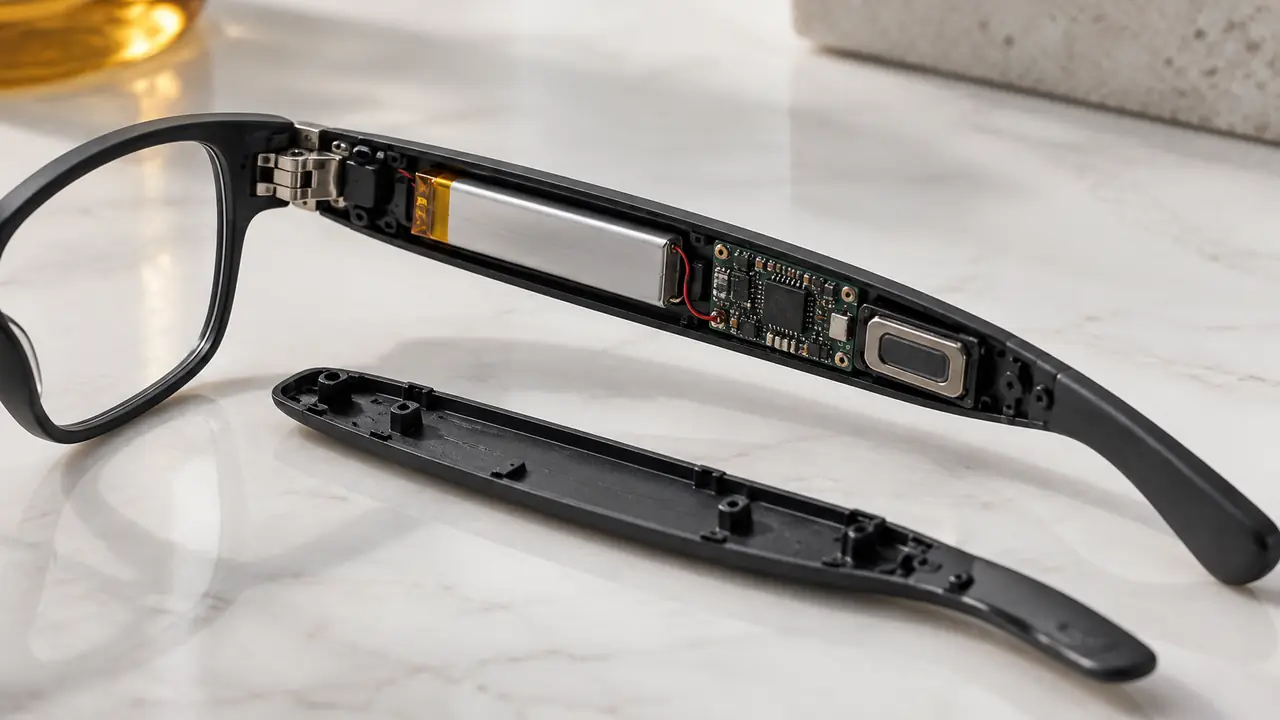
For smart glasses, the weak points are predictable: the charging contacts, the speaker and microphone openings, the touch strip edges, the hinge where the flex enters each temple and the seam between temple halves. Each opening is sealed with membranes, gaskets, glue lines or potting, and each seal has a trade-off with sound, assembly cost or repairability.
When a test report arrives, read it the same way as a spec sheet. Check that the model number and hardware version match the pairs you will buy, that the test date is recent enough to cover the current build, and that the report states which code was tested, not only which code is printed on the box. Check how many samples were tested and whether function was checked after the water test, not only visual ingress. If the frame material, the temple seam or the charging contacts changed after the test - for a new colour process, a metal front or a different connector - ask whether the rating still applies or whether a retest is needed. On a logo program with catalog temples the existing report usually carries over; on a custom temple it normally does not.
Why sweat is a separate problem
IEC 60529 uses clean water. Sweat is salty, slightly acidic and dries into crystals, and it sits on the contacts and temple seams for hours. That is why a pair with a good IP rating can still fail from corrosion on the charging pins or a touch strip that stops responding. A full test plan therefore adds items beyond the IP rating: artificial sweat soaking of the contacts and coatings, salt spray on metal parts and charging connector insertion life. Test counts and pass criteria are a stated working default confirmed per order. The fixes - plated or coated pogo pins, recessed contacts, hydrophobic meshes, sealed seams - are discussed in sweat corrosion on smart glasses.
Choosing a rating by use case
The right rating depends on how the product will be used, and a higher rating is not free: better sealing can affect sound, raise the cost of assembly and make repairs harder.
- Commuting and office use: IPX4 is usually enough for rain on the way to work. See commuting and daily use.
- Running and cycling: IPX4 to IP55 per test, plus sweat soak tests on contacts and grip parts.
- Outdoor work and dusty sites: a rated dust digit, such as IP54 or IP55 per test, matters as much as the water digit.
- Kids models: splash resistance plus attention to contacts and charging, since children are less careful about drying a pair.
How to write water resistance on a listing
Water claims are a frequent source of returns and complaints when the listing promises more than the test showed. Safe wording states the rating and the standard and adds a practical note: for example, water-resistant per IPX4 rating tested per IEC 60529, suitable for splashes and light rain, not for swimming, showering or rinsing under a tap. Avoid absolute words, avoid pictures of the product under water, and keep the rating identical across the box, the manual and the listing. Ask for the test report before printing packaging, and make sure the tested model is the one you ship. Listing content is covered further in smart glasses listing content.
A higher rating on a catalog model is usually not available as an option; raising sealing usually means a custom temple and new tests, which follows the full custom path from 3,000 pairs per model, confirmed in writing per program on MOQ and lead time. To set a water resistance target for a new range, include the use case in the quote form.