
What sport does to a pair of glasses
A run or a ride combines almost every stress an audio glasses temple can face. Sweat runs down the temples and into the charging contacts; wind rushes across the microphone ports; the head moves constantly, so a loose frame slides and the speaker shifts away from the ear; the sun is bright and changing; and the pair is taken off, put on and stuffed into jersey pockets. Products designed for commuting often survive a few gym sessions and then fail in the field, usually at the contacts, the hinge or the microphones. A sports range has to be specified for these conditions from the first brief.
The use case itself is described on sports and outdoor use. One note before the details: rules on using headphones while cycling differ between countries and cities, and some places restrict them on public roads. Listings for cycling ranges should advise customers to follow local rules rather than make any claim about suitability for road use.
Requirements and the spec lines that answer them
| Requirement | Spec sheet line | How it is checked |
|---|---|---|
| Stays put while moving | Wrap frame in PC or TR90, anti-slip nose pads and temple sleeves | Fit check on size fixtures, jog and head-shake test on samples |
| Light enough for long sessions | Target weight within the category range of about 27 to 50 g | Weigh golden sample and batch samples |
| Copes with sweat and rain | Water-resistant per IPX4 to IP55 rating, tested per IEC 60529 | Test report for the unit as built |
| Contacts survive sweat | Contact plating and seal around pogo pins | Artificial sweat immersion and salt spray per test plan |
| Calls usable in wind | Microphone port design and wind handling per firmware | Outdoor call test at speed or with a fan |
| Sound audible outdoors | Open-ear or bone conduction tuning for outdoor levels | Listening test near traffic or wind |
| Lenses suit the light | Polarized or photochromic, lens category per lens spec | Lens report to ISO 12312-1 or ANSI Z80.3 |
| Long enough runtime | Music playback within the typical 4 to 13 h range per spec sheet | Runtime test at a stated volume step |
Fit, frame and lenses
Sports frames are usually wrap shapes in PC or TR90, which flex rather than snap and hold their shape after being sat on. Anti-slip nose pads and silicone temple sleeves keep the pair from sliding when wet. Fit matters doubly here: a frame that moves also moves the speaker port, so the sound changes with every stride. Offering two front sizes, or adjustable nose pads, reduces both fit and sound complaints. Across the category, common frame sizes are 48 to 56 mm lens width, 16 to 20 mm bridge and 140 to 150 mm temple length.
Lens choice follows the light. Polarized lenses cut glare from wet roads and water; photochromic lenses darken and clear with UV exposure, which suits rides that start early or pass through tree cover. Both are specified by structure and standard name only, and the lens category per lens spec. Category 4 lenses carry a not-for-driving marking under ISO 12312-1 and are usually avoided in ranges intended for road use; confirm the category with the lens plant. Lenses typically come from Danyang or Xiamen and are matched to the frame by the desk. The two lens types are compared in polarized vs photochromic smart glasses.
Audio and microphones for movement
Both open-ear and bone conduction formats are used in sport. Open-ear pairs are lighter and look closer to ordinary sports eyewear; bone conduction pairs keep the sound steadier during movement because the transducer stays pressed to the head, at the cost of a firmer clamp and usually more weight. The comparison is in bone conduction vs open-ear glasses. Either way, outdoor tuning needs more headroom than office tuning, and the maximum volume step should be chosen with leak and distortion in mind.
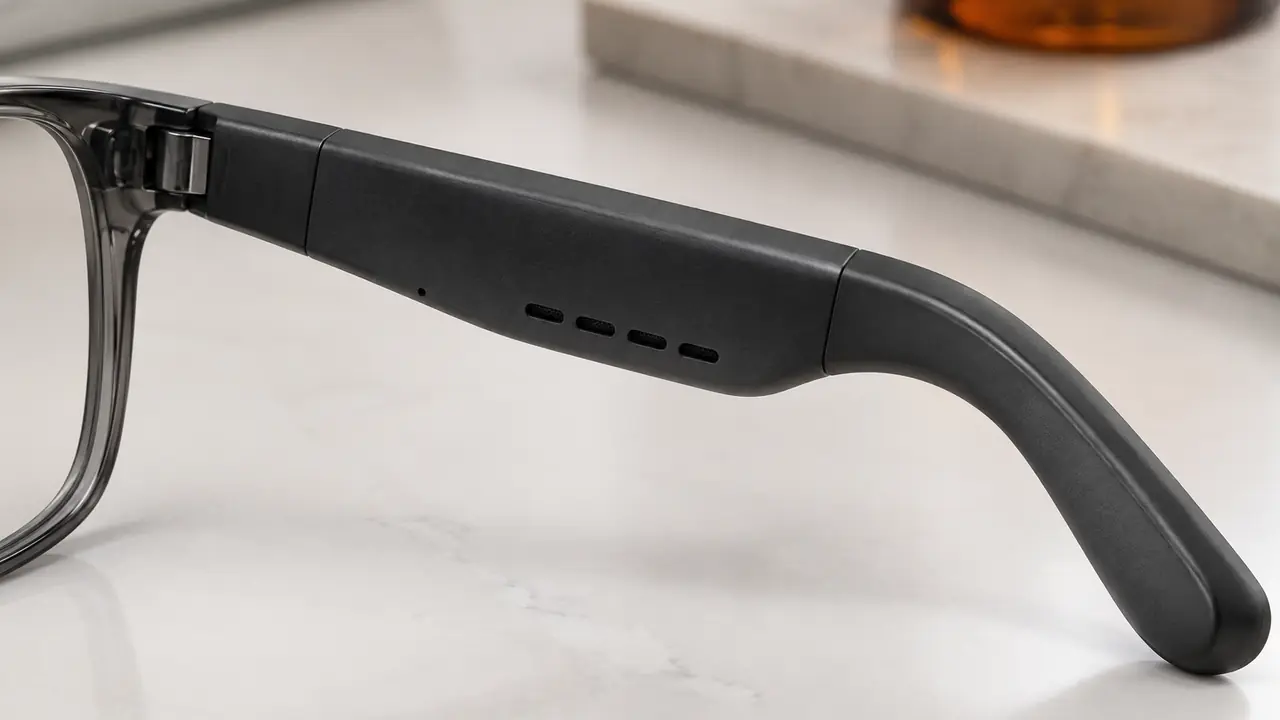
Wind is the main enemy of calls. At cycling speeds, airflow across a microphone port produces low-frequency rumble that can drown the voice. Port position facing away from the airflow, acoustic mesh, and wind handling per firmware all help; the test that matters is a real call at speed. Dual or quad microphone ENC is common across the category, and the design background is in microphone arrays for call glasses.
Controls with gloves and wet fingers
Touch strips can misfire with sweat and fail to respond through gloves. Sports ranges often add a physical button or larger textured touch zones, with a short gesture map: play and pause, answer and end, volume. Prompt tones should be audible over wind. A low-battery prompt a little earlier than on commuter models is worth agreeing too, because a runner far from home has no charger, and runtime falls at the higher volume steps outdoor use needs. Battery planning is set out in the battery runtime guide.
Durability and the test plan
A sports program should add durability checks to the standard plan, with counts and pass rules confirmed per order: artificial sweat immersion, salt spray on contacts and hinges, IPX water spray on the unit as built, drop tests, hinge open-close cycles, temple bending, charging contact insertion cycles and a recheck of acoustic and microphone performance after the durability tests. Water resistance is always described as water-resistant per the tested IPX rating, never as anything stronger. Sweat-related failures are covered in sweat corrosion on smart glasses.
- Brief. Sport, climate, typical session length and whether calls matter.
- Shortlist. Wrap frame toolings with suitable temple electronics from partner plants.
- Sample and ride. Engineering samples tested outdoors as well as on fixtures.
- Durability. Sweat, spray, drop and hinge tests on DVT units.
- Golden sample. Frame, lenses, tuning, firmware and test results frozen.
- Inspect. Batch samples checked for contacts, fit parts, acoustics and firmware version.
Starting a sports range
Most sports ranges start from a catalog wrap model with a logo and a chosen lens option, then move to custom tooling once return data show what to change. Typical starting quantities are 50 to 500 pairs per catalog model, 500 to 1,000 pairs for a logo program and from 3,000 pairs for full custom tooling; batch production typically takes 20 to 35 days for catalog and logo programs. These are reference ranges confirmed in writing per program on MOQ and lead time. Describe your sport, climate and channel on the quote form to start sampling.