
The acoustic problem in a temple
An earbud seals the ear canal and drives a closed volume of air; audio glasses cannot. The speaker sits in the temple, roughly in front of and slightly above the ear, and the sound has to travel through open air to reach the listener. Two things follow. First, bass is hard to produce, because low frequencies need moving air and an open path loses it. Second, whatever the speaker radiates toward the ear it also radiates in other directions, so people nearby can hear it in a quiet room. Every acoustic design choice in this category is a trade between loudness and low-frequency content on one side and leakage and size on the other, inside a temple that also has to hold a cell, a board and microphones.
Across the category, open-ear models state peak levels of about 75 to 90 dB SPL. These are manufacturer figures per spec sheet, measured under the maker's own conditions, and should be read as a design target rather than a comparable value between suppliers.
Open-ear directional speakers and sound chambers
The open-ear module is a small driver mounted in a shaped chamber inside the temple. The main port faces the ear and is placed so that the distance to the ear canal stays short across the frame sizes of the line. The chamber volume, port size and port position set the response: a larger rear volume helps low frequencies, a narrow port can raise a resonance in the mid range, and grille mesh changes the high end and also protects the driver from sweat and dust.
Leakage control usually relies on anti-phase design. The back of the driver produces sound that is opposite in phase to the front. By venting that rear sound through a second port placed so that it meets the front sound away from the ear, the two partly cancel for listeners nearby while the wearer, much closer to the main port, still hears most of the front sound. How well this works depends on port geometry, the frequency range and the room, so leakage is always stated per acoustic test and never as an absolute. Firmware equalisation then shapes the response and sets the volume steps; the volume ceiling is set per firmware and should match the market's expectations. More detail is in open-ear speaker design and sound leakage in audio glasses.
Bone conduction transducers
Bone conduction glasses replace the speaker with a vibrating transducer pressed against the head near the temple or cheekbone. The ear area stays free and leakage is lower in the mid and high range, but the transducer has to touch the skin with consistent pressure. Bass and loudness depend strongly on that contact pressure, so the frame geometry, the temple spring and the fit range of the line matter more than in open-ear models. Bone conduction pairs are usually heavier than open-ear pairs because the transducer and its mounting are larger. They are commonly rated IPX4 to IP55, tested per IEC 60529, for sweat and splashes.
| Design point | Open-ear speaker | Bone conduction transducer |
|---|---|---|
| How sound reaches the listener | Through the air from a port near the ear | Vibration through contact with the head |
| Low-frequency content | Limited by open path; helped by rear volume and EQ | Depends on contact pressure and fit |
| Leakage to nearby people | Controlled by anti-phase ports, per acoustic test | Lower in mid and high range, some vibration noise |
| Weight and size | Lighter, smaller module | Usually heavier pair |
| What fit changes | Distance from port to ear | Contact pressure and transducer position |
The comparison from a buyer's point of view is in bone conduction vs open-ear glasses.
Microphones and call pickup
Calls are often judged more harshly than music. Typical layouts use two microphones per pair, or two per temple, combined with environmental noise cancellation (ENC) or AI noise reduction per firmware. Mic placement decides the result: ports that point toward the mouth and are spaced far enough apart allow beamforming, while ports too close to the speaker pick up echo. Wind is the most common complaint, handled with mesh, small acoustic chambers in front of the mic and firmware wind detection.
How response and leakage are tested
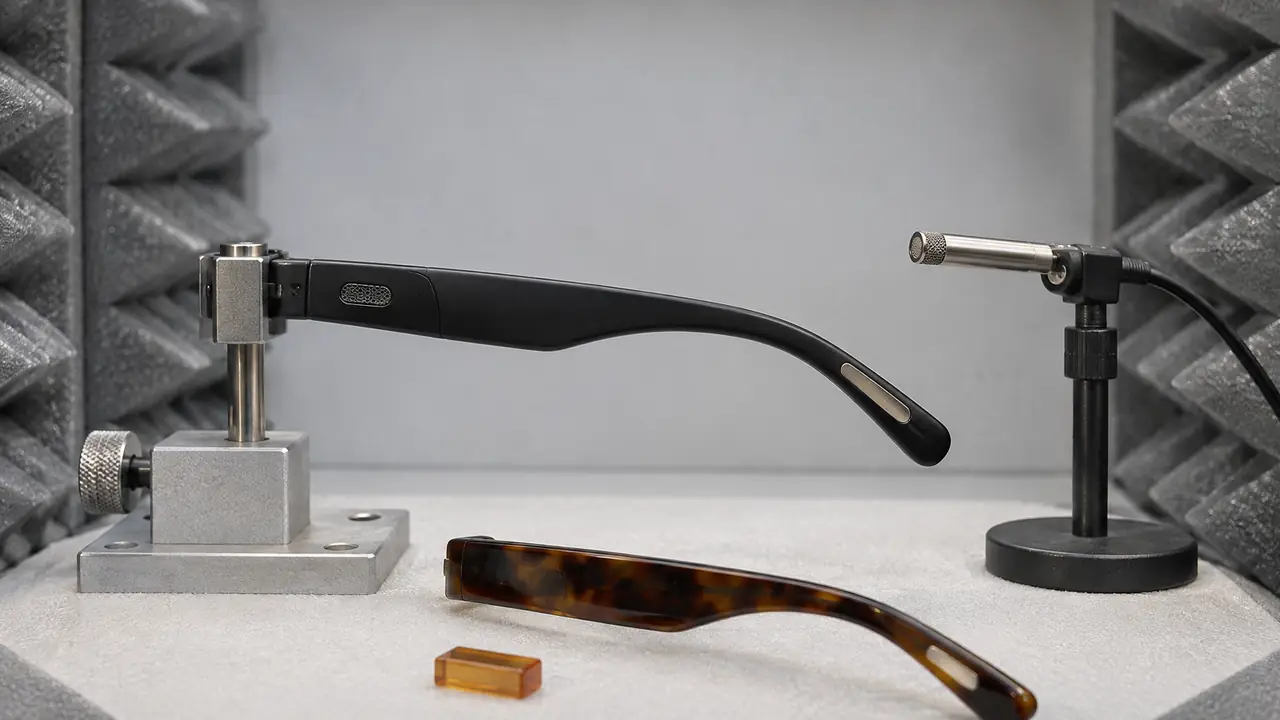
Acoustic tests are run on the engineering sample and again at DVT, with a reduced set at batch inspection. The usual items are frequency response at the listening position measured with a head and torso simulator or an ear simulator fixture, maximum output level at the volume ceiling, distortion at stated levels, leakage measured with a microphone at a set distance from the temple, microphone sensitivity and noise reduction performance in recorded noise, and left-right balance. Test distances, fixtures and limits are a stated working default and are confirmed per order, written into the test plan before tuning starts so the golden sample has a reference curve. The method is described in acoustic testing for smart glasses.
What acoustic tuning costs in time
A catalog model keeps its existing acoustic design; only the EQ and volume steps can change per firmware. A new speaker chamber or transducer position is part of full OEM or ODM work, typically from 3,000 pairs per model, with engineering samples in 30-60 days including tooling. These are reference ranges, confirmed in writing for each program on MOQ and lead time. Send your acoustic target and the reference product you are comparing against through the quote form.