
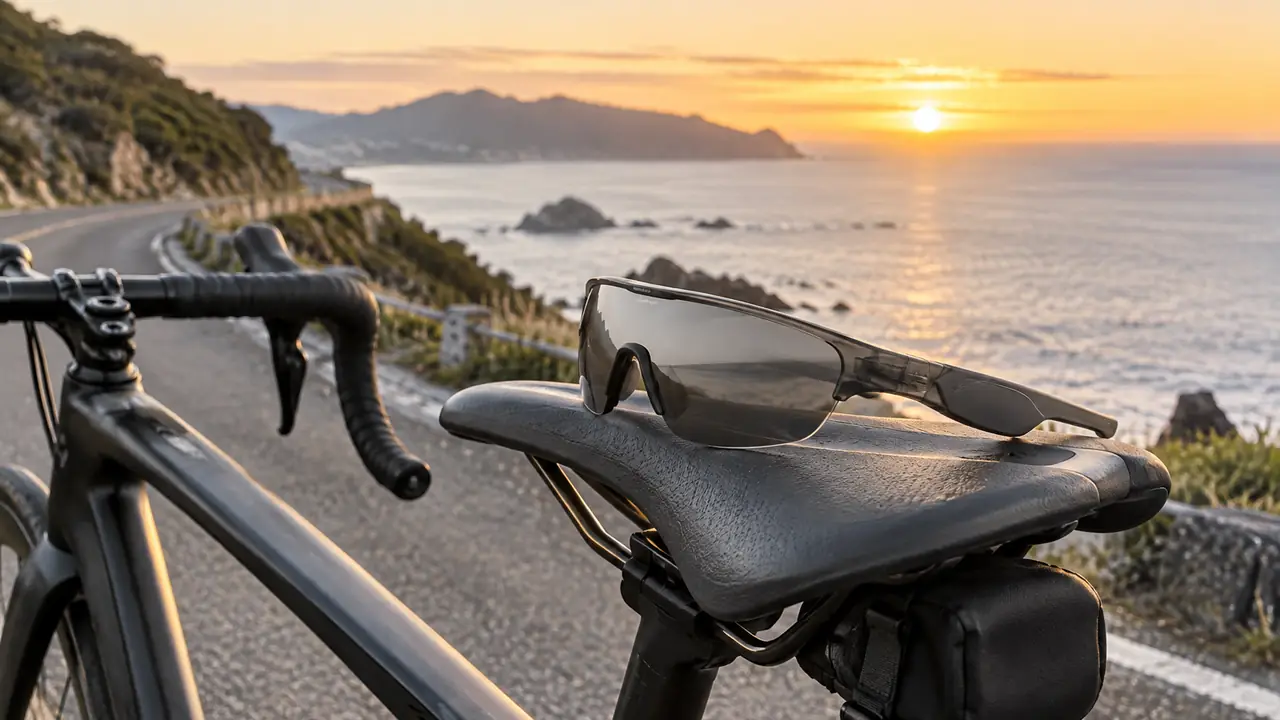
What outdoor sport does to a pair of smart glasses
A sport program asks more of the same temple electronics than any office or commuting model. At road speed on a bike, wind across the microphone ports can mask a voice completely. On a long run, sweat runs down the temples and pools around the magnetic charging contacts, where salt and moisture slowly corrode the pogo pins. On a golf course or a riverbank the problem is glare and hours of sun. And in all four sports the frame has to stay put through movement without pressing hard behind the ears. None of this needs exotic parts; it needs the right choices on the front, lens, microphones and contacts, and a test plan that checks them before the batch ships.
The four sports weight those factors differently, which is why the desk asks for the main activity in the brief rather than a generic outdoor label.
| Activity | Main stress | What to specify | Test focus |
|---|---|---|---|
| Cycling | Wind noise, high speed glare, helmet straps | Mesh-covered mic ports, ENC per firmware, wrap front, slim temples | Call quality in recorded wind, fit under a helmet |
| Running | Sweat, bounce, heat | Sealed contacts, light TR90 front, grippy sleeves, low weight | Artificial sweat soak, IPX spray, retention while moving |
| Golf | Hours of sun, reading the green | Polarized or photochromic lens, comfortable all-day fit | Lens category and UV marking, runtime over a round |
| Fishing | Water glare, spray, long sessions | Polarized lens, IP54-IP55 rated build per test | Spray to rating, salt mist on hinges, contact corrosion |
Microphones and wind
Most sport glasses use one or two microphones per temple with environmental noise cancellation tuned in firmware. Wind is not the same as background noise: it creates turbulence directly at the port. The usual remedies are physical - a fine mesh or foam behind the port, ports placed on the inner face of the temple away from the airflow, and a dual-mic layout that lets the firmware compare signals. The firmware side is then tuned per program. The desk asks partner plants for call recordings in a defined wind and traffic noise condition rather than a single quiet-room sample, because quiet-room recordings tell you little about a ride. Background on array design is in microphone arrays for call glasses.
Sweat, contacts and water resistance
Sweat is the most common source of sport returns that are not about fit. Salt residue on the charging contacts leads to intermittent charging, and moisture at the hinge flex can cause one temple to drop out. Partner plants address this with plated pogo contacts, a seal around the contact block, coated flex and a gasket at the temple seam. The order-level test plan then includes an artificial sweat soak on the contacts and spray to the stated rating. Across the category, sport audio glasses carry an IPX4 to IP55 rating, tested per IEC 60529. That covers splashes, rain and sweat; it is not a rating for immersion, and it describes the unit as tested rather than a pair after a season of use. The failure modes are covered in sweat corrosion on smart glasses.
Wrap frames, fit and lenses
Sport fronts are usually a wrap shape in PC or TR90, which curves around the face for wider coverage and lower wind under the lens. Anti-slip nose pads and rubberised temple sleeves keep the pair in place without extra pressure. Because the temples carry cells and a board, balance matters as much as total weight: a front-heavy pair slides down the nose on every stride. For lenses, polarized options suit water and road glare, and photochromic lenses suit riders who start at dawn and finish in full sun. Lenses are specified with their transmittance category under ISO 12312-1 in Europe and ANSI Z80.3 in North America, plus the drop-ball impact test under 21 CFR 801.410 for the US. Category 4 lenses are not suitable for driving and must be marked accordingly, so the category is set per lens spec with the riding and driving use in mind. Lens choices are compared on lens options.
Audio: open-ear or bone conduction
Open-ear temple speakers leave the ear canal free, so a runner or rider still hears traffic and other people. Bone conduction moves the transducer onto the side of the head; it can feel more stable during movement, but low frequencies and loudness depend on contact pressure, and the pair is usually heavier. Neither format is presented as a safety device; both simply avoid blocking the ear. The comparison is in audio glasses for cycling and running and on the bone conduction line page.
Program route and timing
A sport range usually starts from a catalog board and a catalog wrap front, then changes the lens, colourways, sleeves and logo. Catalog samples take 5-10 working days and logo samples 10-15 working days; batch production runs 20-35 days. A new wrap front with its own tooling moves the program onto the full custom route, typically 3,000 pairs per model and 45-75 days of batch production after engineering samples. These are typical reference ranges, confirmed in writing for each program on MOQ and lead time. Brief a sport program on the quote form.