
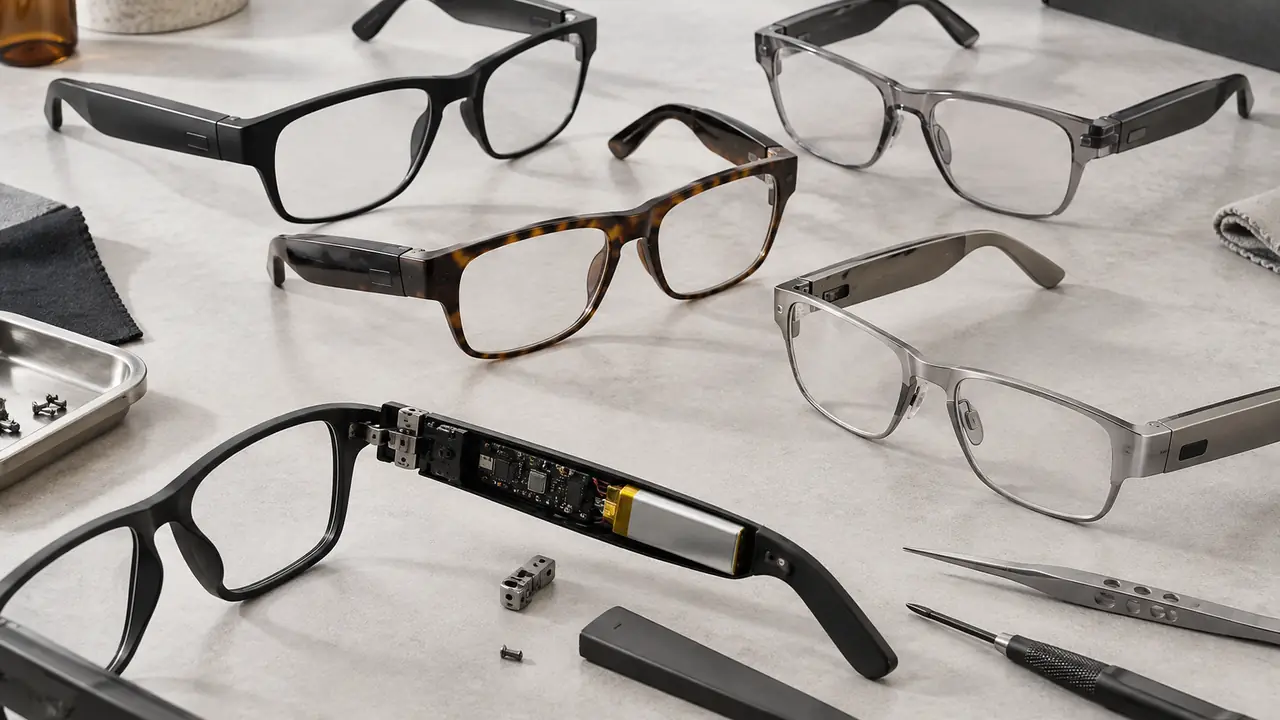
What sweat damage looks like
Sweat damage develops slowly, which is why it surfaces as complaints weeks or months after launch rather than at inspection. The typical signs are a green, white or dark crust on the magnetic charging contacts; charging that becomes intermittent and then stops; a speaker that becomes muffled because the mesh is clogged with dried salt; a touch strip that responds erratically; a metal hinge or screw that rusts or seizes; and a frame coating that turns sticky, peels or loses colour where the temple meets the skin behind the ear.
All of these come from the same chemistry. Sweat is mostly water with dissolved salts, acids and skin oils. When it dries, the salts stay behind; when the next sweat session arrives they dissolve again, forming a conductive, corrosive film. Where two different metals touch - a plated contact over a base metal, a steel screw in a brass insert - that film speeds up galvanic corrosion. Charging current through a wet contact makes it worse.
Why an IP rating does not settle it
Across the category, smart glasses are typically rated IPX4 to IP54, and sports models IPX4 to IP55, per test report. These ratings, tested per IEC 60529, describe resistance to splashing water and, for IP5x, to dust, on new units under laboratory conditions. They do not describe resistance to salt residue drying on exposed contacts day after day, to skin oils softening a coating, or to the slow ingress that happens when a seal ages. A product can pass its water rating and still fail from sweat in a season of daily runs. For listings, the correct wording is water-resistant per the stated rating and test report; the background is in IP ratings for smart glasses.
Where corrosion starts
| Location | Root cause | Typical symptom |
|---|---|---|
| Pogo charging contacts | Thin or porous plating, base metal exposed at edges, charging while wet | Crust on pads, intermittent charging |
| Speaker and mic ports | Open mesh that traps sweat; no hydrophobic membrane | Muffled sound, weaker calls |
| Hinge and screws | Unplated steel, mixed metals, no sealing at the barrel | Rust, stiff or loose hinge |
| Temple tips and shell | Coating not resistant to sweat and skin oil; soft-touch layers too thin | Sticky, peeling or discoloured finish |
| Seams and buttons | Gasket compression set; adhesive gaps at the shell joint | Internal corrosion, failures on one side |
Each row is a design or material decision, plus a use factor. Charging immediately after a workout, storing the glasses damp in a closed case and never wiping the contacts all accelerate damage. That is why good programs address both the product and the user guidance.
Field triage routine
- Photograph the contacts and ports. Close-up photos usually show whether the problem is surface residue, corrosion of the plating or something else.
- Ask about use. Running, cycling, gym use, hot climates and charging straight after exercise are the common patterns.
- Clean per the manual. Wipe contacts and ports with a dry cloth or as the manual directs, let them dry fully, then retry charging and audio.
- Check the finish. Note where the coating is damaged: at the temple tip, along the inside of the temple, at the bridge.
- Separate residue from corrosion. A unit that works after cleaning had residue. A unit with pitted or discoloured pads that still fails has corrosion and goes back with photos and lot number.
A pattern of corroded contacts within the first months, concentrated in one lot, points to plating quality. A pattern spread across lots in sports use points to the design and the user guidance.
Spec lines that prevent it
- Contact metals and plating. State the base metal, the plating system and thickness agreed with the plant, and require plating to cover the contact edges.
- Charge-while-wet behaviour. Ask whether the charge circuit detects moisture or abnormal current, per firmware, and what the manual tells the user.
- Port protection. Specify mesh type and, where acoustics allow, a hydrophobic membrane on speaker and microphone ports, checked against the acoustic target.
- Hinge and screw materials. Avoid unplated steel; agree plating or stainless grades and thread lock.
- Coatings. Specify the frame coating and its sweat and skin-oil resistance; finishes are compared in frame coatings and finishes.
- Endurance tests. Require an artificial sweat soak and a salt spray test on the golden sample, with duration and pass criteria as a stated working default confirmed per order, and a functional check after each.
- Care instructions. Wipe after exercise, dry before charging, store open to air - printed in the manual and on the insert.
Inspection and test items
Typical items, confirmed per order; the full routine is on testing and inspection.
- Visual check of contact plating colour and edge coverage on sampled units, under magnification where agreed.
- Artificial sweat soak on samples from the first lot and after any material change, followed by charging and audio checks.
- Salt spray on metal hinges, screws and contacts at the golden sample stage.
- Coating adhesion and rub tests on the temple tips.
- IPX splash test on samples per the stated rating, per IEC 60529, where the program includes it.
Sweat and salt tests are accelerated approximations. They show whether one material choice is better than another and whether a lot matches the golden sample; they do not predict exact service life. Results are reported as pass or fail against criteria agreed in writing.
A useful habit is to run the same soak on two or three competing material options at the engineering sample stage - two plating systems on the contacts, say, or two coatings on the temple tips - and pick the better one on evidence. The extra samples cost little compared with a season of returns, and the comparison photos are a clear record for the program file if a later supplier change is proposed.
Bringing it into the program
For sports, outdoor and hot-climate ranges, sweat resistance should be on the brief from the first call, because it decides contact plating, port design and coating - all of which are cheaper to set before tooling than to change after. The sports and outdoor page lists the modules that matter. For catalog models, the desk asks for the plant's sweat and salt spray records before samples ship; changes to plating or coating are usually a logo or custom program, with typical ranges on MOQ and lead time. Use the quote form to describe the climate and activity your customers will use the glasses in.