
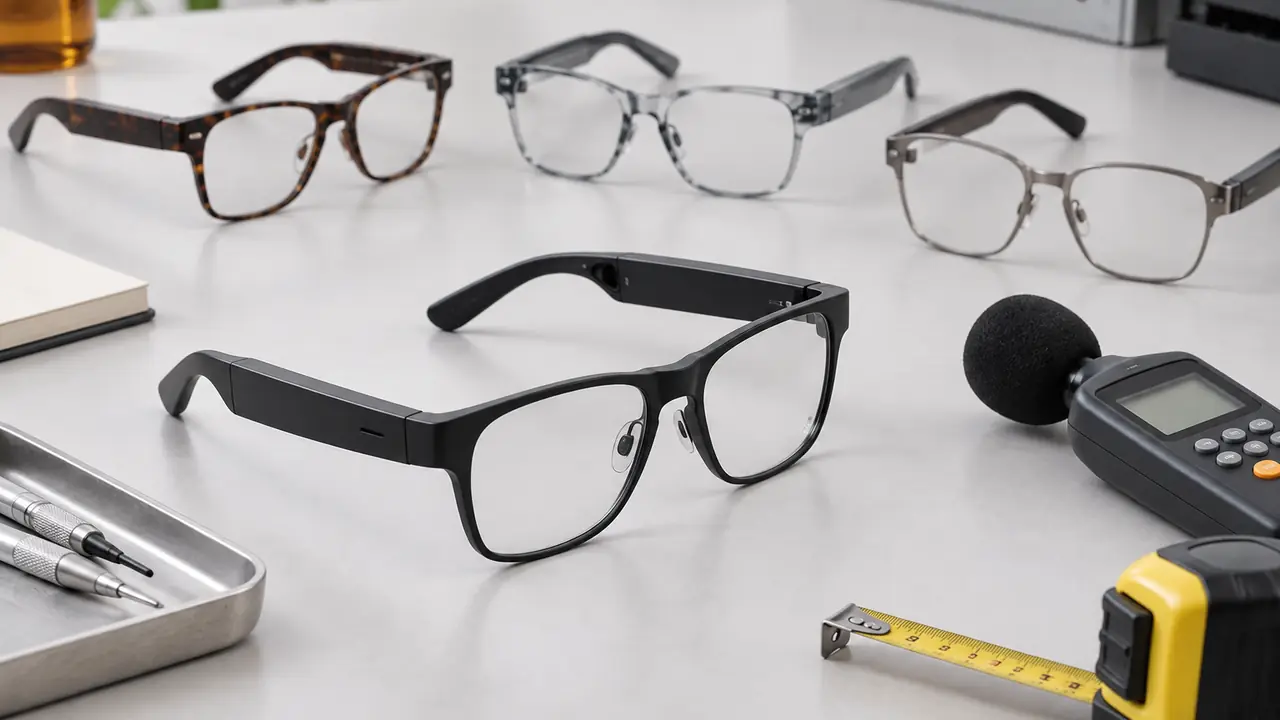
Acoustic method: open-ear or bone conduction
Audio glasses deliver sound in one of two ways. Open-ear models place a small directional speaker in each temple, aimed at the ear canal; manufacturers typically quote peak sound pressure of about 75 to 90 dB SPL, and leakage to people nearby is controlled with anti-phase ports and guided acoustic chambers, verified per acoustic test. Bone conduction models press a vibrating transducer against the temple or cheekbone area, so loudness and low-frequency feel depend on contact pressure, and the pair is usually heavier than an open-ear equivalent.
For most everyday and office ranges, open-ear is the default: lighter, more like normal eyewear and easier to fit across face sizes. Bone conduction suits buyers whose customers value hearing their surroundings in noisy outdoor settings and who accept a firmer fit. Neither method seals the ear, which is the main difference from earbuds; the trade-off is covered in audio glasses vs earbuds, and the tuning side on acoustic design.
Runtime and charging
Battery capacity across the category runs from about 85 to 235 mAh in total, split between the two temples. That translates into roughly 4 to 13 hours of music and 3 to 9 hours of calls, depending on cell size, chipset, codec and volume, with magnetic charging in about 1 to 2 hours. Claims should always be read per spec sheet and checked in the runtime test of the golden sample, because test conditions vary widely between suppliers. A buyer selling to commuters can work with the lower end; a buyer selling to call-heavy professionals should look for the larger cells and accept a few grams more. The battery and runtime guide explains how mAh becomes hours.
Microphones and call quality
Call quality is the most common reason audio glasses are praised or returned. Entry models use one microphone per temple; business and call-focused models use dual or quad microphone arrays with environmental noise cancellation (ENC) or AI noise reduction per firmware. Wind is the hardest condition, because the microphones sit on the outside of the temple. Ask for call recordings in wind and traffic during sampling, and specify multipoint pairing if users switch between a phone and a laptop. Compatibility with conferencing software is verified per project rather than assumed.
Water resistance, weight and lenses
Most audio models carry an IPX4 to IP54 rating, meaning they are water-resistant to splashes and sweat as tested per IEC 60529; some bone conduction and sports models reach IP55 per test. None of these ratings covers immersion. Sweat matters as much as rain: the charging contacts are the weak point, so the test plan should include an artificial sweat soak on the pogo contacts.
Weight runs from about 27 to 50 grams per pair. Lighter pairs are easier to wear all day; at the heavier end, the balance between the front and the temple tips matters more than the total, so ask the partner plant where the cells and boards sit along the temple and try the sample for a full working day before signing the golden sample. Lenses decide the market position: clear or filter lenses for office use, polarized for driving and outdoors (ISO 12312-1 Cat. 4 lenses are not suitable for driving), photochromic for all-day wear and Rx-ready fronts for glasses wearers. See the lens and frame fit guide.
How to choose: spec, use case and line
| Priority spec | Typical use case | Line to start from |
|---|---|---|
| Low weight, normal look, moderate runtime | Commuting and daily wear | Bluetooth audio glasses |
| Loudness with controlled leakage | Office, home, public transport | Open-ear audio glasses |
| Ear canals open, firm fit, IP55 per test | Running, cycling, outdoor work | Bone conduction or sports smart glasses |
| Dual or quad mics, ENC, multipoint | Calls all day, field teams | Business call glasses |
| Rx-ready front, light frame | Glasses wearers, optical retail | Prescription-ready smart glasses |
| Photochromic or polarized lens | Indoor-outdoor wear, driving with Cat. 0-3 lenses | Photochromic glasses or a sunglass version of the audio line |
What to put in the brief
- Target market and channel, which fix the certification scope: FCC Part 15, CE RED with EN 18031, Bluetooth SIG, lens standard.
- Acoustic method, runtime target and microphone count.
- Frame size, material, lens type and colours.
- Branding scope: temple print, box, app skin.
- Quantity per model and launch date.
Catalog models typically start at 50-500 pairs per model and logo programs at 500-1,000 pairs, with samples in 5-15 working days and batches in 20-35 days, all typical reference ranges confirmed in writing for each program on MOQ and lead time. Send the brief through the quote form.