
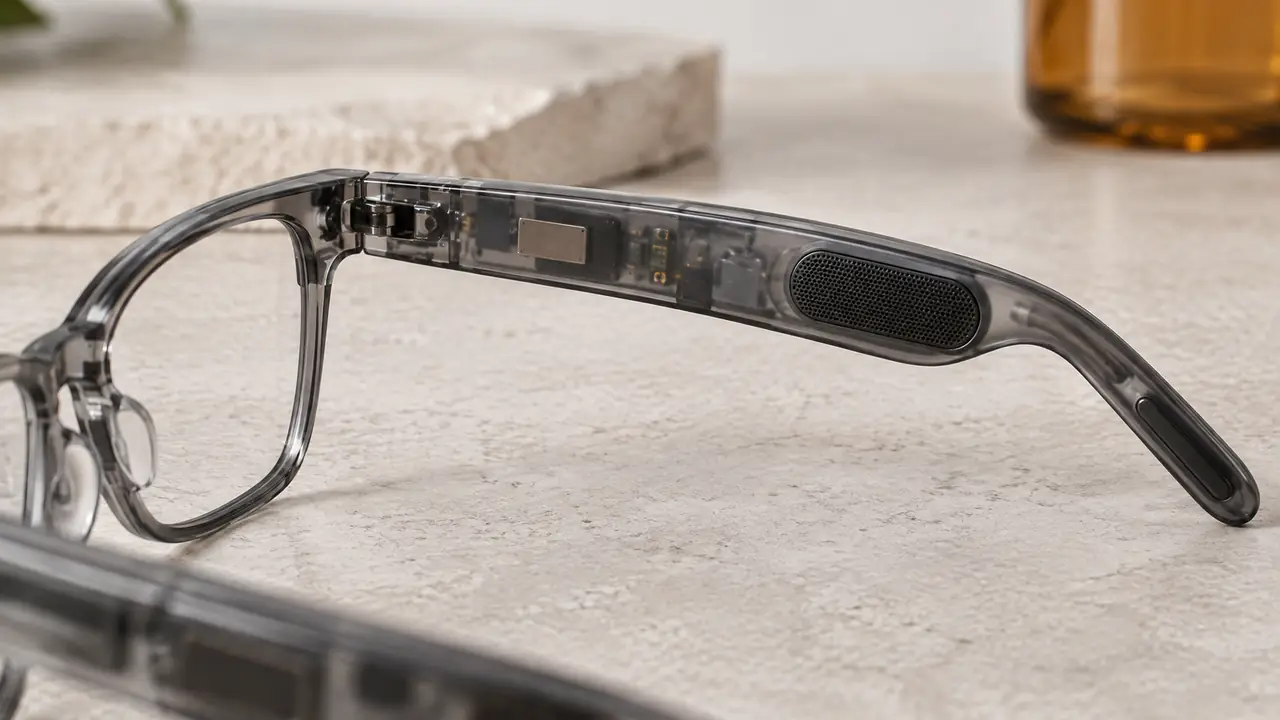
How open-ear audio glasses deliver sound
An open-ear audio glasses unit places a small directional speaker in each temple, just in front of the ear, and aims it at the ear canal without touching or covering it. The ear stays open to traffic, colleagues and announcements, which is the main reason buyers choose the format over earbuds. The difference between an ordinary Bluetooth audio frame and a true open-ear model is what sits around the speaker: a moulded acoustic chamber, one or more output ports shaped to direct sound forward, and often a second vent that releases sound in reverse phase to cancel some of the energy that would otherwise spread outward.
Across the category, manufacturers state peak sound pressure of about 75 to 90 dB SPL at the ear for this line. Treat that as the manufacturer's figure, measured under its own conditions, not as a value you can compare directly between suppliers. The desk asks partner plants for the test conditions behind the number and repeats a frequency response and leakage check on the golden sample. For the design background, see open-ear speaker design in glasses.
Sound leakage: the variable buyers judge first
An open speaker always leaks some sound. How much depends on chamber volume, port position, the reverse-phase vent and the tuning applied in firmware. Leakage is the complaint that shows up first in reviews, because people notice when a neighbour on a train or in an office can hear the wearer's audio. It is controlled by design and verified by acoustic test, not by a single number on a spec sheet.
| Design lever | What it does | Trade-off |
|---|---|---|
| Port position and shape | Points the sound at the ear canal | Fit window narrows if the head shape differs from the target |
| Larger acoustic chamber | Fuller low end and more loudness | Thicker temple and slightly more weight |
| Reverse-phase vent | Cancels part of the outward sound | Some loss of low end; needs careful tuning |
| Firmware EQ and volume curve | Limits leakage at high volume | Lower maximum loudness in quiet mode |
| Temple fit and angle | Keeps the port aligned with the ear | Depends on frame size and hinge spring |
The causes and the tuning fixes are covered in sound leakage in audio glasses; the engineering view is on acoustic design.
Microphones and calls
Open-ear models usually carry two or four microphones with environmental noise cancellation (ENC) on the call uplink. Two mics give basic voice pickup; four mics, two per temple, allow beamforming towards the mouth and better rejection of wind and traffic. The real performance depends on the firmware and on mic placement relative to the speaker, because a speaker that sits too close to a microphone creates echo on the far end. The desk includes a call test in noise and wind in the sample review. If calls are the main use case rather than a secondary feature, the business call glasses line is the better starting point.
Options brand owners usually specify
Open-ear is the line most brand owners use as the anchor of a range, because sound quality is where the product is compared on the shelf. The common customisation points are the front shape and lens, the acoustic tuning target, the app EQ presets and branding. A catalog model with a logo stays within 500-1,000 pairs per model; changing the chamber, the port or the tuning target moves the program into full OEM territory, typically from 3,000 pairs per model with an ODM engineering sample of 30-60 days.
- Lens: clear, filter, polarized or photochromic, with ISO 12312-1 or ANSI Z80.3 as the optical reference.
- Tuning target: loudness-first, leakage-first or balanced, signed off on the golden sample.
- App: EQ presets, a quiet mode and firmware OTA, with an app skin in your brand.
- Packaging: retail box, charging cable and a care card that states the IP rating correctly.
Tests, documents and lead time
Radio and safety follow the same route as the rest of the family: FCC Part 15.247 and Part 15 Subpart B for the US, CE RED 2014/53/EU with EN 300 328, EN 301 489, EN 62368-1 and EN 18031 for the EU, Bluetooth SIG listing, a UN 38.3 summary and IEC 62133-2 for the cells. Water resistance is stated as an IPX4 to IP54 rating tested per IEC 60529. On top of compliance, the order test plan for this line adds speaker frequency response, a leakage check at set volume steps, a call test in noise, hinge cycling and sweat soak on the charging contacts. Details are on testing and inspection.
Catalog and logo programs run 20-35 days in batch production; full OEM runs 45-75 days, excluding certification queues. These are typical reference ranges, confirmed in writing for each program on MOQ and lead time. Send your target market and tuning preference through the quote form.